
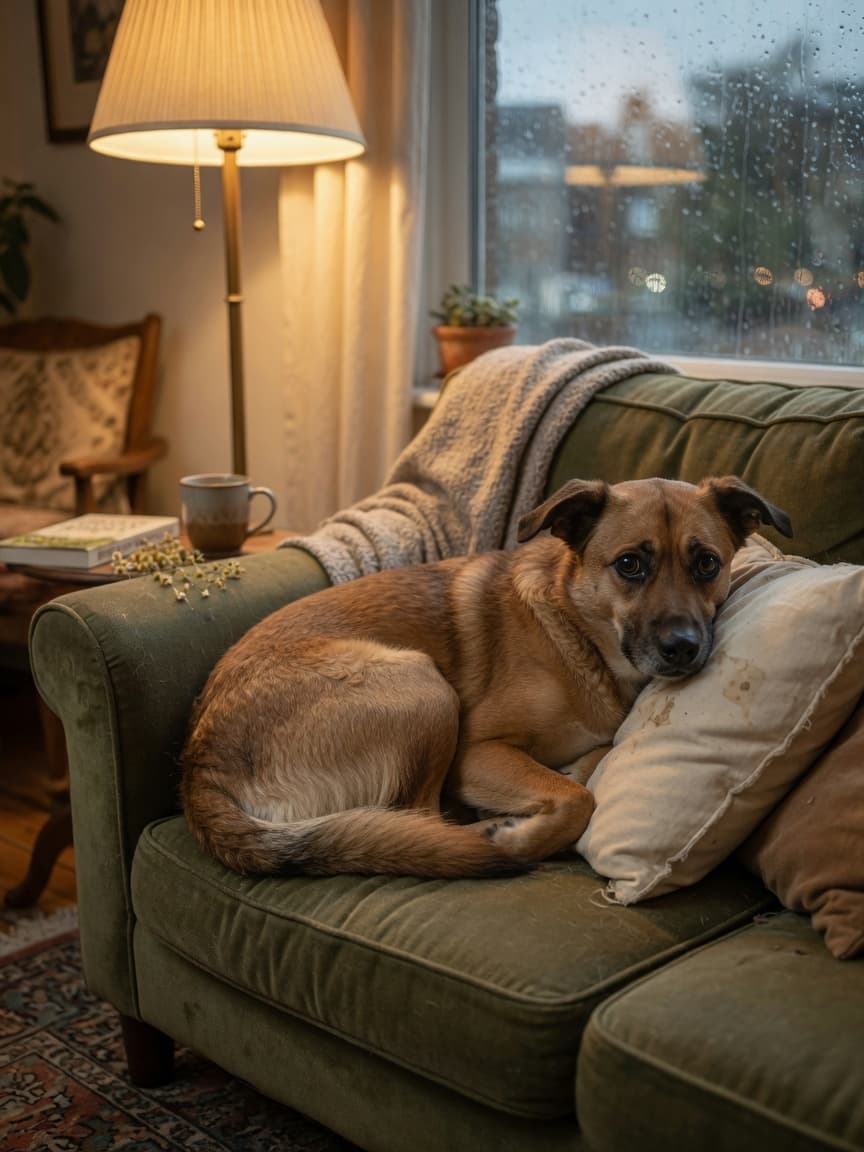
How Common Is Dog Anxiety?
A landmark study published in Scientific Reports (2020) analysed behavioural data from 13,715 dogs across Finland and found that 72.5% displayed at least one anxiety-related behaviour. Noise sensitivity, separation anxiety, and fearfulness were the most prevalent.
Yet most dogs with anxiety never receive treatment. Many owners attribute the signs to "bad behaviour" or personality quirks, not recognising them as distress signals. This guide helps you identify anxiety early — and outlines the natural interventions with the strongest scientific support.
Signs of Anxiety in Dogs — The Complete Checklist
Anxiety in dogs manifests differently depending on the trigger and the individual dog. The most reliable signs fall into three categories:
Physical Signs
- Excessive panting not related to heat or exercise
- Trembling or shaking
- Dilated pupils
- Excessive yawning (a calming signal)
- Lip licking when not near food
- Tail tucked between legs
- Ears flattened or pinned back
- Piloerection (raised hackles along spine)
Behavioural Signs
- Destructive behaviour when left alone
- Excessive barking or howling
- Attempting to escape (digging under fences, chewing doors)
- Pacing or inability to settle
- Refusing food in new environments
- Hiding or seeking constant contact
- House soiling despite being trained
Physiological Signs (often overlooked)
- Diarrhoea or loose stools before stressful events
- Reduced appetite over extended periods
- Frequent urination
- Self-grooming to excess (licking paws, flanks)
Important: If your dog shows multiple signs simultaneously or the behaviour has escalated over time, consult a veterinary behaviourist. Natural remedies work best for mild-to-moderate anxiety; severe anxiety often requires a combined approach with veterinary-prescribed medication.
Types of Dog Anxiety
Identifying the type of anxiety helps target the right intervention:
- Separation anxiety — triggered by departure or absence of the owner. Affects roughly 14–20% of dogs.
- Noise phobia — thunderstorms, fireworks, construction. The most common type, affecting up to 49% of dogs.
- Generalised anxiety — persistent low-level stress without a clear trigger, often linked to early socialisation gaps.
- Social anxiety — fear of strangers, other dogs, or new environments.
- Travel anxiety — car sickness combined with anticipatory fear.
7 Natural Remedies for Dog Anxiety — What the Evidence Says
1. CBD Oil (Cannabidiol)
Evidence level: Moderate — growing rapidly
CBD interacts with the endocannabinoid system (ECS), which plays a central role in regulating fear and stress responses in mammals. Dogs have a higher density of CB1 receptors in the brain than humans, which may explain their particular responsiveness.
A 2019 pilot study from Cornell University College of Veterinary Medicine found that 2mg/kg of CBD administered twice daily significantly reduced anxious behaviours in dogs without adverse effects. A 2023 study in Frontiers in Veterinary Science corroborated these findings in a larger cohort.
Recommended dose: 1–2mg per kg of body weight, twice daily. Start at the lower end and adjust over 2 weeks. Use a broad-spectrum oil from a brand with third-party Certificates of Analysis (CoA). Avoid products with THC above 0.3%.
Best for: Generalised anxiety, separation anxiety, noise phobia (given 30–60 minutes before the event).
2. L-Theanine
Evidence level: Moderate
L-theanine is an amino acid found naturally in green tea. It promotes alpha-wave brain activity — the calm, alert mental state associated with meditation. In dogs, it has been studied as a component in commercial supplements like Zylkene and Adaptil Chews.
A randomised controlled trial published in the Journal of Veterinary Behavior found L-theanine significantly reduced noise-induced anxiety scores compared to placebo over a 60-day period.
Recommended dose: 25–50mg for small dogs, 50–100mg for medium, 100–200mg for large breeds. Can be given daily or situationally.
3. Valerian Root
Evidence level: Preliminary
Valerian root has been used in human anxiety management for centuries. The active compounds — valerenic acid and isovaleric acid — appear to inhibit GABA transaminase, increasing levels of the calming neurotransmitter GABA in the brain.
While clinical trials in dogs are limited, valerian is a recognised calming agent in veterinary herbalism and is safe at appropriate doses. It works best as a short-term situational supplement (e.g., fireworks, vet visits).
Caution: Some dogs experience paradoxical excitability. Introduce on a low-stress day first to test response.
4. Adaptil (Dog Appeasing Pheromone — DAP)
Evidence level: Strong
Adaptil is a synthetic analogue of the pheromone produced by nursing dogs to calm their puppies. It's available as a diffuser, spray, or collar. Multiple blinded trials have shown it reduces anxiety scores in shelter dogs, separation anxiety cases, and noise phobia — making it one of the best-studied natural options available.
A 2003 study in the Veterinary Record found DAP collars significantly reduced fear behaviours during fireworks compared to placebo. More than 15 peer-reviewed studies support its efficacy.
5. Melatonin
Evidence level: Moderate (particularly for noise phobia)
Melatonin regulates the sleep-wake cycle and has a well-established calming effect. Veterinary behaviourist Dr. Nicholas Dodman has advocated its use for noise phobia specifically. It's fast-acting (30–60 minutes) and has an excellent safety profile.
Dose: 1mg for dogs under 10kg, 1.5mg for 10–25kg, 3mg for larger dogs. Administer 30 minutes before the stressor. Important: check the product contains no xylitol, which is toxic to dogs.
6. Massage and TTouch
Evidence level: Moderate
The Tellington TTouch method — a specific pattern of circular touches along the body — has been studied in shelter dogs and shown to reduce cortisol levels and anxiety-related behaviours. It costs nothing, has zero side effects, and strengthens the human-dog bond simultaneously.
Research from the Applied Animal Behaviour Science journal found TTouch reduced stress indicators in kennelled dogs within 10-minute sessions.
7. Exercise and Enrichment (The Most Underrated Remedy)
Evidence level: Strong
Physical exercise reduces cortisol and increases serotonin and dopamine. A 2019 study found that dogs walked for 30+ minutes daily showed significantly lower anxiety scores than dogs with minimal exercise. Mental enrichment — sniff walks, puzzle feeders, nosework — has an even stronger effect on generalised anxiety than physical exercise alone.
Before reaching for any supplement, ensure your dog's exercise and enrichment needs are fully met. Many cases of "anxiety" resolve with lifestyle adjustments alone.
What Doesn't Work (Despite Claims)
- Lavender essential oil directly applied: Toxic to dogs. Diffused lavender has some evidence, but essential oils on skin or ingested are dangerous.
- Punishment for anxiety behaviours: Increases anxiety. Never punish a dog for destructive behaviour caused by distress.
- Sedation as a long-term solution: Heavy sedation masks the problem without addressing the underlying cause and negatively impacts quality of life.
Creating a Calm Environment
Natural remedies work best as part of a broader strategy:
- Establish a consistent daily routine — predictability reduces generalised anxiety
- Create a dedicated safe space (crate or corner) your dog associates with safety
- Use white noise machines during storms or fireworks to muffle triggers
- Practice desensitisation and counter-conditioning for specific phobias
- Consider a certified veterinary behaviourist for complex cases
When to See a Vet
Natural remedies are appropriate for mild-to-moderate situational or chronic anxiety. Seek veterinary advice if:
- Anxiety is severely impacting your dog's quality of life
- Self-injury is occurring (excessive licking to the point of wounds)
- Multiple natural approaches have failed over 8+ weeks
- The behaviour escalated suddenly (may indicate underlying medical cause)
Prescription options like fluoxetine (Prozac) or trazodone are not failures — they are appropriate tools when warranted and often work synergistically with natural remedies.
References
- Salonen M, et al. "Prevalence, comorbidity, and breed differences in canine anxiety in 13,700 Finnish pet dogs." Scientific Reports. 2020. PubMed 32616847
- McGrath S, et al. "Randomized blinded controlled clinical trial to assess the effect of oral cannabidiol administration in addition to conventional antiepileptic treatment on seizure frequency in dogs with intractable idiopathic epilepsy." J Vet Intern Med. 2019. PubMed 31006124
- Landsberg G, et al. "Noise phobias in companion animals." Vet Clin Small Anim. 2014. PubMed 24182513
- Gaultier E, Pageat P. "Effects of a synthetic dog appeasing pheromone on behaviour problems during transport." Vet Rec. 2003. PubMed 14509432
- Dodman N, et al. "Use of melatonin in the treatment of canine noise phobia." JAVMA. 2004.
Medically reviewed by a licensed veterinarian. Last updated June 2026.