
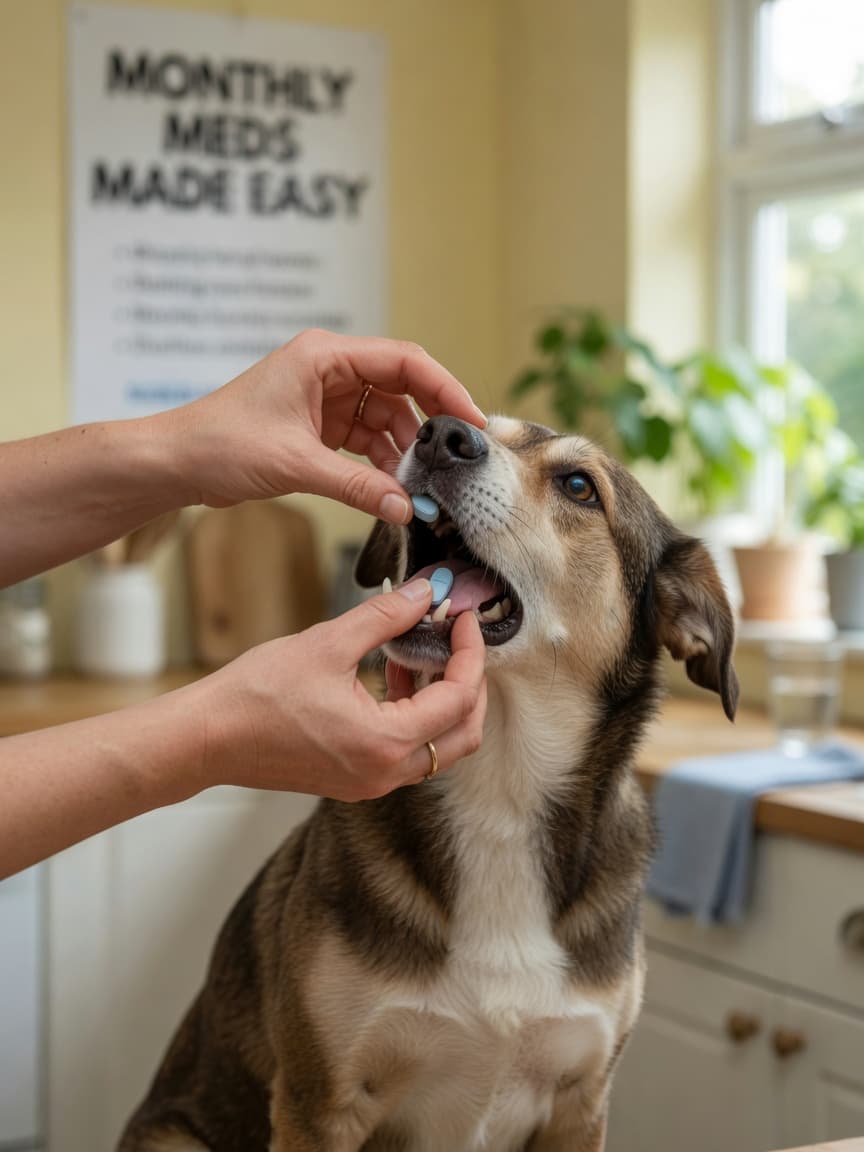
The Challenge of Medicating Your Dog
Giving a dog medicine is one of those tasks that sounds straightforward until you are standing in your kitchen with a tablet, a suspicious dog, and a trail of half-chewed pill pockets on the floor. Dogs are remarkably talented at detecting hidden medication, spitting out tablets after seemingly swallowing them, and developing an instant aversion to their favourite food the moment it contains anything remotely medicinal.
The good news is that most dogs can be successfully medicated at home using one of several tried-and-tested techniques. The key is knowing which approach suits your dog's temperament and the type of medication involved, and having a backup plan when your first strategy fails.
Hiding Pills in Food
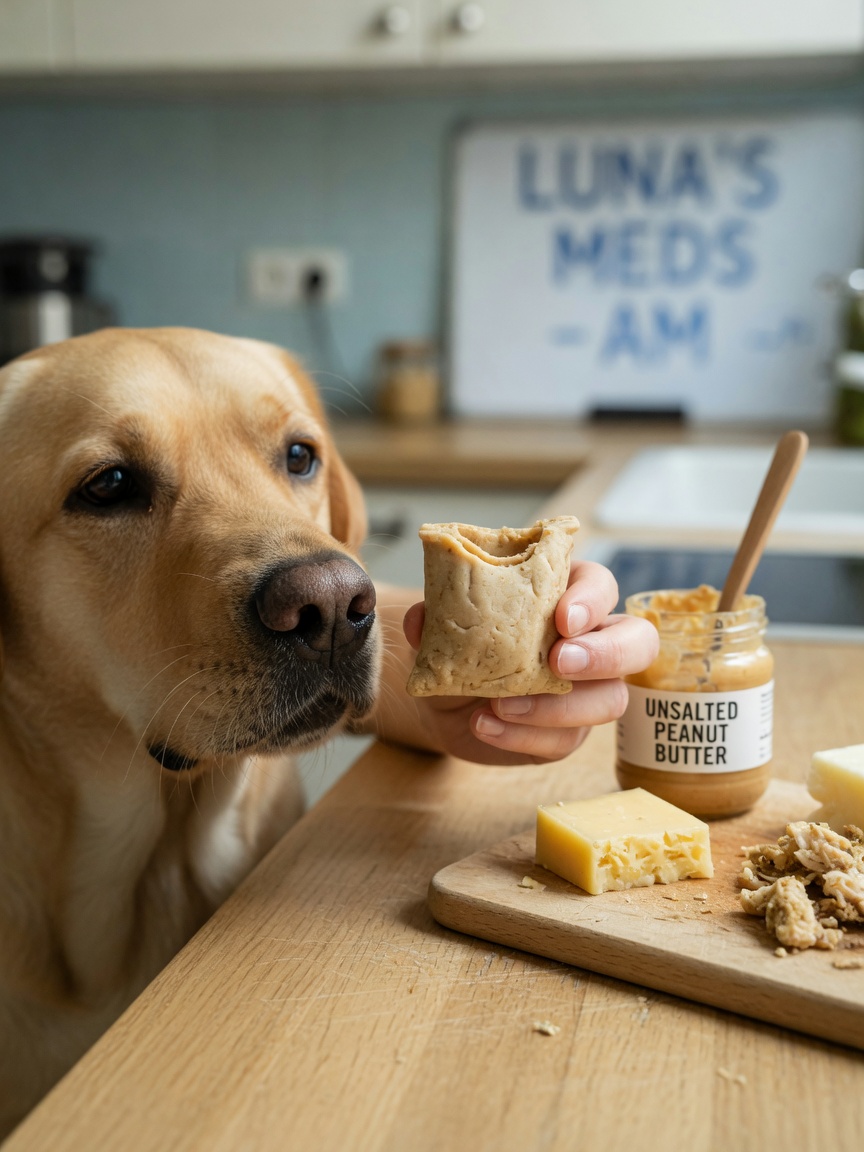
The simplest approach for many dogs is to disguise the tablet inside a small piece of food with a strong enough flavour and texture to mask both the taste and the feel of the pill.
The Pill Pocket Method
Pill pockets are purpose-made soft treats with a hollow centre designed to wrap around a tablet or capsule. They come in various flavours — chicken, duck, salmon — and are available from Zooplus and most veterinary practices. Press the pill into the pocket, seal the opening, and offer it as a treat. For dogs who eat quickly and enthusiastically, this method has an excellent success rate. However, some clever dogs learn to eat around the hidden pill; if yours manages this, move to a more secure food wrapper.
The Peanut Butter Method
A small amount of unsalted, xylitol-free peanut butter spread onto a tablet creates a sticky coating that adheres to the roof of the mouth, making it harder to spit out. Check the label of any peanut butter carefully — xylitol, an artificial sweetener sometimes used in reduced-sugar products, is highly toxic to dogs. Plain, unsalted varieties are safe in small amounts. Cream cheese, soft spreadable cheese, or a ball of wet dog food work on the same principle and are worth trying if your dog is not keen on peanut butter.
The Three-Treat Trick
This technique exploits your dog's competitive instinct. Offer a plain treat, then a second plain treat, then the treat containing the hidden pill, and follow immediately with a fourth plain treat. The rapid succession keeps your dog focused on getting the next treat rather than investigating what they just swallowed. Many owners find this is the most reliable method for dogs who have already learned to be suspicious of a single offered treat.
Choosing the Right Food Wrapper
The food must be strongly flavoured, soft enough to mould around the pill without crumbling, and appealing enough to be eaten without chewing — since chewing often reveals the hidden tablet. Options that work well include:
- A small ball of wet dog food or pate-style dog food
- A piece of soft cheese such as Dairylea or Babybel
- A small piece of cooked meat — chicken, turkey, or a tiny strip of sausage
- A smear of unsalted butter moulded around the pill
Avoid very hard or crunchy foods, or anything your dog typically chews rather than gulps. The goal is to have the pill swallowed whole with minimal investigation.
Direct Pilling
When food-hiding fails — or when the medication must not be given with food — you may need to pill your dog directly. This sounds intimidating but is manageable with the right technique and a calm approach.
- Hold the tablet between your thumb and index finger
- With your other hand, place your palm over the top of your dog's muzzle, with your thumb and fingers curling around behind the upper canine teeth
- Gently tilt the head upward and use your pilling hand's middle finger to press down on the lower front teeth, opening the mouth
- Place the tablet as far back on the tongue as possible — the further back, the harder it is to spit out
- Close the mouth, lower the head to a neutral position, and gently stroke the throat or blow lightly on the nose to encourage swallowing
- Watch for your dog to lick their nose — this usually indicates they have swallowed
- Follow with a small treat or a syringe of water to ensure the pill reaches the stomach, particularly important with some tablets that can cause oesophageal irritation if they sit in the throat
Giving Liquid Medicine
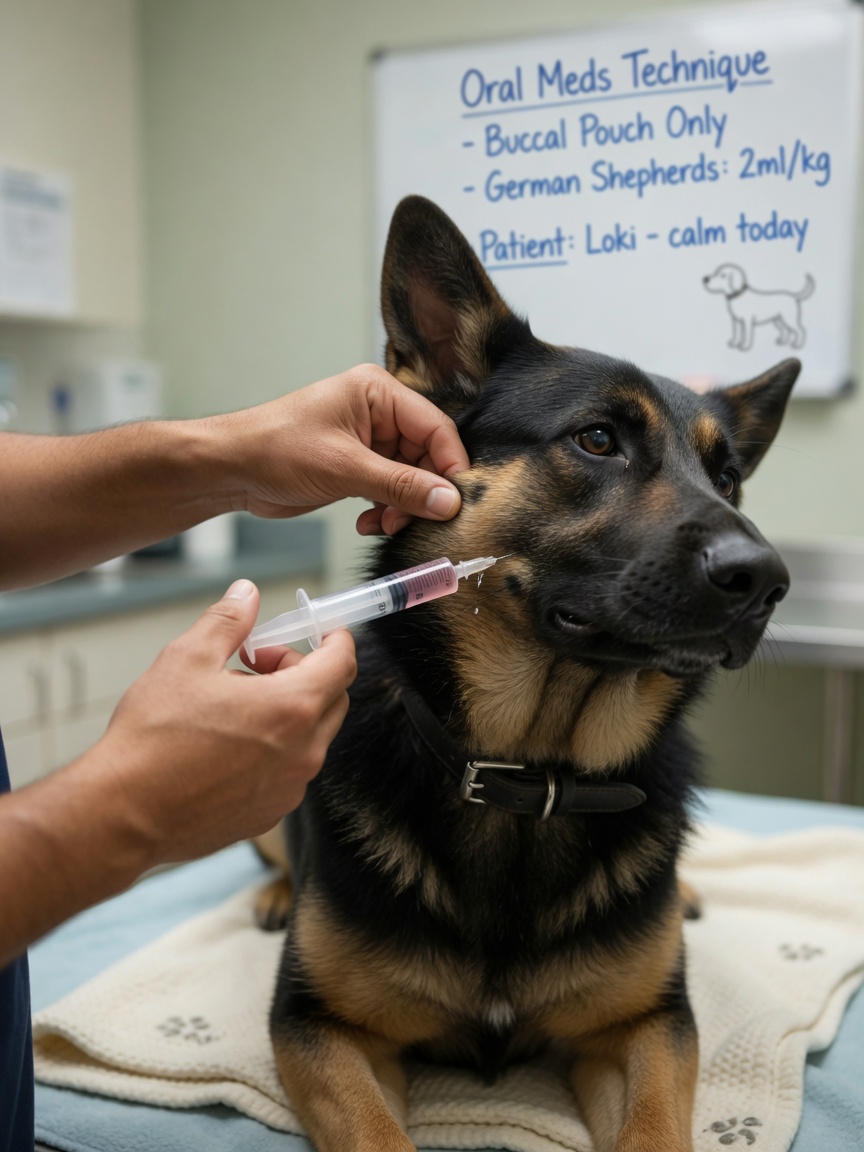
Liquid medications are often easier to measure accurately and can sometimes be added to food. However, some liquids have a strong taste that dogs immediately detect and reject.
If the liquid can be mixed with food, stir it into a small portion of wet food or something strongly flavoured like a spoonful of bone broth. Give this medicated portion separately from the main meal to ensure it is fully consumed.
If the medication must be given directly, use a syringe (your vet will usually provide one). Draw up the correct dose and insert the syringe into the side of the mouth, behind the canine teeth, aiming towards the cheek rather than directly down the throat. Dispense the liquid slowly — squirting it in too quickly can cause choking. Tipping the head slightly upward helps, but do not tilt it back so far that the dog cannot swallow comfortably.
Ear Drops
Many dogs tolerate ear drops better than tablets, particularly if their ears are not acutely painful. Warm the bottle briefly in your hands before applying — cold drops are more startling. Gently hold the ear flap up, insert the nozzle just inside the ear opening, and apply the prescribed number of drops. Massage the base of the ear gently for 20 to 30 seconds to distribute the medication, then allow your dog to shake their head. Reward with a treat immediately afterwards.
If your dog's ears are very painful and they will not tolerate handling, do not force it — contact your vet, as the infection may be more severe than it appears, or a different formulation may be needed.
Eye Drops and Eye Ointments
Eye medications require a steady hand and a cooperative dog. Hold your dog's head still — a second person helps enormously. Approach from above and slightly behind the eye rather than from the front, which triggers a blink reflex. For drops, hold the bottle close to but not touching the eye, squeeze the prescribed number of drops onto the surface of the eyeball, then allow the dog to blink. For ointment, apply a thin ribbon along the inner corner of the lower eyelid, then gently close the eye and massage briefly to distribute.
What NOT to Do
- Never crush tablets or open capsules without checking with your vet first — some medications are specifically formulated as slow-release and become dangerous if crushed
- Never mix medication into a full bowl of food and hope for the best — if the dog does not eat all the food, the dose is unknown
- Never use xylitol-containing products as a food wrapper
- Do not give human pain relief such as ibuprofen, paracetamol, or aspirin to dogs — these are toxic and potentially fatal
- Avoid showing anxiety or frustration when medicating your dog — they read your body language and become more resistant if they sense tension
When to Ask for a Different Formulation
If you are consistently unable to medicate your dog, speak to your vet. Many medications are available in multiple forms — a tablet can often be compounded into a flavoured liquid, a chewable treat, or even a transdermal gel applied to the inner ear flap. Compounding pharmacies work directly with vets to produce bespoke formulations when standard options are failing. There is no benefit to a prescription that cannot be administered reliably, and your vet would always rather know so that an alternative can be found.