
Can Fish Feel Pain? What Science Now Says
Why This Question Matters
For most of human history, fish were assumed to be automata — biological machines that responded to stimuli without any subjective experience of suffering. This assumption shaped fishing practices, aquaculture conditions, scientific experimentation, and the general attitude that fish welfare was not a serious concern. If fish can feel pain, these assumptions require fundamental revision. The question is not merely academic: billions of fish are caught, farmed, and kept in aquariums every year.
The scientific study of fish pain and consciousness has accelerated dramatically since the early 2000s, driven largely by the work of researchers like Victoria Braithwaite at Penn State University and Lynne Sneddon at the University of Liverpool. Their findings — and the debates they sparked — have reshaped how biologists, ethicists, and increasingly regulators think about fish welfare.
What Nociception Is (And How It Differs from Pain)
To understand the debate, it helps to distinguish between nociception and pain. Nociception is the physiological detection of potentially damaging stimuli — it is a reflexive, hardware-level response to tissue damage or dangerous temperatures that occurs across virtually all animal phyla, including insects and even some plants. Pain, by contrast, involves subjective experience — a conscious awareness that something hurts. A thermostat "detects" temperature; it doesn't feel cold.
The question of whether fish feel pain is therefore two questions: Do fish have the hardware to detect noxious stimuli (nociceptors)? And do they have the neural architecture to process those signals into a subjective experience of suffering?
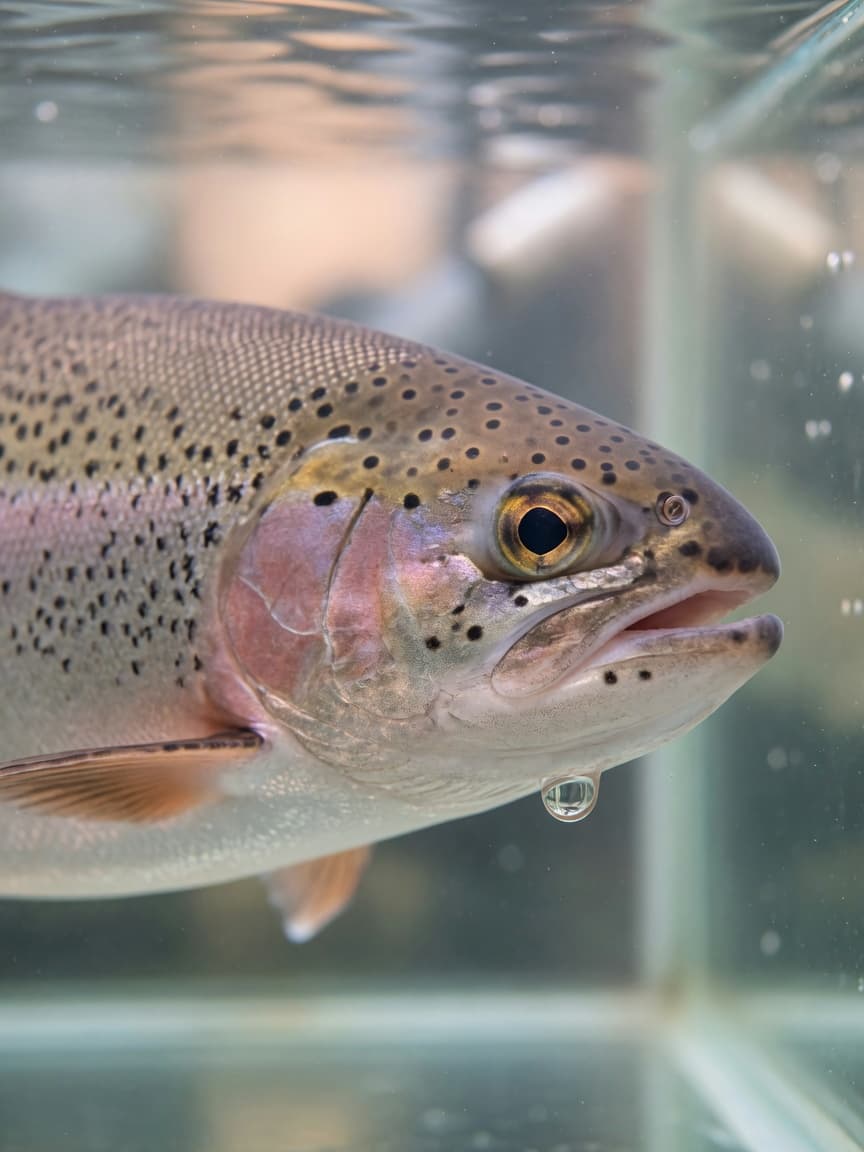
The first question has been definitively answered: yes. Fish have nociceptors — sensory neurons that respond specifically to harmful stimuli. Sneddon et al.'s landmark 2003 study identified 58 nociceptors on the heads of rainbow trout, including both A-delta fibers (fast-responding, typically associated with sharp pain) and C-fibers (slower, associated with burning or aching sensations) — the same two types that underlie pain in mammals.
Key Research Findings
The Acetic Acid Studies
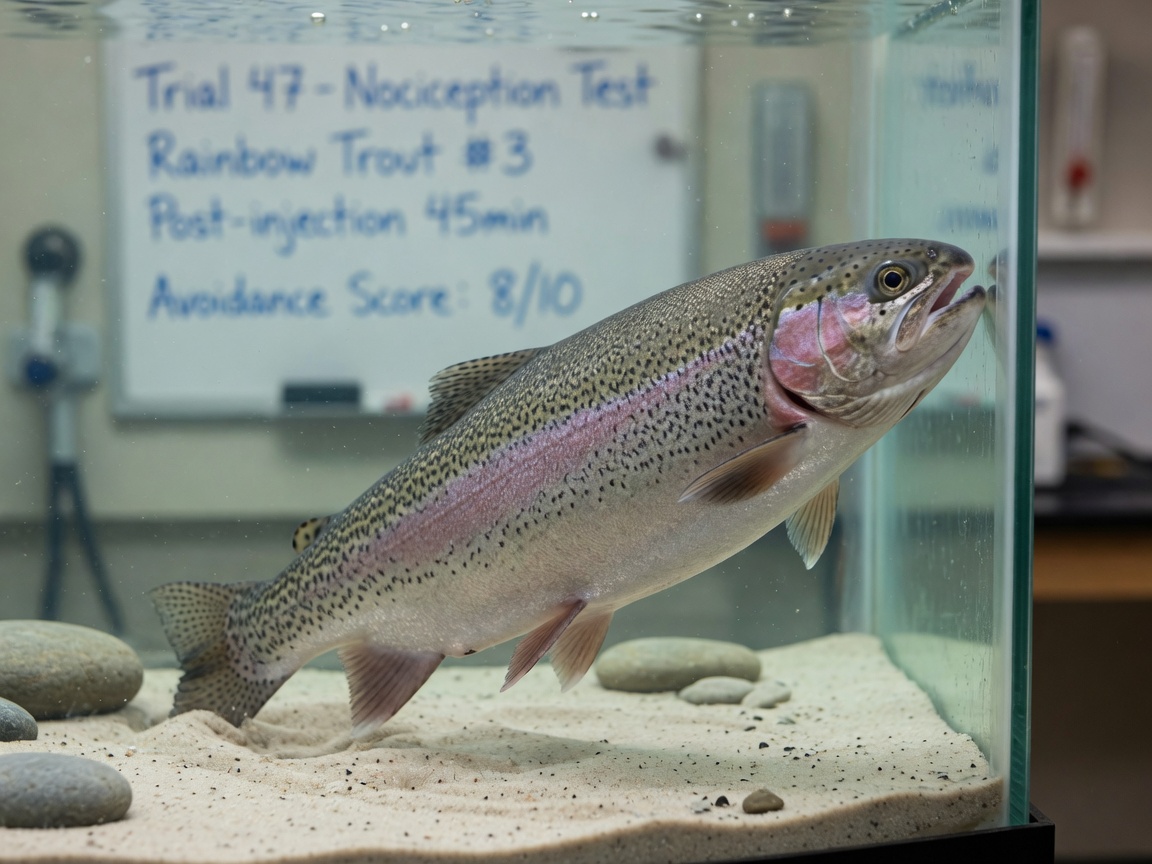
In Sneddon's foundational experiments, rainbow trout injected with dilute acetic acid into their lips showed distinctive behaviors: rocking on the tank bottom, rubbing their lips against surfaces, increased ventilation rate, and reduced feeding. These behaviors were not present in fish injected with saline. When morphine (an opioid analgesic) was administered, the behaviors reduced significantly — suggesting the fish were not just reflexively responding but were experiencing something that opioid pain relief could alleviate. This is a critical distinction: analgesia works on pain experience, not on mere nociception.
Trade-off Behavior and the Attention Hypothesis
Pain in conscious beings diverts cognitive resources toward the injury — it commands attention. Subsequent studies tested whether pain-experiencing fish would show this "attention capture." Fish trained to associate a certain area of a tank with food were injected with painful stimuli. Fish with pain stimuli spent less time in the food area and showed disrupted learning, suggesting their attention was diverted — a hallmark of pain experience rather than pure nociceptive reflex.
The Neurological Debate
The most significant objection to the conclusion that fish consciously experience pain comes from neuroanatomy. Mammals process pain partly through the neocortex — a brain structure that fish lack. The argument, advanced most prominently by James Rose (University of Wyoming), is that without a neocortex, fish cannot have the conscious component of pain even if they have the physiological signaling.
The counter-argument, now supported by more researchers, is that the neocortex is not the only possible substrate for conscious experience — it is simply the mammalian substrate. Fish have well-developed telencephalons and other brain regions that may serve analogous functions. The assumption that consciousness requires the specific mammalian architecture is, as Braithwaite argued in her 2010 book "Do Fish Feel Pain?", an example of anthropocentric reasoning. The AVMA's animal welfare guidelines have progressively incorporated fish welfare considerations as evidence has accumulated.
What the Current Consensus Looks Like
A 2016 review by Elwood in the journal Animal Behaviour surveyed the state of the evidence and concluded that fish show behavioral indicators of pain experience, respond to analgesics in ways consistent with pain relief, and show the kind of motivational state changes (like the attention effects described above) that are associated with conscious suffering rather than mere reflex. Most fish biology researchers now accept that fish are capable of nociception at minimum, and that the balance of evidence supports some form of pain experience.
Notably, cephalopods (octopus, squid, cuttlefish) and decapod crustaceans (crabs, lobsters, shrimp) are now included in welfare legislation in several countries precisely because of parallel evidence about their capacity for pain. The UK's Animal Welfare (Sentience) Act 2022 explicitly extends sentience recognition to cephalopods and decapods. Fish protection remains patchier but is moving in the same direction.
Stress in Fish: What We Know More Certainly
While the conscious pain debate continues, fish stress responses are not debated. Fish have a fully functional hypothalamic-pituitary-interrenal (HPI) axis — the fish equivalent of the mammalian stress axis — that responds to stressors by releasing cortisol, adrenaline, and other stress hormones. Chronic stress in fish causes measurable physiological damage: immune suppression, disrupted growth, reproductive failure, and increased susceptibility to disease. These effects occur at measurable levels well below those that would cause behavioral changes.
What this means practically: even if you remain skeptical about fish conscious pain experience, there is no doubt that poor aquarium conditions — chronic ammonia exposure, overcrowding, incompatible tankmates, inappropriate temperature — cause measurable physiological harm to fish through stress responses that parallel mammalian stress biology.
Implications for Fishkeeping
Responsible fishkeeping in light of the pain and stress evidence means: providing species-appropriate tank size and water conditions, avoiding practices known to cause stress (sudden temperature changes, aggressive tankmates, handling fish unnecessarily), using appropriate anesthesia for any procedures (surgery, tagging, sampling) — most veterinary fish practices now use MS-222 or clove oil for this purpose — and choosing euthanasia methods appropriate to the evidence. The AVMA recognizes that simply flushing fish or leaving them out of water is not a humane end-of-life option.
Key Takeaways
- Fish definitively have nociceptors — sensory neurons that detect painful stimuli, including both A-delta and C-fiber types
- Behavioral and analgesic response studies strongly suggest fish experience something beyond pure reflex — likely some form of pain
- The "no neocortex, no pain" argument is increasingly rejected as anthropocentric; fish have other brain regions that may serve analogous functions
- Fish cortisol and stress responses are well-documented and cause measurable physical harm — this is not debated
- Scientific and regulatory recognition of fish sentience is growing; humane euthanasia and handling practices matter
- Good aquarium husbandry is not just aesthetics — it is an ethical obligation given what we now know
References
- Sneddon LU, Braithwaite VA, Gentle MJ. "Do fishes have nociceptors? Evidence for the evolution of a vertebrate sensory system." Proceedings of the Royal Society B. 2003. PMID: 12693558
- Elwood RW. "Pain and suffering in invertebrates?" ILAR Journal. 2011. PMID: 22205447