
Can Cats Eat Onions? No — Onions Are Toxic to Cats in Every Form
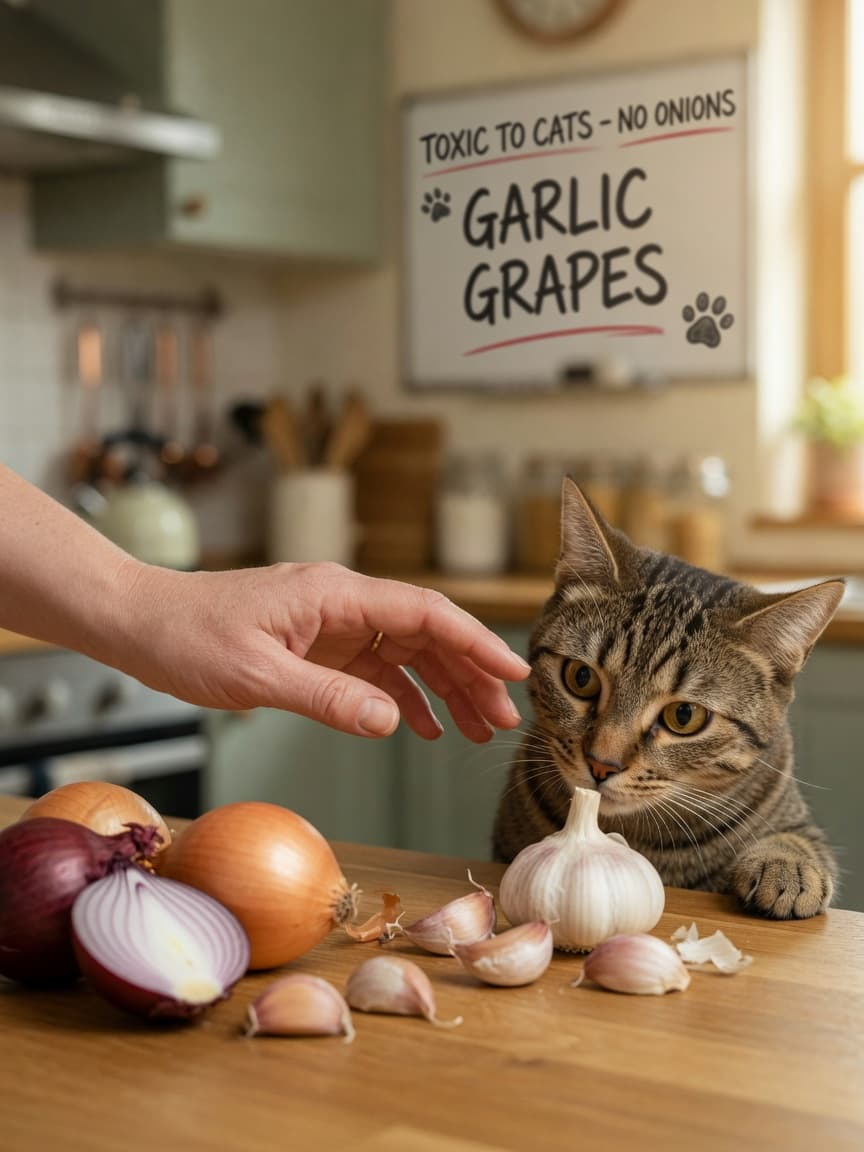
Onions — in every form, raw, cooked, powdered, or dehydrated — are poisonous to cats. They belong to the Allium family and contain compounds that destroy a cat's red blood cells, causing hemolytic anemia that can be fatal if left untreated. Even small amounts consumed repeatedly over time can accumulate to dangerous levels. If your cat has eaten onions or any Allium-family vegetable, contact your veterinarian or the ASPCA Animal Poison Control Center immediately: (888) 426-4435.
Onions are a staple of human cooking worldwide. They appear in soups, stews, sauces, broths, baby food, snack seasonings, and countless prepared meals. This ubiquity makes them one of the most common sources of accidental cat poisoning. Many cat owners are surprised to learn that the onion in a shared piece of chicken, a lick of soup broth, or even a cat who has eaten commercial baby food flavored with onion powder has been exposed to a potentially life-threatening toxin.
Understanding why onions are dangerous, what forms pose a risk, and how to recognize and respond to poisoning could save your cat's life.
The Allium Family: All Members Are Toxic to Cats
Onions are part of the Allium genus of plants, which includes a wide range of common vegetables and seasonings. Every single member of this family is toxic to cats:
- Onions (Allium cepa) — all varieties: yellow, white, red, sweet, pearl, and spring onions
- Garlic (Allium sativum) — even more concentrated in toxins than onions
- Leeks (Allium ampeloprasum)
- Chives (Allium schoenoprasum) — often overlooked as a garnish but equally dangerous
- Shallots (Allium cepa var. aggregatum)
- Scallions / green onions
- Wild onions and wild garlic
There is no safe member of this plant family for cats. If a food contains any of these ingredients — even as a minor seasoning — it must be kept away from your cat entirely.
How Onions Poison Cats: The Mechanism of Toxicity
The toxic agents in onions are organosulfur compounds, most notably N-propyl disulfide. These compounds are released when onion cells are damaged — whether through cutting, chewing, cooking, or processing into powder. Once ingested and absorbed into the bloodstream, they attack the cat's red blood cells at a molecular level.
Here is what happens: N-propyl disulfide oxidizes the hemoglobin inside red blood cells. Hemoglobin is the iron-containing protein that binds and transports oxygen. When oxidized, hemoglobin becomes denatured and clumps together, forming abnormal structures called Heinz bodies — visible as dark inclusions inside the red blood cells when examined under a microscope.
The cat's immune system — specifically the spleen — then identifies these Heinz-body-laden cells as abnormal and destroys them. As red blood cells are eliminated faster than the bone marrow can produce new ones, the cat develops hemolytic anemia: a dangerous drop in the number of functional red blood cells circulating in the body.
Cats are especially vulnerable to this process compared to most other mammals. Feline hemoglobin has a molecular structure with more reactive sulfhydryl groups than dog or human hemoglobin. This means the thiosulfate compounds in onions cause oxidative damage more rapidly and more severely in cats. A dose that causes mild illness in a dog can cause life-threatening anemia in a cat of similar size.
All Forms of Onion Are Equally Dangerous
Many cat owners mistakenly believe that cooking onions renders them safe. This is completely false. The N-propyl disulfide and related thiosulfate compounds in onions are heat-stable — they are not destroyed or denatured by cooking at any temperature. Whether onions are sautéed, boiled, roasted, caramelized, or fried, the toxic compounds remain fully active.
The following forms of onion are all toxic to cats:
- Raw onion — the most immediately recognized form, but cats may chew on discarded onion skins or roots
- Cooked onion — in soups, stews, casseroles, stir-fries, and shared table food
- Onion powder — extremely concentrated; a fraction of a gram can be toxic to a cat
- Dehydrated onion flakes — similarly concentrated and dangerous
- Onion in commercial food — some human baby foods, particularly meat-flavored purées, historically contained onion powder and have caused poisoning in cats fed these products
- Onion broth or stock — even cooking liquid that has simmered with onions retains toxic compounds
Onion powder and dehydrated onion flakes deserve special alarm. Because the water content has been removed, these forms are dramatically more concentrated per gram than fresh onion. A small amount of seasoning in a marinade, a pinch of onion powder in a sauce, or a flavored cracker that your cat licks contains the equivalent toxin load of a much larger volume of raw onion.
Recognizing the Symptoms of Onion Poisoning in Cats
The insidious nature of onion toxicity is that symptoms often do not appear until 1 to 4 days after ingestion, by which point red blood cell destruction is well underway. Do not wait for symptoms to appear before seeking veterinary help — if you know or suspect your cat has eaten onion in any form, call for help immediately.
When symptoms do appear, they include:
- Profound lethargy — the cat appears exhausted, does not want to move, and loses interest in play or surroundings
- Pale, white, or yellowish gums — a clear sign of severe anemia; healthy gums should be bubble-gum pink
- Rapid, labored, or open-mouth breathing — the body is struggling to compensate for reduced oxygen-carrying capacity
- Elevated heart rate
- Vomiting and diarrhea — may occur in the early phase of poisoning
- Loss of appetite
- Weakness and stumbling gait
- Dark-colored urine — red, orange, or brown urine results from hemoglobin released by destroyed red blood cells (hemoglobinuria)
- Jaundice — yellowing of the skin, gums, or whites of the eyes, indicating liver stress from processing the destroyed cells
- Collapse — a severe, life-threatening emergency
Even if your cat appears completely normal after eating onion, do not assume they escaped harm. The delay before symptoms appear is common. Anemia can develop quietly and then reach a crisis point very suddenly.
Cumulative Toxicity: Small Amounts Over Time Are Also Dangerous
Another critical point that many cat owners overlook: onion toxicity in cats can be cumulative. A cat who receives small amounts of onion regularly — perhaps through table scraps, shared human food, or commercial food containing hidden Allium ingredients — can develop hemolytic anemia even if no single meal contained a large dose. The damage accumulates gradually until it reaches a clinically dangerous threshold.
This is why it is essential not only to avoid giving your cat onion intentionally, but to carefully check the ingredient lists of any human food you share with your cat and to never allow cats access to kitchen scraps or unattended plates.
Emergency Response: What to Do Right Now
If your cat has eaten onion — any amount, any form — take these steps immediately:
- Call the ASPCA Animal Poison Control Center: (888) 426-4435. Available 24/7. A consultation fee may apply, but the guidance you receive can be lifesaving.
- Call your veterinarian or the nearest emergency animal hospital. Tell them what your cat ate, how much, and when.
- Do not attempt to induce vomiting at home without explicit instructions from a veterinarian — improper methods can harm or injure your cat.
- Bring packaging or a list of ingredients from any food your cat consumed so the vet can accurately estimate the toxin dose.
- Keep your cat calm and warm while arranging transport to the vet.
Treatment depends on when exposure occurred and how severe the anemia is. Within the first hour or two of ingestion, a vet can safely induce vomiting to prevent further absorption. Activated charcoal may be administered. In severe cases, blood transfusions, intravenous fluids, and supportive care are required to stabilize the cat while the bone marrow recovers and produces new red blood cells.
- Onions and all Allium vegetables (garlic, leeks, chives, shallots) are toxic to cats.
- The mechanism: N-propyl disulfide oxidizes feline hemoglobin, causing Heinz body hemolytic anemia.
- Cooked onion is just as toxic as raw — heat does not destroy the compounds.
- Onion powder is highly concentrated and especially dangerous.
- Even small repeated amounts can accumulate to dangerous levels over time.
- Symptoms may not appear for 1–4 days after ingestion.
- Any onion exposure = veterinary emergency. Call (888) 426-4435 immediately.
Protecting Your Cat: Feed Only Cat-Appropriate Food
The safest approach is to feed your cat a balanced, species-appropriate commercial diet and to resist sharing human food. Many human dishes contain Allium ingredients that are not obvious — soups, gravies, broths, seasonings, and processed snacks are common hidden sources. Always check ingredient labels carefully.
Look for high-quality cat foods that list named meat proteins as the first ingredient, contain no artificial additives, and are free from onion, garlic, and other Allium derivatives.
Ver alimentos para gatos en Zooplus →Choosing vet-approved, toxin-free nutrition is the most important step you can take to keep your cat safe from preventable poisoning.
References and Further Reading
- Cope RB. "Allium species poisoning in dogs and cats." Vet Med. 2005;100(8):562–566.
- Kovalkovicova N, Sutiakova I, Pistl J, Sutiak V. "Some food toxic for pets." Interdiscip Toxicol. 2009;2(3):169–76. PMID: 21217842
- Lee KW, Yamato O, Tajima M, et al. "Hematologic changes associated with the appearance of eccentrocytes after intragastric administration of garlic extract to dogs." Am J Vet Res. 2000;61(6):582–8. PMID: 10850838