
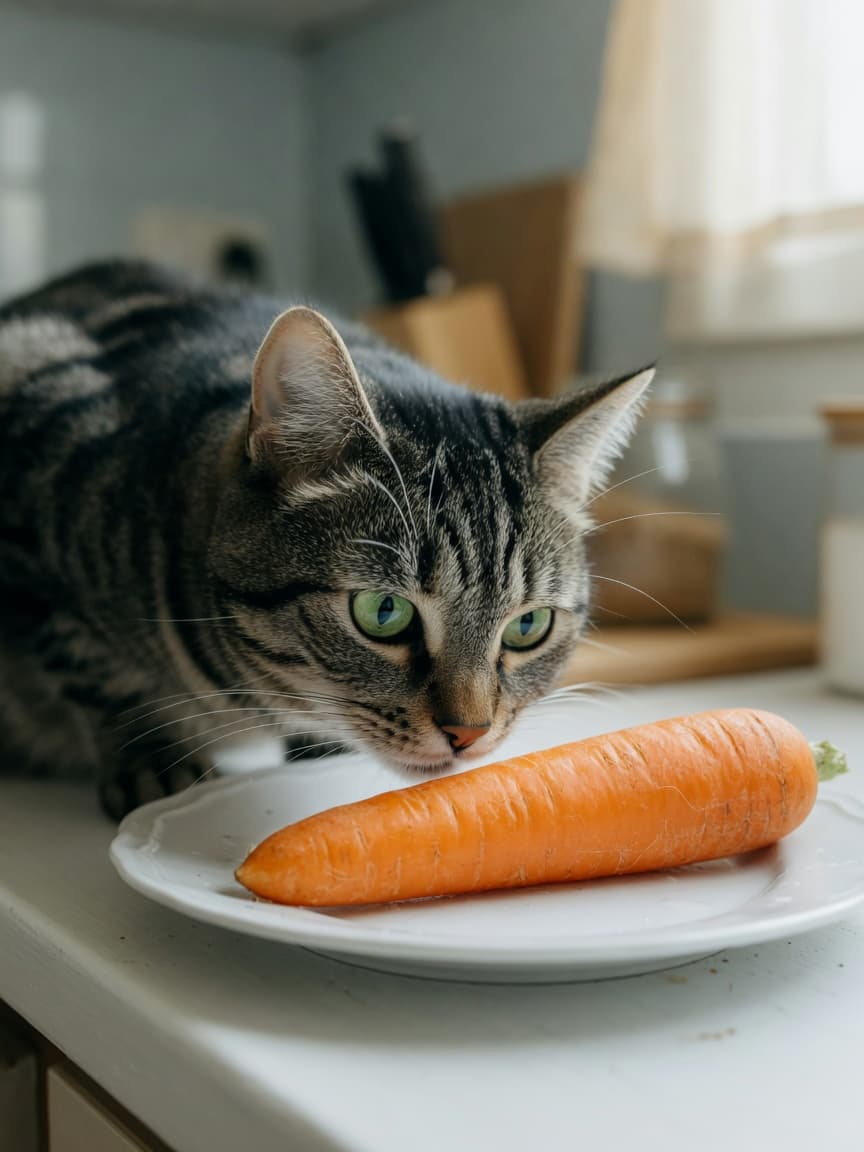
Can Cats Eat Carrots? The Truth About Cats and Vegetables
Carrots have an excellent reputation in human nutrition — and for good reason. They are packed with beta-carotene, fiber, and a range of vitamins and minerals. If you are eating carrots regularly yourself, it might seem logical to share a piece with your cat. The good news is that carrots are not toxic to cats. The more important news is that cats and carrots occupy completely different metabolic worlds, and what benefits you substantially will do very little for your feline companion.
Cats Are Obligate Carnivores — And That Changes Everything
The foundational fact of feline nutrition is that cats are obligate carnivores. This means their entire metabolic system evolved around the consumption of animal prey. Unlike omnivores such as humans, dogs, and bears, cats have lost the enzymatic capacity to efficiently convert many plant-based nutrients into the forms their bodies can use. This is not a matter of preference — it is genetics and physiology.
One of the clearest examples of this is vitamin A metabolism. In humans and many omnivores, beta-carotene from plant sources is split by the enzyme beta-carotene dioxygenase to produce retinol (the active form of vitamin A). Cats have extremely low levels of this enzyme and cannot perform this conversion efficiently. They are entirely dependent on preformed vitamin A — retinol — found exclusively in animal tissues, particularly liver.
This means that carrots, one of the richest plant sources of beta-carotene, offer cats essentially nothing in terms of vitamin A. The very nutrient carrots are famous for is largely inaccessible to the feline metabolism.
What About the Other Nutrients in Carrots?
Carrots also contain fiber, potassium, vitamin C, and vitamin K. Here again, context matters for cats:
- Vitamin C: Unlike humans, cats synthesize their own vitamin C in the liver. They do not need to obtain it from food. Carrots' vitamin C content is nutritionally irrelevant to a cat.
- Fiber: Some fiber can be beneficial for cats with certain digestive issues, particularly constipation. However, cats get more appropriately calibrated fiber from commercial cat foods designed for digestive health — not from raw vegetables.
- Potassium: Cats do need potassium, but they obtain it readily from meat-based diets. The small amount in a piece of carrot is negligible in the context of a cat's total diet.
- Carbohydrates: Carrots are primarily composed of carbohydrates and water. Cats have a limited ability to digest carbohydrates compared to omnivores; their digestive enzymes are adapted for protein and fat, not starch and sugar.
The Choking Hazard Risk With Raw Carrots

Raw carrots are firm and crunchy — perfect for a human snack, but potentially problematic for a small cat. A cat's jaw is designed for tearing meat, not grinding hard plant material. The molars of cats lack the flat grinding surface found in herbivores and omnivores. A large chunk of raw carrot could present a choking risk, particularly in smaller cats or older cats with dental issues.
If you choose to offer your cat carrot, cook it first until it is soft enough to mash between your fingers. Steaming or boiling without any added salt or seasoning is the safest method. Allow it to cool to room temperature before offering it. Cut it into very small, manageable pieces.
Ver alimentos para gatos en Zooplus →Why Some Cats Show Interest in Carrots
Some cats do show curiosity about carrots. This is not because their body is telling them they need something in the carrot — cats lack the sweet taste receptor that would make a starchy vegetable appealing. More likely, a cat investigating a carrot is responding to the smell, the texture novelty, or simply mirroring human behavior they have observed. Cats are curious animals, and novelty often drives investigative behavior independent of nutritional need.
If your cat sniffs a carrot and then walks away, that is entirely typical. If your cat seems genuinely interested and nibbles a small piece of cooked carrot, that is also fine — it simply is not doing much for their health either way.
Are There Any Benefits at All?
In narrow, specific scenarios, there is one minor benefit worth noting. Cooked carrot provides a small amount of soluble fiber that may gently support gut motility in a cat prone to mild constipation. However, if your cat has a chronic digestive problem, this is a matter for veterinary guidance — not carrot supplementation. There are commercial cat foods and veterinary fiber supplements specifically formulated for feline digestive support that will be far more effective and precisely dosed.
It is also true that chewing on a piece of soft cooked carrot is not going to harm your cat. If it keeps your cat entertained and you are simply looking for a low-calorie treat alternative, it is one of the safest vegetables you can offer. Just do not expect nutritional miracles.
What Cats Actually Need for Vitamin A
A cat's vitamin A requirement is best met through a diet built around animal protein. Liver — whether chicken, beef, or turkey — is exceptionally rich in preformed vitamin A. This is why virtually all complete commercial cat foods include liver or liver meal in their formulations. A cat eating a balanced commercial diet has no need for additional vitamin A from any source, plant or animal.
In fact, the greater risk on the vitamin A front for cats is overdose, not deficiency — which can occur in cats fed excessive amounts of raw liver. Hypervitaminosis A in cats leads to skeletal deformities and joint pain over time. A quality commercial diet eliminates this risk by calibrating vitamin A to the correct level.
- Carrots are not toxic to cats and a small piece of cooked carrot is safe to offer.
- Cats cannot efficiently convert beta-carotene to vitamin A — the main nutritional selling point of carrots does not apply to cats.
- Raw carrots can be a choking hazard; always cook and soften them first.
- Cats are obligate carnivores — their nutritional needs are met by animal protein, not vegetables.
- Vitamin C in carrots is irrelevant to cats, who synthesize their own.
- There is no compelling nutritional reason to feed your cat carrots — though a small amount is harmless if your cat enjoys it.
- A complete commercial cat food meets all of your cat's vitamin and mineral needs without vegetable supplementation.
References
- Verbrugghe A, Bakovic M. "Peculiarities of one-carbon metabolism in the strict carnivore, the domestic cat." Nutrients. 2013;5(7):2811-35. PMID: 23873295
- Morris JG. "Idiosyncratic nutrient requirements of cats appear to be diet-induced evolutionary adaptations." Nutr Res Rev. 2002;15(1):153-68. PMID: 19087395
- Plantinga EA, Bosch G, Hendriks WH. "Estimation of the dietary nutrient profile of free-roaming feral cats: possible implications for nutrition of domestic cats." Br J Nutr. 2011;106 Suppl 1:S35-48. PMID: 22005436