
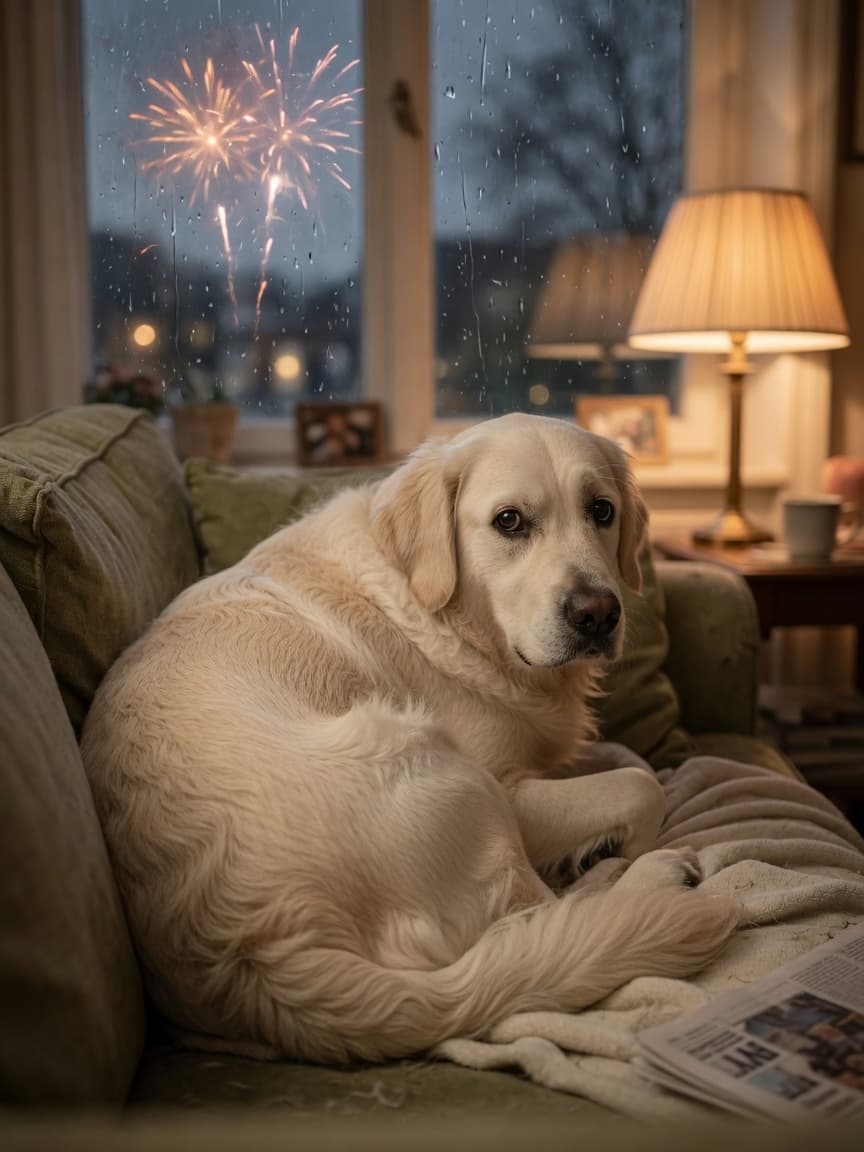
New Year's Eve & Pets: Managing Fireworks Anxiety
New Year's Eve presents a uniquely challenging scenario for pet owners. Unlike bonfire night or national holidays — which pets may have experienced enough times to form a fearful but somewhat predictable association — New Year's Eve fireworks often extend for hours on either side of midnight, in multiple locations simultaneously, with sudden bursts at unexpected intervals throughout the night. For anxious pets, there is no clear "end point" to wait out. With the right preparation, starting at least a week before, you can significantly reduce your pet's distress and start the new year on a calmer note.
Why New Year's Eve Is Particularly Stressful
Several features of New Year's Eve make it harder for pets than other firework events:
- The midnight surprise: Many owners forget to prepare in advance. Midnight arrives, the city erupts simultaneously, and a pet who was sleeping peacefully goes into immediate crisis — with no gradual build-up to allow even minimal acclimatisation.
- Prolonged duration: Unlike a bonfire display that lasts 20–30 minutes, New Year's fireworks may begin at 10pm and continue past 1am, with private displays staggered across a wide area. This sustained exposure is more exhausting for pets than a single intense event.
- Unfamiliar sounds from multiple directions: Professional displays are directional; domestic fireworks fired across a neighbourhood come from all sides simultaneously, making spatial orienting impossible and increasing disorientation.
- Owner behaviour: Owners are often out, distracted by celebrations, or hosting parties — reducing the reassuring presence pets rely on during stressful events.
Preparation the Week Before
Exercise
Ensure your dog gets a long, tiring walk well before dark on New Year's Eve — ideally by late afternoon. A physically tired dog has lower baseline arousal and recovers from stress events more easily. Do not walk dogs after dark on New Year's Eve; even early evening carries risk as informal displays begin.
Desensitisation Sounds
In the days leading up to New Year's Eve, play recordings of firework sounds at low volume during positive activities — mealtimes, playtime, relaxed cuddle sessions. This will not eliminate an existing phobia in a week, but it can reduce the shock response slightly by making the sounds fractionally more familiar. The Dogs Trust "Sounds Scary" programme and YouTube search for "firework sounds for dog desensitisation" provide suitable recordings.
Safe Space Setup
Prepare a safe room well before the evening begins so it is already a familiar, comforting environment when the fireworks start:
- Choose an interior room with limited windows — a hallway, bathroom, or ground-floor room with curtains drawn.
- Set up a den: a covered crate or a corner with blankets, your worn clothing (familiar scent), and a favourite toy.
- Run a radio or television at moderate volume — this both masks outside sounds and signals "normal home activity."
- Plug in a pheromone diffuser (Adaptil for dogs, Feliway for cats) 1–2 weeks before the event. The calming effect builds over time — a diffuser installed on December 30th provides much less benefit than one installed December 17th.
- Ensure water is available in the safe room — stressed animals pant and need to drink.
- Leave the room accessible from early evening so the animal chooses it voluntarily rather than being placed there when already stressed.
Julia's Pick: Candid Tails
For natural anxiety and stress support, Candid Tails is one of the few CBD pet brands in Europe that meets my quality criteria: every batch independently lab-tested (THC <0.3% guaranteed), formulated in compliance with EU complementary feedstuff regulations, veterinary-approved, and 4.9/5 on Google Reviews. According to the brand, their products are used in over 3,000 veterinary clinics across 10+ countries. 30-day money-back guarantee.
Pheromone Diffusers and Calming Collars
Synthetic pheromone products work by mimicking naturally occurring calming signals:
- Adaptil (DAP — Dog Appeasing Pheromone): Available as plug-in diffusers, sprays, and collars. The collar format is particularly useful on New Year's Eve as it delivers pheromones directly around the dog's head throughout the evening and into the night.
- Feliway (for cats): The classic diffuser or spray mimics the facial pheromone cats use to mark safe, familiar spaces. Spray on bedding in the safe room 15 minutes before your cat settles.
- Calming collars with botanicals: Some collars combine pheromones with lavender and chamomile essential oils. These are suitable as a complement to other measures, not a standalone solution for severe anxiety.
Calming support for New Year's night: HolistaPet calming chews and CBD tinctures provide additional natural anxiety support alongside environmental management. Start the supplement a few days before New Year's Eve for the best results, and continue through the night if needed.
Prescription Medication: Consult Your Vet in Advance
For pets with moderate to severe noise phobia, over-the-counter measures alone are often insufficient. Veterinary prescription options should be discussed and — importantly — trialled well before the event:
- Sileo (dexmedetomidine oromucosal gel): The only product specifically licensed for canine noise aversion in the EU and US. Applied to the gum before fireworks begin, it calms without causing heavy sedation. Requires a prescription and ideally a pre-event trial.
- Trazodone: An anxiolytic increasingly used in veterinary practice for situational anxiety. Must be trialled in advance to assess individual response.
- Gabapentin: Useful for generalised anxiety and pain-related anxiety; sometimes used off-label for noise phobia in conjunction with other measures.
Contact your vet in mid-December to discuss options — many practices become fully booked in the last week before New Year's Eve with anxious pet owners who left it too late.
Post-New Year's Eve: Escapees and ID Checks
New Year's Day brings a surge in lost pet reports. Panicked animals that bolted during the fireworks may have travelled long distances overnight. Before New Year's Eve:
- Confirm your pet's microchip is registered and your contact details are current — check with your microchip database provider directly.
- Ensure your pet wears a collar with a clearly readable ID tag bearing your current phone number (not a home address alone).
- Take a recent, clear photograph of your pet — full body and face — so you can circulate it quickly if needed.
- Check garden fencing and gate latches before the evening, not during a crisis at midnight.
For additional guidance on managing noise phobia in dogs, see the AVMA's noise aversion resources and the AKC's fireworks anxiety guide.
Key Takeaways
- New Year's Eve is harder than other firework events — prolonged, multi-directional, and often beginning at midnight without warning.
- Tire your dog with a long afternoon walk before dark; do not walk them after dusk on NYE.
- Set up a safe room with a den, white noise, and a pheromone diffuser installed at least 1–2 weeks in advance.
- For moderate to severe anxiety, book a vet appointment in mid-December to discuss prescription options and trial them before the event.
- Check microchip registration and ID tags before the evening — more pets go missing on New Year's Eve than almost any other night.
References
1. Storengen LM, Lingaas F. "Noise sensitivity in 17 dog breeds: prevalence, breed risk and correlation with fear in other situations." Applied Animal Behaviour Science. PMID: 25987815
2. Korpivaara M, et al. "Dexmedetomidine oromucosal gel for noise-associated acute anxiety and fear in dogs — a randomised, double-blind, placebo-controlled clinical study." Veterinary Record. PMID: 28684584