

Essential Oils & Dogs: Which Are Safe & Which Are Toxic
VERDICT: DEPENDS — with a strong caution. Many essential oils commonly found in homes are toxic to dogs. A small number may be tolerated at extreme dilution, but there are very few therapeutic scenarios where an essential oil is the best or safest option for a dog. When in doubt, consult your vet before exposing your dog to any essential oil product.
The Essential Oil Landscape for Dog Owners
Essential oils have surged in popularity over the past decade, appearing in everything from household cleaning products to pet shampoos and aromatherapy diffusers. For dog owners, this proliferation creates a genuine safety challenge: oils that smell pleasant and feel natural can cause serious harm to dogs. Understanding which oils pose the greatest risk — and why — is essential knowledge for any responsible pet owner.
Dogs metabolise aromatic compounds differently from humans, primarily through hepatic cytochrome P450 enzymes and, to a lesser extent, glucuronidation. While dogs have better glucuronidation capacity than cats, high concentrations of certain terpenoids, phenols, and ketones still overwhelm their detoxification pathways, particularly in small breeds, puppies, senior dogs, and those with liver disease.
Clearly Toxic Essential Oils for Dogs
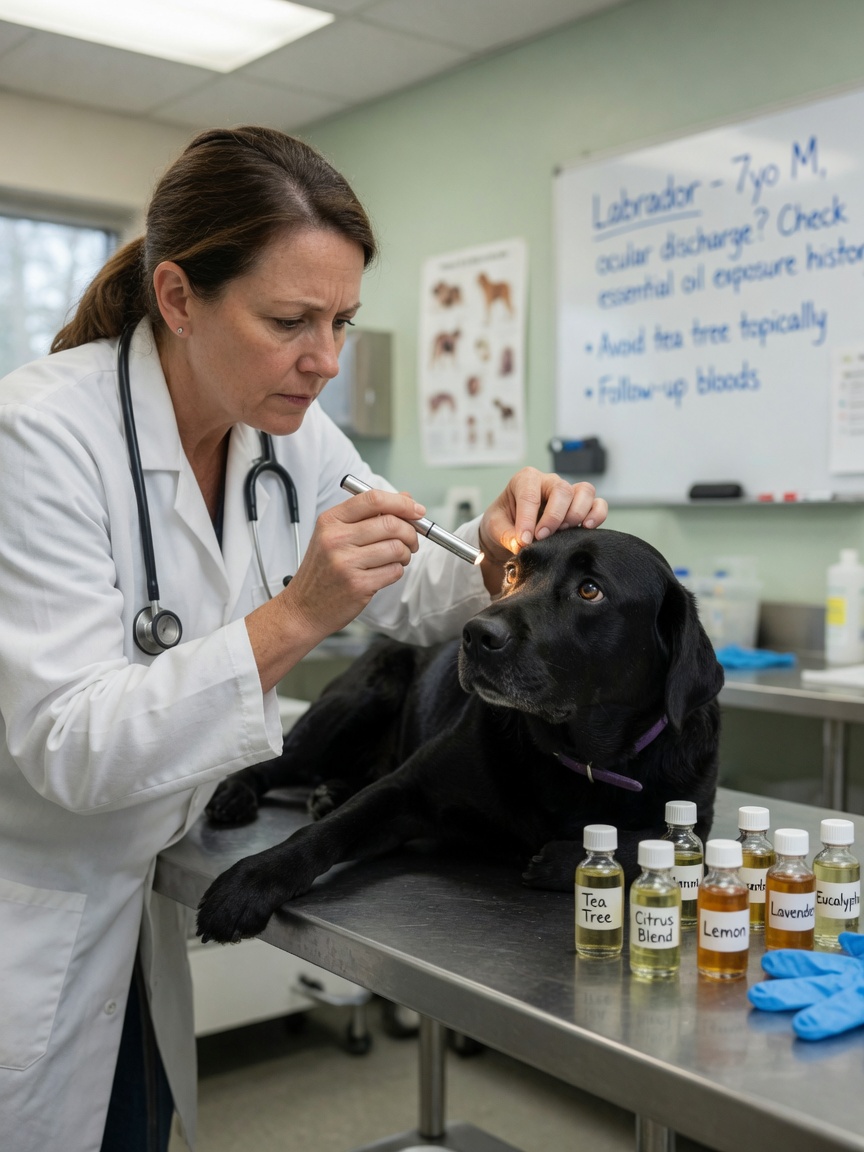
The following oils are well-documented as toxic to dogs and should never be used around them:
- Tea tree oil (Melaleuca alternifolia): Contains terpinen-4-ol and 1,8-cineole, which cause severe neurotoxicity in dogs. Even 1–2% topical solutions have caused poisoning. See our dedicated article on tea tree oil toxicity.
- Pennyroyal oil: Contains pulegone, a potent hepatotoxin. Has caused fatal liver failure in dogs even at small doses. Historically used as a flea repellent — do not use it.
- Wintergreen oil: Contains methyl salicylate at concentrations of up to 99%. Equivalent to giving your dog concentrated aspirin dermally. Causes GI bleeding and salicylate toxicity.
- Pine oil: Phenolic compounds cause GI upset, CNS depression, and kidney damage. Common in cleaning products — keep these away from dogs.
- Cinnamon oil: Causes mouth and skin burns, vomiting, and can cause dangerous drops in blood sugar at higher doses.
- Citrus oils (lemon, orange, grapefruit): D-limonene and linalool cause CNS depression, vomiting, and skin irritation. D-limonene at high concentrations is particularly concerning.
- Clove oil: Eugenol causes liver toxicity and GI irritation. Has caused deaths in cats and significant toxicity in small dogs.
- Ylang ylang: Causes vomiting, hypersalivation, weakness, and cardiac arrhythmias.
- Juniper oil: Kidney irritant; contraindicated in dogs with renal disease.
- Eucalyptus oil: 1,8-cineole causes salivation, vomiting, diarrhoea, depression, and weakness.
Essential Oils Sometimes Used in Pet Products (Lower Risk at Proper Dilution)
A few oils appear in veterinary-approved or commercially formulated pet products at concentrations well below toxic thresholds. These are not "safe" as a category — safety depends entirely on concentration, formulation, and individual dog health status:
- Lavender (diluted): At cosmetic dilutions (0.1–1%) in pet-formulated shampoos, considered low risk for most adult dogs. Not appropriate undiluted or in diffusers in enclosed spaces.
- Chamomile: German chamomile (Matricaria recutita) at low concentrations in topical formulations is generally well tolerated. Avoid Roman chamomile, which has a different compound profile.
- Frankincense: Limited veterinary literature; some holistic vets use it at very high dilution. Not independently verified as safe by mainstream veterinary toxicology bodies.
The American Veterinary Medical Association (AVMA) does not endorse essential oil use in dogs for any therapeutic purpose and recommends consulting a veterinarian before using any such products.
Concentration Is Everything
One of the most important concepts for dog owners to understand is that concentration determines toxicity. An oil that is "safe at 0.5%" becomes dangerous at 5% and potentially lethal at 50%. The problem is that most consumer essential oils are sold undiluted at 100% concentration, and instructions on how to dilute for use around pets are rarely provided.
A 2018 survey published in Topics in Companion Animal Medicine found that the majority of essential oil toxicity cases in pets involved undiluted oil applied directly to the animal or diffused in enclosed spaces for extended periods. PMID 30612740.
Diffusers: A Hidden Household Hazard
Even without direct contact, ultrasonic diffusers running toxic oils in a home with dogs represent a meaningful exposure risk. Airborne particles settle on fur and surfaces, and dogs ingest them during normal grooming. Dogs with brachycephalic (flat-faced) anatomy — Bulldogs, Pugs, French Bulldogs — are at elevated respiratory risk from aerosolised essential oils because their airways are already compromised.
BBC Health reported on the growing concern around essential oil diffusers and pet health, citing veterinary toxicologists who observed a rise in diffuser-related pet poisoning calls to poison control centres.
What to Do If Your Dog Is Exposed
If your dog has ingested, inhaled, or had skin contact with an essential oil and is showing any symptoms — drooling, vomiting, tremors, weakness, redness of skin, difficulty breathing — act immediately. Do not induce vomiting unless directed by a vet. Remove the dog from the exposure area, rinse affected skin with plain water (not soap initially), and call your vet or the ASPCA Animal Poison Control Center (US: 888-426-4435) or VPIS (UK, for vets). Take the product with you to the vet so they can identify the compounds involved.
For safe, vet-formulated dog grooming products free from harmful essential oils, Zooplus carries a broad selection of pet-safe shampoos and conditioners. Browse pet-safe grooming at Zooplus →
Key Takeaways
- Many common essential oils — tea tree, pennyroyal, wintergreen, cinnamon, clove, eucalyptus, pine — are genuinely toxic to dogs.
- A small number of oils appear in pet-formulated products at safe cosmetic dilutions; this does not mean the undiluted oil is safe.
- Concentration is the key variable: oils that are tolerable at 0.5% can be dangerous at 5% and lethal at higher concentrations.
- Diffusers in enclosed rooms expose dogs to aerosolised particles that settle on fur and are ingested during grooming.
- The AVMA does not endorse essential oil therapy for dogs — always consult your vet before use.
- If your dog shows symptoms after essential oil exposure, contact your vet immediately and bring the product.
References
- Brutlag A, Hommerding H. "Toxicology of essential oils appreciated more fully." Top Companion Anim Med. 2018;33(4):150-155. PMID 30612740
- Genovese AG, McLean MK, Khan SA. "Adverse reactions from essential oil-containing natural flea products and insecticides in dogs and cats." J Vet Emerg Crit Care. 2012;22(4):470-475. PMID 22882229