
Can Cats Eat Broccoli? Safety, Benefits, and What to Expect
Broccoli is widely celebrated as one of the most nutritious vegetables a human can eat. It is dense with vitamin C, vitamin K, folate, fiber, and antioxidant compounds. So when a cat decides to bat a broccoli floret off your plate and take a few nibbles, it is natural to wonder: is this fine? And is my cat accidentally doing something healthy?
The answer to the first question is largely yes. The answer to the second is largely no — at least not in any meaningful way. Here is the full picture.
Is Broccoli Safe for Cats?
Broccoli does not appear on any established list of feline toxins. It is not in the same category as onion, garlic, grapes, raisins, or xylitol — all of which are genuinely dangerous to cats. The ASPCA's Animal Poison Control database does not list broccoli as a toxic plant for cats. In small quantities, it is considered safe for feline consumption.
That said, "not toxic" is different from "beneficial." And "safe in small amounts" is different from "safe in large amounts." Broccoli, like many vegetables, contains fiber and plant compounds that the feline digestive system handles imperfectly — more on that shortly.
Why Cats Gain Little From Broccoli Nutritionally
Cats are obligate carnivores. This biological classification means that their digestive systems, metabolic pathways, and nutritional requirements evolved around the consumption of animal prey. Several features of this biology make broccoli nutritionally irrelevant to cats:
- Vitamin C synthesis: Broccoli is famous for its vitamin C content. Cats synthesize their own vitamin C endogenously in the liver. They do not need — and cannot meaningfully benefit from — dietary vitamin C from plant sources.
- Beta-carotene limitations: Broccoli contains some beta-carotene, but as with carrots, cats lack sufficient levels of the enzyme needed to convert beta-carotene into usable vitamin A. They require preformed vitamin A from animal sources, particularly liver.
- Fiber metabolism: Cats have a shorter gastrointestinal tract than omnivores and limited capacity to ferment plant fiber. Some fiber passes through undigested. This is not harmful in small doses, but it does mean the fiber in broccoli is not contributing to feline health the way it contributes to human health.
- Carbohydrate digestion: Cats have low salivary amylase activity and reduced pancreatic amylase compared to omnivores — both enzymes are needed to break down plant starches. Broccoli is relatively low in starch, but the general limitation remains: plant-derived carbohydrates are not what the feline digestive system is optimized for.
Why Some Cats Like Broccoli
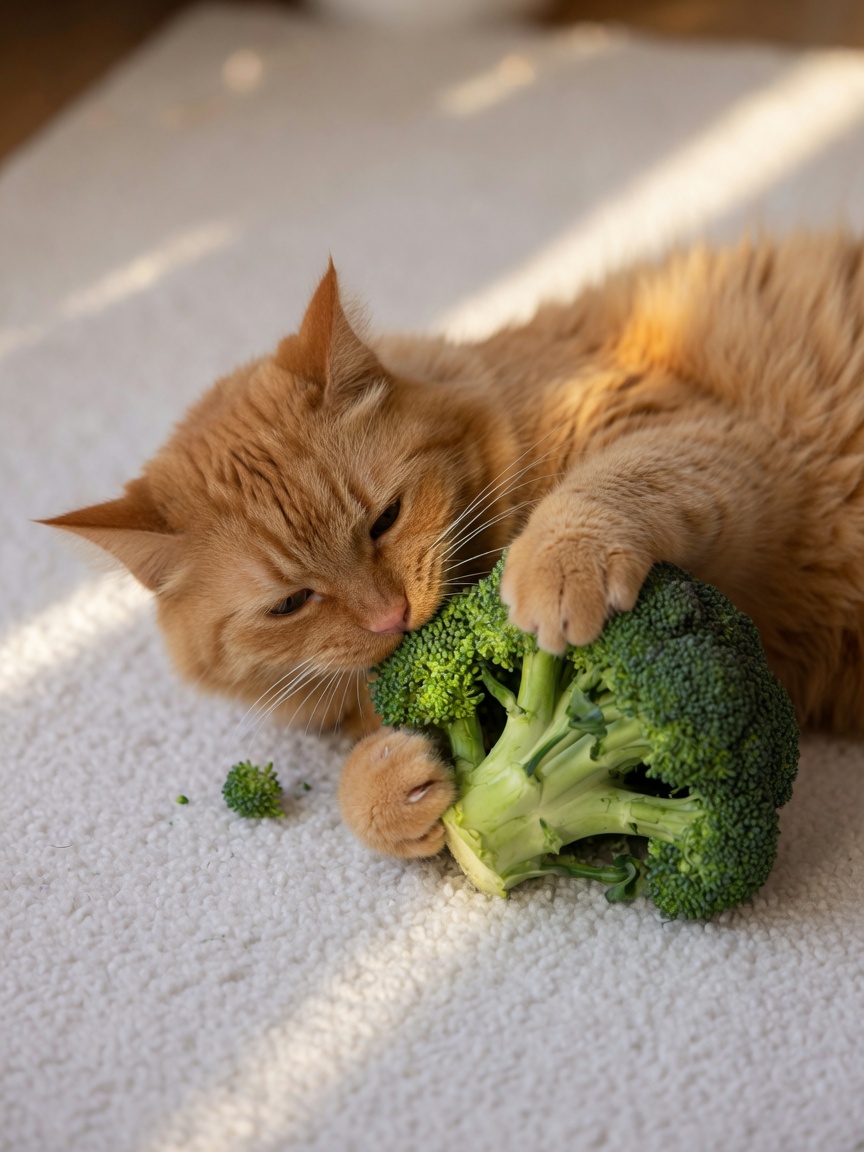
It is genuinely curious that some cats show interest in broccoli — especially since cats lack functional sweet taste receptors and should theoretically have little incentive to seek out plant matter. A few factors may explain this behavior:
- Texture appeal: The bumpy, fibrous texture of a broccoli floret may be interesting to chew on, functioning almost like a toy as much as food.
- Grass-like associations: Cats that enjoy eating grass sometimes extend that interest to other plant material. The experience of chewing on plant fiber may provide mild digestive relief or simply be self-stimulating behavior.
- Curiosity: Cats investigate their environment with their mouths. A novel object on the floor or table will often get a lick or nibble regardless of nutritional content.
None of these reasons suggest that a cat craving broccoli is trying to meet a nutritional need. More likely, it is textural novelty or behavioral interest.
Ver alimentos para gatos en Zooplus →The Risk of Too Much Broccoli
While a small amount of broccoli is safe, too much can cause problems. Broccoli belongs to the Brassica family — alongside cabbage, cauliflower, and Brussels sprouts — a group of vegetables known for containing compounds called glucosinolates. In large quantities, glucosinolates can interfere with thyroid function by inhibiting iodine uptake, though this is primarily a concern with very large, sustained dietary exposure rather than an occasional small piece.
More commonly, the high fiber content of broccoli causes digestive upset in cats when offered in excess. Symptoms include:
- Flatulence and gas
- Bloating and abdominal discomfort
- Loose stools or diarrhea
- Vomiting (in sensitive individuals)
These symptoms typically resolve once broccoli is removed from the diet. If they persist beyond 24 hours, consult your veterinarian.
Raw vs. Cooked Broccoli for Cats
Cooked broccoli is the safer choice. Cooking softens the fibrous cell walls, making it easier for a cat's limited plant-digestion capacity to process. It also reduces the concentration of glucosinolates somewhat. Steam or boil broccoli with no added salt, butter, garlic, onion, or any seasoning. Plain and soft is the goal.
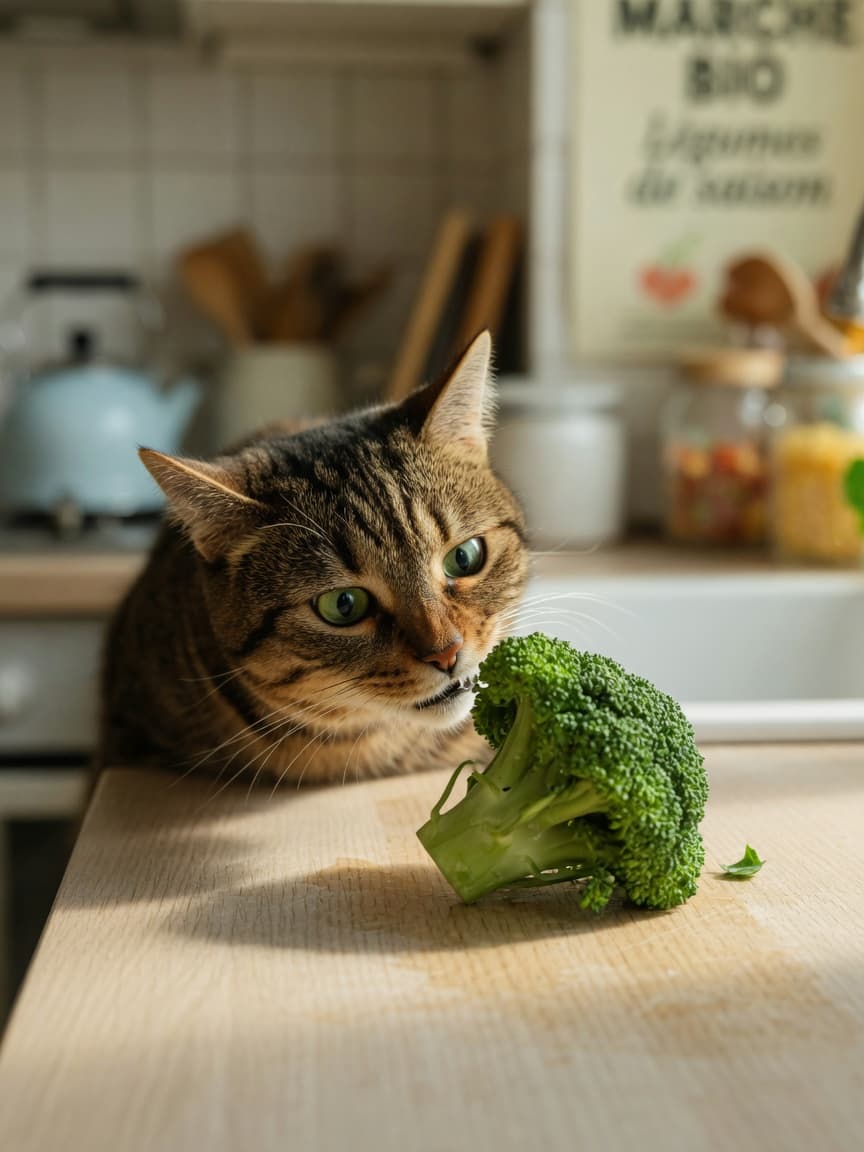
Raw broccoli is not toxic, but it is harder to digest and the firmer texture could be a mild choking risk for small or older cats. If your cat grabs a raw broccoli floret off the counter, one small bite is not an emergency — but it is not the recommended serving method.
How Much Is Appropriate?
If you choose to offer broccoli to your cat, keep it very small — a single floret or even a portion of one, offered occasionally and not as a regular feature of the diet. Treats of all kinds should not exceed 10% of a cat's total daily caloric intake. The primary nutrition source should always be a complete, balanced commercial cat food that meets AAFCO nutritional standards for cats.
Broccoli is best understood as a low-risk curiosity food for the small subset of cats that enjoy it — not as a health supplement, and certainly not as a replacement for any component of a proper feline diet.
What Cats Actually Need Instead
The vitamins and minerals that broccoli is celebrated for providing to humans are obtained by cats through an entirely different route: animal tissue. Liver provides preformed vitamin A and B vitamins. Meat provides taurine, B12, zinc, and iron. Fish provides omega-3 fatty acids. A high-quality commercial cat food integrates all of these in correctly calibrated ratios — something no single vegetable or even combination of vegetables can replicate for an obligate carnivore.
If you are concerned about whether your cat is getting adequate nutrition, the answer is not to add vegetables — it is to evaluate the quality of the commercial diet you are feeding. Look for foods with named meat proteins as the first ingredient, formulated to AAFCO complete and balanced standards.
- Broccoli is not toxic to cats; a small piece of plain cooked broccoli is safe.
- Some cats enjoy the texture of broccoli, but this is curiosity — not a nutritional signal.
- Cooked broccoli is preferred over raw; it is easier to digest and softer to chew.
- Too much broccoli causes gas, bloating, and digestive upset in cats.
- Broccoli's main nutrients (vitamin C, beta-carotene) are not meaningfully available to cats due to their obligate carnivore metabolism.
- Cats are obligate carnivores — plant foods like broccoli are non-essential and nutritionally marginal at best.
- A balanced commercial cat food provides everything cats need; vegetables are not a supplement cats require.
References
- Morris JG. "Idiosyncratic nutrient requirements of cats appear to be diet-induced evolutionary adaptations." Nutr Res Rev. 2002;15(1):153-68. PMID: 19087395
- Verbrugghe A, Bakovic M. "Peculiarities of one-carbon metabolism in the strict carnivore, the domestic cat." Nutrients. 2013;5(7):2811-35. PMID: 23873295
- Plantinga EA, Bosch G, Hendriks WH. "Estimation of the dietary nutrient profile of free-roaming feral cats: possible implications for nutrition of domestic cats." Br J Nutr. 2011;106 Suppl 1:S35-48. PMID: 22005436