
Aquarium Water Quality: pH, Ammonia, Nitrite & Nitrate Explained
By Julia Wrenfield, Pet Wellness Researcher
Most fish deaths blamed on "unknown causes" have a measurable, preventable explanation sitting in the water chemistry. Fish do not fall ill randomly — their immune systems, organ function, and gill respiration all depend on specific water conditions remaining within tight tolerances. When those conditions drift, fish become vulnerable to pathogens that would otherwise cause no disease at all. This guide explains the critical water quality parameters, what they mean biologically, and precisely what to do when your readings go wrong.
The Nitrogen Cycle: The Foundation of Every Aquarium
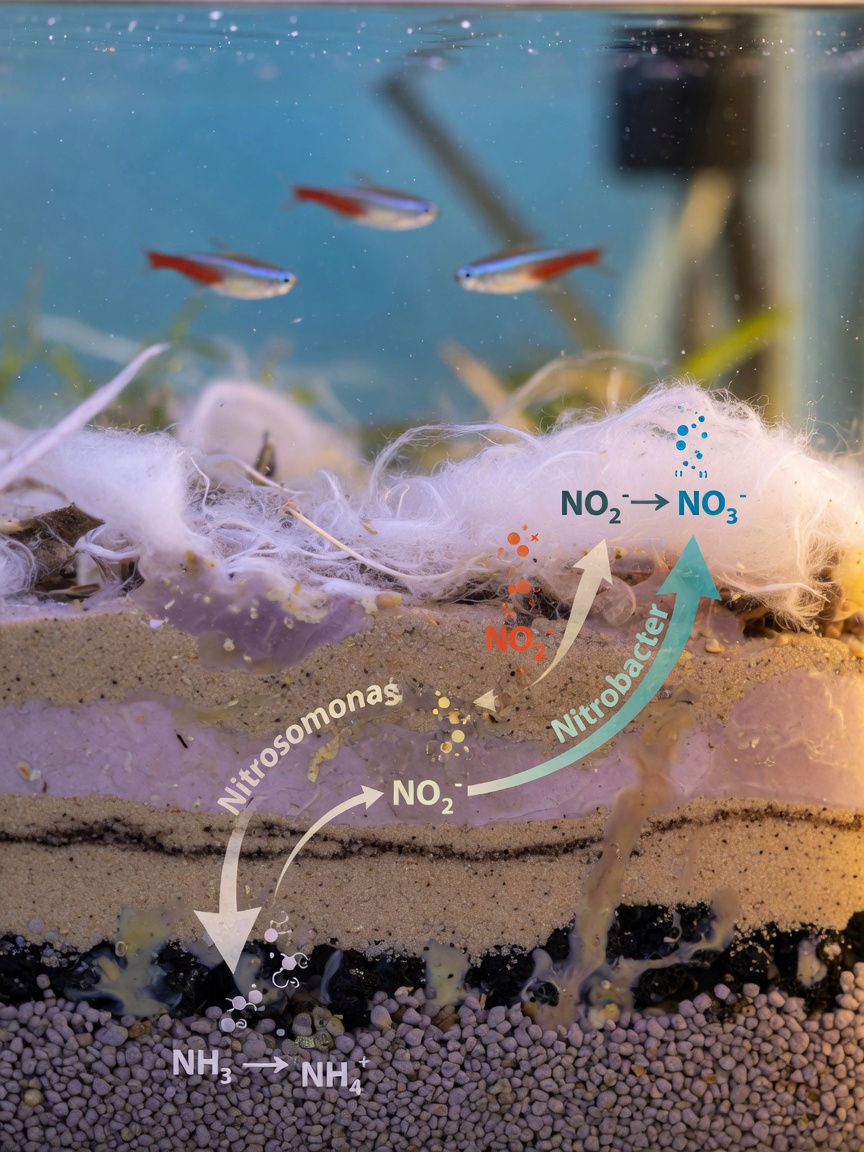
Before discussing individual parameters, it is essential to understand the nitrogen cycle — the biological process that makes aquarium keeping viable at all.
Fish excrete ammonia through their gills as a byproduct of protein metabolism. Decomposing uneaten food and waste also produce ammonia. In a new, uncycled aquarium, this ammonia accumulates with nothing to break it down. Enter Nitrosomonas bacteria: these autotrophic microorganisms colonize filter media and substrate and oxidize ammonia (NH₃) into nitrite (NO₂⁻). Nitrite is itself highly toxic to fish. A second bacterial group, Nitrospira (previously attributed to Nitrobacter), then oxidizes nitrite into nitrate (NO₃⁻) — relatively harmless at low concentrations and managed through regular water changes.
A fully cycled aquarium maintains ammonia at 0 ppm, nitrite at 0 ppm, and accumulates nitrate slowly between water changes. Establishing this cycle takes 4–8 weeks in a new tank, or 1–2 weeks when seeded with established filter media or bacterial cultures. No fish should be added before the cycle completes, and no antibiotic should ever be used in a main display tank, as it destroys the bacterial colonies that make the system work.
Ammonia: The Most Urgent Parameter
Ammonia exists in two forms in aquarium water: ionized ammonium (NH₄⁺), which is relatively benign, and un-ionized ammonia (NH₃), which is acutely toxic. The ratio between these forms is determined almost entirely by pH and temperature: higher pH and higher temperature shift the equilibrium toward the toxic NH₃ form.
This is why a reading of "0.5 ppm total ammonia" means something very different in a cichlid tank at pH 8.0 (dangerous) versus a soft-water community tank at pH 6.5 (manageable). Online calculators — or the Seachem ammonia alert card — can tell you what fraction of your total ammonia reading is the toxic form.
Target: 0 ppm in all established aquariums. Any detectable ammonia in a cycled tank signals a problem: overfeeding, a dead fish, an overstocked tank, or a crashed nitrogen cycle.
What to do when ammonia is elevated: Perform a 25–30% water change immediately to dilute the concentration. Do not feed for 24–48 hours. Identify and remove the source (dead animal, excessive uneaten food). Add a commercial ammonia detoxifier such as Seachem Prime, which converts ammonia to a non-toxic form that your bacteria can still process. Test daily until readings return to 0 ppm.
Nitrite: The Forgotten Danger
New aquarists often watch ammonia carefully and assume that once it drops, the danger is over. But the ammonia spike is followed by a nitrite spike as Nitrosomonas bacteria establish before Nitrospira catch up. Nitrite toxicity in fish causes methemoglobinemia — it converts haemoglobin to methemoglobin, which cannot carry oxygen. Fish in high-nitrite water effectively suffocate even in well-oxygenated water. Symptoms include gasping at the surface, lethargy, and reddened gills.
Target: 0 ppm in established tanks.
What to do when nitrite is elevated: Water changes are the primary tool — dilute the concentration and give the bacterial colony time to process the load. Adding aquarium salt (sodium chloride) at 1–3 g/L raises chloride levels, which competitively inhibits nitrite uptake through fish gill cells. This buys time during a cycle or a cycle crash without harming the fish further. Do not overstock or overfeed while nitrite is present.
Nitrate: Slow but Not Harmless
Nitrate is the end product of the nitrogen cycle and is commonly presented as harmless. This is a simplification that causes long-term problems. Chronic nitrate exposure at concentrations above 40–50 ppm in freshwater fish has been documented to impair immune function, reduce reproductive success, affect larval development, and cause "head and lateral line erosion" (HLLE) in certain species. Elevated nitrate also promotes algae growth and degrades water quality in ways that compound over time.
Target: Below 20 ppm for sensitive species (discus, wild-caught fish, most marine fish); below 40 ppm for hardier community fish; below 10 ppm for freshwater shrimp.
How to manage nitrate: Regular water changes are the primary method — a 25–30% weekly change is the standard recommendation for most community tanks. Live plants consume nitrate as fertilizer; a well-planted tank with fast-growing plants like hornwort, water sprite, or val can maintain near-zero nitrate without chemical intervention. Nitrate-removing filter media exists but is an adjunct, not a substitute, for water changes.
pH: Not a Single Number
pH measures the acidity or alkalinity of water on a logarithmic scale from 0 to 14, with 7 being neutral. Each unit represents a tenfold difference: pH 6 is ten times more acidic than pH 7. Most freshwater fish tolerate a range of 6.5–8.0, but the optimal range varies significantly by species.
Species-specific targets:
- South American fish (tetras, discus, corydoras, angelfish): pH 6.0–7.0
- African Rift Lake cichlids (Malawi, Tanganyika): pH 7.8–8.5
- Goldfish, livebearers (mollies, guppies, platies): pH 7.0–7.8
- Bettas: pH 6.5–7.5
- Marine/reef aquariums: pH 8.1–8.4
Stability matters more than precision. A fish adapted to pH 7.0 can generally tolerate pH 6.8 or 7.2 without ill effects. The same fish will be severely stressed by a swing from 7.0 to 8.0 over 24 hours. pH fluctuations are often caused by CO₂ changes across day and night cycles, especially in planted tanks — if your pH varies by more than 0.5 units between morning and evening, aeration should be increased.
Adjusting pH: Use specific buffers rather than adding chemicals arbitrarily. For soft, acidic water, peat filtration or Indian almond leaves lower pH gently and add beneficial tannins. For alkaline water, crushed coral or aragonite substrate raises pH and buffers it stably. Avoid products marketed as "pH Up" or "pH Down" — they cause rapid, unstable swings that stress fish.
Testing: Equipment That Actually Works
The difference between liquid test kits and paper test strips is not a matter of preference — it is a matter of accuracy. Multiple comparative studies have found that dip strips underperform liquid reagent kits significantly, particularly for ammonia and nitrite readings. The API Freshwater Master Test Kit remains the standard recommendation in the hobby because it provides accurate readings at reasonable cost and tests ammonia, nitrite, nitrate, and pH with a single kit.
Test your water in these circumstances: every week during the first three months of a new tank; any time a fish shows signs of illness; after adding new fish or changing feeding habits; after any medication course (some medications crash the nitrogen cycle); and any time you notice algae blooms or unusual odour.
When Parameters Go Wrong: A Quick-Reference Protocol
When test results show elevated parameters: perform a 25–30% water change, do not feed for 24 hours, add Seachem Prime or equivalent detoxifier, identify and remove the likely cause, and retest after 24 hours. Repeat water changes daily until all parameters return to target. If ammonia or nitrite remains elevated after two days of this protocol, the biological filter may have crashed — re-seeding with bottled bacteria or media from an established tank is required.
Key Takeaways
- The nitrogen cycle — ammonia → nitrite → nitrate — is the biological foundation of every aquarium; establish it before adding fish.
- Ammonia toxicity increases significantly with pH; the same reading is far more dangerous in alkaline water.
- Nitrite causes fish to suffocate even in oxygenated water — treat nitrite spikes as emergencies requiring immediate water changes and salt addition.
- Nitrate is not harmless; keep it below 20–40 ppm with regular water changes or live plants.
- Match pH to your fish species, but prioritize stability over precision — swings are more dangerous than a reading slightly outside the ideal range.
- Use liquid test kits, not strips — accuracy matters when you're diagnosing problems that can kill fish within hours.
- Water changes are the universal first response to any elevated parameter; detoxifiers buy time but do not replace filtration.
References
- Camargo JA, Alonso A. "Ecological and toxicological effects of inorganic nitrogen pollution in aquatic ecosystems: A global assessment." Environment International. 2006;32(6):831–849. PMID: 16781774
- Hargreaves JA, Tucker CS. "Managing ammonia in fish ponds." USDA Southern Regional Aquaculture Center Fact Sheet No. 4603; 2004. [Foundational applied aquaculture reference on ammonia speciation and management; widely cited in ichthyology and fishkeeping literature]