
Tropical Fish for Beginners: 10 Hardy Species & Tank Setup
By Julia Wrenfield, Pet Wellness Researcher
Tropical fish are one of the most rewarding pets you can keep, but the hobby has a steep learning curve when you start with the wrong species or skip the science behind water chemistry. This guide covers ten genuinely hardy species that tolerate beginner mistakes, plus the tank setup essentials that make the difference between a thriving aquarium and a frustrating string of unexplained deaths.
The 10 Best Tropical Fish for Beginners
1. Guppy (Poecilia reticulata)
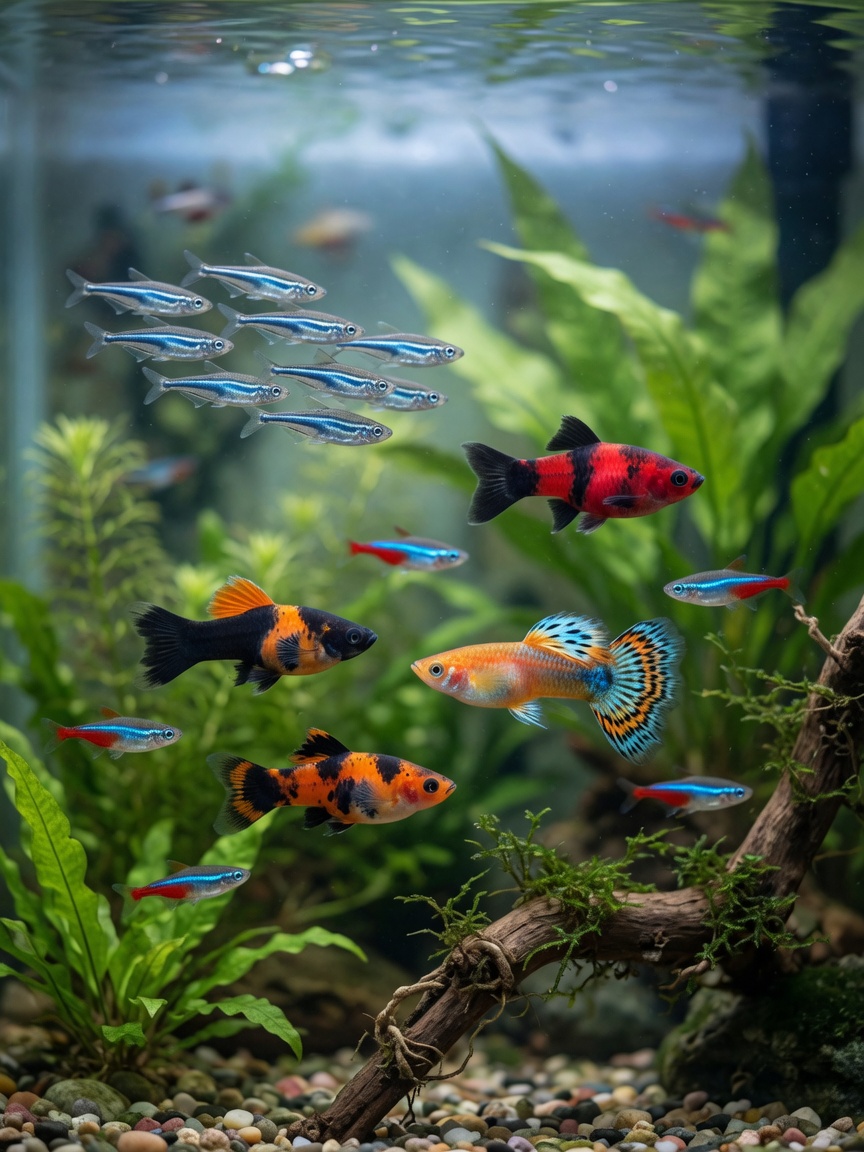
Guppies are livebearers that tolerate a wide pH range (6.8–7.8) and temperatures from 22–28°C. Males display brilliant color variations; females are larger and plainer. They breed prolifically — if you mix sexes, expect fry within weeks. A ratio of one male to two or three females reduces harassment stress.
2. Molly (Poecilia sphenops)
Mollies are adaptable livebearers that actually tolerate slightly brackish water, making them unusually forgiving of elevated mineral content. Black mollies, dalmatian mollies, and balloon mollies are all the same species in different dress. They need vegetable matter in their diet — algae wafers or blanched spinach prevent intestinal issues common in mollies fed pure protein diets.
3. Platy (Xiphophorus maculatus)
Platies may be the single most beginner-proof tropical fish available. They tolerate temperatures as low as 18°C in a pinch, accept virtually any quality flake food, and coexist peacefully with almost every community fish. Sunset platies, mickey mouse platies, and wagtail platies are all color morphs of the same species.
4. Zebra Danio (Danio rerio)
Zebra danios are fast-moving schooling fish that thrive in groups of six or more. They are one of the few tropical species that can handle unheated tanks in warm climates (tolerate 15–28°C), which makes them useful as "cycling fish" for establishing a new aquarium's bacterial colony — though fishless cycling with ammonia is more humane.
5. Neon Tetra (Paracheirodon innesi)
Neon tetras are often sold to beginners but deserve a caveat: they are sensitive to ammonia spikes and should only enter a fully cycled tank. Once established, however, they are hardy and stunning. Keep them in groups of ten or more for natural schooling behavior and lower stress. They prefer soft, slightly acidic water (pH 6.0–7.0).
6. Corydoras Catfish (Corydoras spp.)
Corydoras are armored bottom-dwellers that perform genuine tank maintenance by consuming uneaten food before it decomposes. They are social animals and must be kept in groups of at least six of the same species. Corydoras paleatus (peppered cory) and Corydoras aeneus (bronze cory) are the most widely available and tolerant of a range of water conditions.
7. Cherry Barb (Puntius titteya)
Unlike their cousin the tiger barb — which is notorious for fin-nipping — cherry barbs are peaceful, jewel-colored fish ideal for community tanks. Males turn an intense crimson when breeding. They prefer tanks with plant cover, which reduces stress and brings out their best color. A group of eight to ten looks spectacular.
8. Betta (Betta splendens)
Bettas are magnificent fish, but come with rules: male bettas cannot coexist with other male bettas, and should not share a tank with fin-nipping species or anything with flowing fins they might mistake for a rival. A single male betta in a planted tank of 20 liters or more, with a gentle filter and a heater set to 26°C, is an ideal beginner setup. Contrary to popular myth, bettas do not thrive in bowls or vases — they need filtration and heating like any tropical fish.
9. Swordtail (Xiphophorus helleri)
Swordtails are livebearers closely related to platies and nearly as hardy. Males have the distinctive elongated lower tail fin. They are active swimmers and appreciate tanks of at least 80 liters. Keep more females than males to prevent harassment, and expect fry regularly if you mix sexes.
10. Harlequin Rasbora (Trigonostigma heteromorpha)
Harlequin rasboras are peaceful schooling fish with a distinctive black triangle on their flanks. They are excellent dither fish — their confident movement in open water encourages shyer species to come out from hiding. They prefer soft, warm water (25–28°C) and groups of eight or more.
Essential Tank Setup for Tropical Fish
Tank Size
Bigger is more stable. A 60-liter (roughly 60x30x30 cm) tank is a realistic minimum for a beginner community of five to eight small fish. Smaller tanks experience temperature swings and ammonia spikes far more rapidly, leaving you almost no time to correct problems before fish are already stressed.
Filtration
A filter does two things: it moves water (oxygenation) and it houses beneficial bacteria that convert toxic ammonia into less harmful nitrate. For beginners, a hang-on-back (HOB) filter rated for at least twice your tank volume is a practical choice. Internal sponge filters are quieter and cheaper, and are excellent for betta tanks or fry tanks where gentle flow matters.
Heating
Most tropical fish require 24–27°C. A submersible heater with a built-in thermostat, rated at 1 watt per liter, is sufficient for most setups. Always use a separate thermometer to verify the heater is accurate — factory calibration is not always reliable.
The Nitrogen Cycle
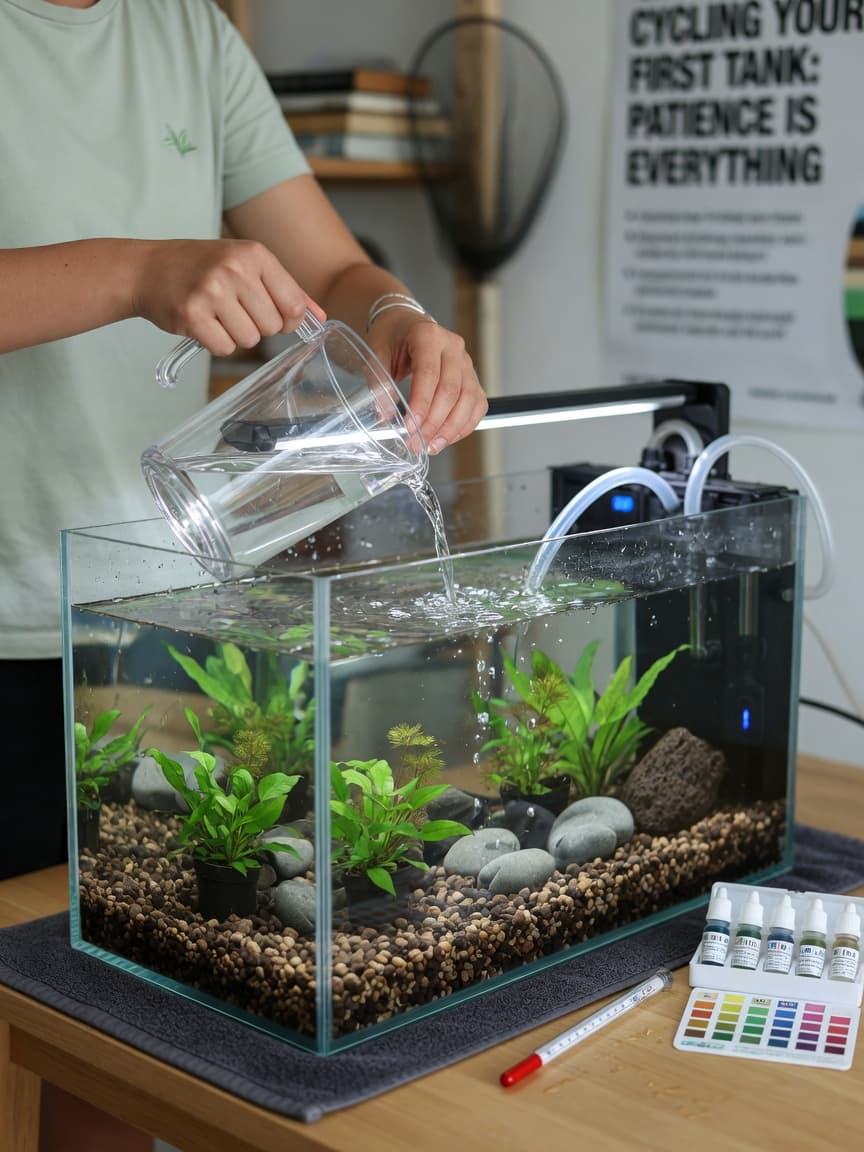
This is non-negotiable. Ammonia from fish waste is toxic. Beneficial bacteria (primarily Nitrosomonas and Nitrobacter species) colonize your filter media and convert ammonia to nitrite, then nitrite to nitrate. Nitrate is far less toxic and is removed by water changes. Cycling a tank takes 3–6 weeks. You can test progress with a liquid test kit (not test strips, which are less reliable). Ammonia and nitrite should both read zero before fish are added.
Stocking Rules
The old "one inch of fish per gallon" rule is too simplistic — a six-inch goldfish produces far more waste than six one-inch tetras. Better guidelines: stock slowly (add only a few fish at a time and wait two weeks between additions), prioritize fish from similar water chemistry requirements, and do a 25–30% water change every week regardless of how clear the water looks. Clear water is not necessarily clean water — nitrate is invisible.
A quality starter kit with filter, heater, and lighting makes the setup process significantly more straightforward. Browse complete aquarium starter kits — including nano tanks ideal for bettas and species-only setups — at Zooplus:
Shop Aquarium Starter Kits at Zooplus
Key Takeaways
- Always cycle your tank before adding fish — 3 to 6 weeks, or use a bacterial starter product.
- Platies, guppies, and corydoras are the most forgiving species for true beginners.
- Neon tetras and bettas are beautiful but require a mature, stable tank — not a brand-new setup.
- A hang-on-back filter rated for 2x your tank volume and a reliable submersible heater are your two most important equipment purchases.
- Weekly 25–30% water changes are more important than any additive or supplement.
- Stock slowly: add a few fish, wait two weeks, test water, then add more.
References
- Helfman GS, et al. "The Diversity of Fishes: Biology, Evolution, and Ecology." Wiley-Blackwell, 2009. Related aquaculture research: PMID 19791798.
- Timmons MB, Ebeling JM. "Recirculating Aquaculture." Cayuga Aqua Ventures, 2010. Nitrogen cycle dynamics in closed aquatic systems: PMID 22301058.