

Mange in Dogs: Types, Symptoms & Treatment Options
Mange is a skin disease caused by mite infestation — but that simple description barely captures how distressing and disruptive this condition can be for affected dogs and their owners. Intense itching, progressive hair loss, painful skin damage, and in some cases serious systemic implications make mange one of the more challenging skin conditions in veterinary medicine. Making matters more complex, there are two fundamentally different forms of mange seen in dogs, caused by entirely different mite species, with different contagion risks, different underlying mechanisms, and different treatment requirements. Understanding the distinction is not just academic — getting the diagnosis right is the foundation of effective treatment.
Two Types of Mange: An Essential Distinction
The two forms of mange encountered in dogs are sarcoptic mange and demodectic mange. They are caused by different mite species, behave very differently in the body and environment, and carry very different implications for the dog's household and other animals. Many owners — and even some general-interest sources — conflate the two, which leads to dangerous confusion about contagion risk and treatment choice.
Sarcoptic Mange (Scabies): Highly Contagious and Zoonotic
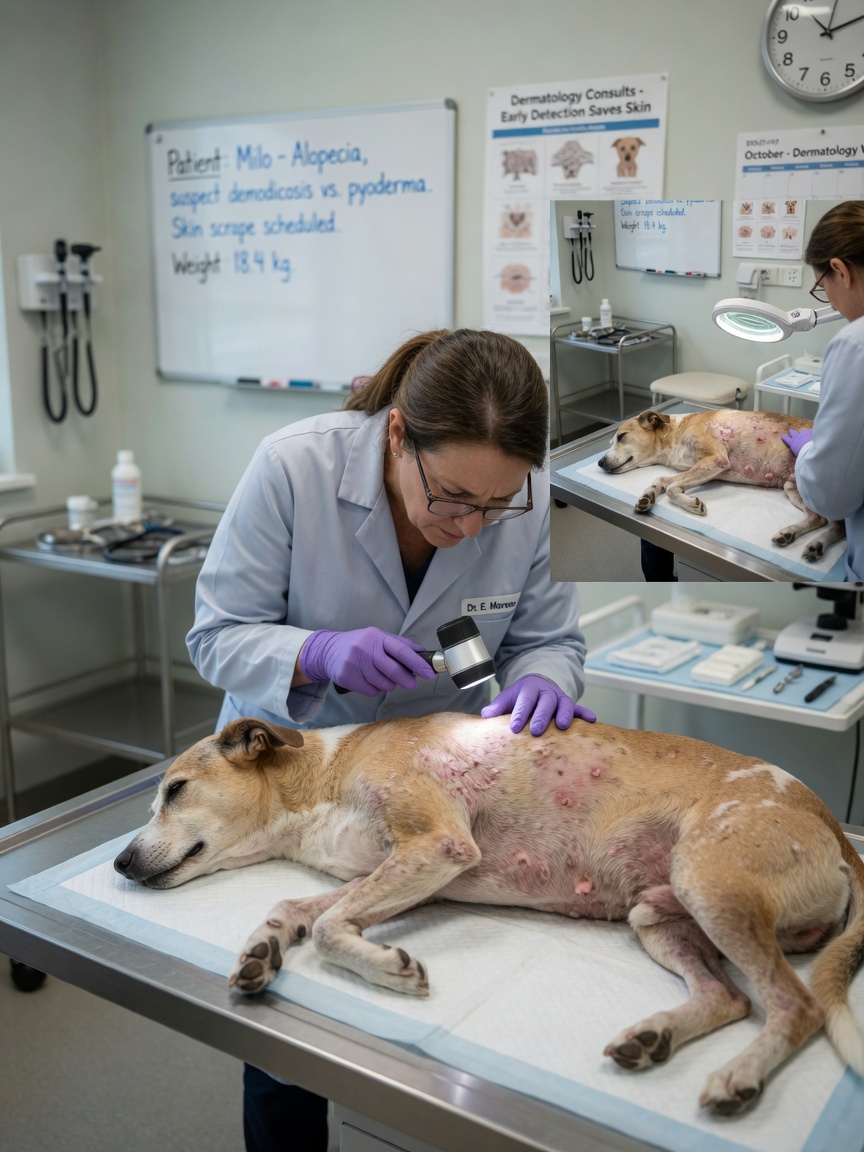
Sarcoptic mange is caused by Sarcoptes scabiei var. canis — a microscopic, eight-legged mite that burrows into the superficial layers of the skin to lay its eggs. The entire life cycle, from egg to adult, takes approximately 17 to 21 days and occurs in or on the host's skin. The mites' burrowing activity, combined with an intense immune hypersensitivity reaction to mite proteins, faecal matter, and eggs, causes the characteristic extreme pruritus (itching) that defines the condition.
Transmission and Zoonotic Risk
Sarcoptic mange is one of the most contagious skin conditions in dogs. Direct contact with an infected animal is the primary route of transmission. Mites can also survive off a host for 24 to 36 hours in the environment, meaning indirect transmission via shared bedding, grooming equipment, or contaminated spaces is possible. Dogs frequently acquire sarcoptic mange from wildlife — foxes are a particularly common source — as well as from dog parks, grooming facilities, or other infected dogs.
Critically, sarcoptic mange is a zoonotic disease, meaning it can be transmitted from dogs to humans. Human infestation causes intensely itchy, red, papular rashes, typically appearing on the arms, waist, and areas of skin contact with the affected dog. The dog-adapted and human-adapted variants of Sarcoptes scabiei show some host preference — the mites do not complete a full reproductive cycle on human skin, so human infestation is self-limiting once the dog is treated. However, the itching is real and distressing and requires medical attention. If members of your household develop an unexplained itchy rash while your dog is symptomatic, consult a physician promptly and inform them of the animal diagnosis. Other pets — cats, rabbits, and additional dogs — can also be affected and should be assessed and treated concurrently.
Symptoms of Sarcoptic Mange
The dominant symptom is intense, relentless pruritus — itching so severe that it is often described as all-consuming. Affected dogs may be scratching, biting, rubbing, and shaking almost constantly, to the point of disrupting sleep and normal activity. This level of itching, disproportionately severe relative to the visible skin changes in early stages, is itself an important diagnostic clue.
Lesions typically begin at the ear margins, elbows, hocks (ankles), and ventral (under) abdomen — areas with less dense fur and more direct skin contact. As infestation progresses, changes spread to cover larger body areas and include red, inflamed skin with small papules and crusts; patchy hair loss; thickened, hardened skin in chronic cases; and excoriations (scratch wounds) that can become secondarily infected with bacteria. A useful clinical sign known as the pinnal-pedal reflex — where rubbing the ear margin triggers an automatic scratching motion of the hind leg — is considered a reliable indicator of sarcoptic mange when present.
Diagnosis and Treatment of Sarcoptic Mange
Diagnosis is attempted through skin scraping and microscopic examination, but the mites are notoriously difficult to find; sensitivity is reported as low as 20–50%. A negative scraping does not rule out sarcoptic mange. Many veterinarians make a clinical diagnosis based on symptoms, exposure history, and response to treatment.
Treatment has been transformed by the isoxazoline class of parasiticides — fluralaner (Bravecto), afoxolaner (NexGard), sarolaner (Simparica), and lotilaner (Credelio). These oral medications, originally developed for flea and tick control, are highly effective against sarcoptic mange mites, typically resolving infestations within four to eight weeks. They are prescription medications requiring veterinary authorisation. Older options include injectable or topical ivermectin, selamectin (Revolution), and medicated lime sulfur or amitraz baths. All in-contact animals should be treated simultaneously. Bedding, grooming tools, and soft furnishings should be washed in hot water and, where possible, treated with an appropriate environmental miticide product.
Demodectic Mange (Demodicosis): Not Contagious, But Not Simple
Demodectic mange is caused by Demodex canis — a cigar-shaped mite that lives naturally in the hair follicles and sebaceous glands of the skin. Unlike Sarcoptes, Demodex mites are part of the normal canine skin microbiome. Small numbers of these mites are present on virtually all healthy dogs without causing any disease whatsoever. Demodectic mange develops when these normally harmless mites proliferate to pathological numbers — a situation that is invariably linked to immune dysfunction.
Why Demodicosis Is Not Contagious
Because Demodex canis is present on healthy dogs without causing illness, and because the primary route of transmission is direct contact between a nursing mother and her newborn puppies in the first days of life, demodectic mange does not spread between dogs during normal household interaction. A dog with demodicosis poses no contagion risk to other healthy animals in the home with normal immune function — and poses absolutely no zoonotic risk to humans. This is a fundamental difference from sarcoptic mange and one that dramatically changes the management approach.
Localised vs. Generalised Demodicosis
Demodectic mange is classified as either localised or generalised, with important differences in severity, prognosis, and what the condition signals about the dog's health.
Localised demodicosis typically affects young dogs between three months and two years of age. It presents as one to several small, clearly defined patches of alopecia (hair loss), mild scaling, and slight redness — usually on the face around the muzzle or eyes, or on the forelegs. Pruritus is typically mild or absent, which distinguishes it sharply from sarcoptic mange. Localised demodicosis often resolves spontaneously as the young dog's immune system matures. Monitoring without treatment may be appropriate in mild cases, though treatment can accelerate resolution.
Generalised demodicosis is defined by more than five lesions, involvement of an entire body region, or pododemodicosis (involvement of the feet — a notoriously treatment-resistant form). This is a more serious diagnosis carrying a more guarded prognosis and requiring active, sustained treatment. In young dogs, generalised demodicosis may reflect a genetic predisposition to inadequate immune control of mite populations. In adult or senior dogs, however, new-onset generalised demodicosis is a red flag for an underlying systemic illness suppressing immunity — including hypothyroidism, Cushing's disease, cancer, or immunosuppressive drug therapy. Identifying and treating any underlying condition is a critical and non-negotiable part of managing adult-onset generalised demodicosis.
Symptoms and Diagnosis of Demodectic Mange
The primary visible signs of demodicosis are patchy hair loss, scaling, and skin changes — often with minimal itching in uncomplicated cases. Comedones (blackheads) form as affected follicles become blocked. In generalised cases, widespread lesions, thickened and hyperpigmented skin, secondary bacterial folliculitis, and swollen lymph nodes may all be present. Pododemodicosis causes painful swelling and redness between the toes.
Diagnosis is made by deep skin scraping with microscopic examination. Unlike sarcoptic mange, Demodex mites are relatively straightforward to find on properly performed scrapings. The isoxazoline parasiticides (Bravecto, NexGard, Simparica, Credelio) are now the standard of care for generalised demodicosis, offering high efficacy over a course of several months. Treatment is continued until two consecutive monthly skin scrapings confirm complete resolution — stopping early based on appearance alone is a common cause of relapse.
Key Takeaways
- Sarcoptic mange is caused by Sarcoptes scabiei, is highly contagious between animals, and is zoonotic — it can spread to humans in the household.
- Demodectic mange is caused by Demodex canis, is not contagious in normal household conditions, and is linked to immune dysfunction rather than exposure.
- Adult-onset generalised demodicosis should prompt investigation for a serious underlying disease such as Cushing's, hypothyroidism, or cancer.
- Modern isoxazoline parasiticides (Bravecto, NexGard, Simparica) are highly effective for both types and are the current standard of care.
- Never diagnose or treat mange at home without veterinary confirmation — the two types look alike, require different treatments, and misidentification has real consequences.
References
- Mueller RS. "Treatment protocols for demodicosis: an evidence-based review." Vet Dermatol. 2004;15(2):75-89. PMID: 15030553
- Bornstein S, et al. "Sarcoptic mange in dogs: a review." Vet Dermatol. 2006;17(5):340-7. PMID: 16961670