

Is Lavender Safe for Cats? Why Cats Are More Sensitive Than Dogs
VERDICT: NO. Lavender is not safe for cats. Cats lack the hepatic glucuronidation enzyme needed to metabolise linalool and linalyl acetate — the primary compounds in lavender. Even brief or low-level exposure through diffusers, sprays, or topical contact can cause drooling, vomiting, lethargy, and in severe cases, liver damage. There is no safe lavender dose for cats. If your cat has been exposed, contact your vet immediately.
The Hard Answer: No, Lavender Is Not Safe for Cats
Unlike dogs, cats face a fundamental biochemical problem with lavender. The answer to "Is lavender safe for cats?" is a clear no, and the reason lies in feline liver physiology. Cats are obligate carnivores that evolved in an environment with few plant toxins requiring glucuronidation — so their livers never developed robust glucuronyl transferase enzyme activity. This means compounds that humans and dogs can detoxify through glucuronidation simply accumulate in a cat's body to toxic levels.
Lavender essential oil contains primarily linalool (25–45%) and linalyl acetate (25–45%), both of which require glucuronidation for hepatic clearance. In cats, these compounds build up, causing progressive clinical signs ranging from gastrointestinal upset at low doses to liver failure at sustained or high exposures.
What Is Glucuronidation and Why Do Cats Lack It?
Glucuronidation is a phase II detoxification process in which the liver attaches glucuronic acid to fat-soluble compounds, making them water-soluble enough to be excreted in urine or bile. Humans, dogs, and most mammals use this pathway extensively to clear aromatic compounds, many medications, and plant-derived chemicals. Cats have a well-documented deficiency in the enzyme UDP-glucuronosyltransferase (UGT1A6 and UGT1A9), which handles a broad range of phenolic and terpenoid compounds.
This deficiency is not a quirk or individual variation — it is a species-wide trait documented across feline biochemistry literature. The same mechanism explains why paracetamol (acetaminophen) is acutely lethal to cats at doses that are entirely safe for humans and dogs. Lavender compounds share a similar metabolic fate: they cannot be adequately cleared and accumulate to toxic levels. A 2020 review in PLOS ONE examining feline UGT gene expression confirmed the near-complete absence of UGT1A activity compared to dogs and humans. PMID 32105265.
Routes of Exposure: All Are Dangerous
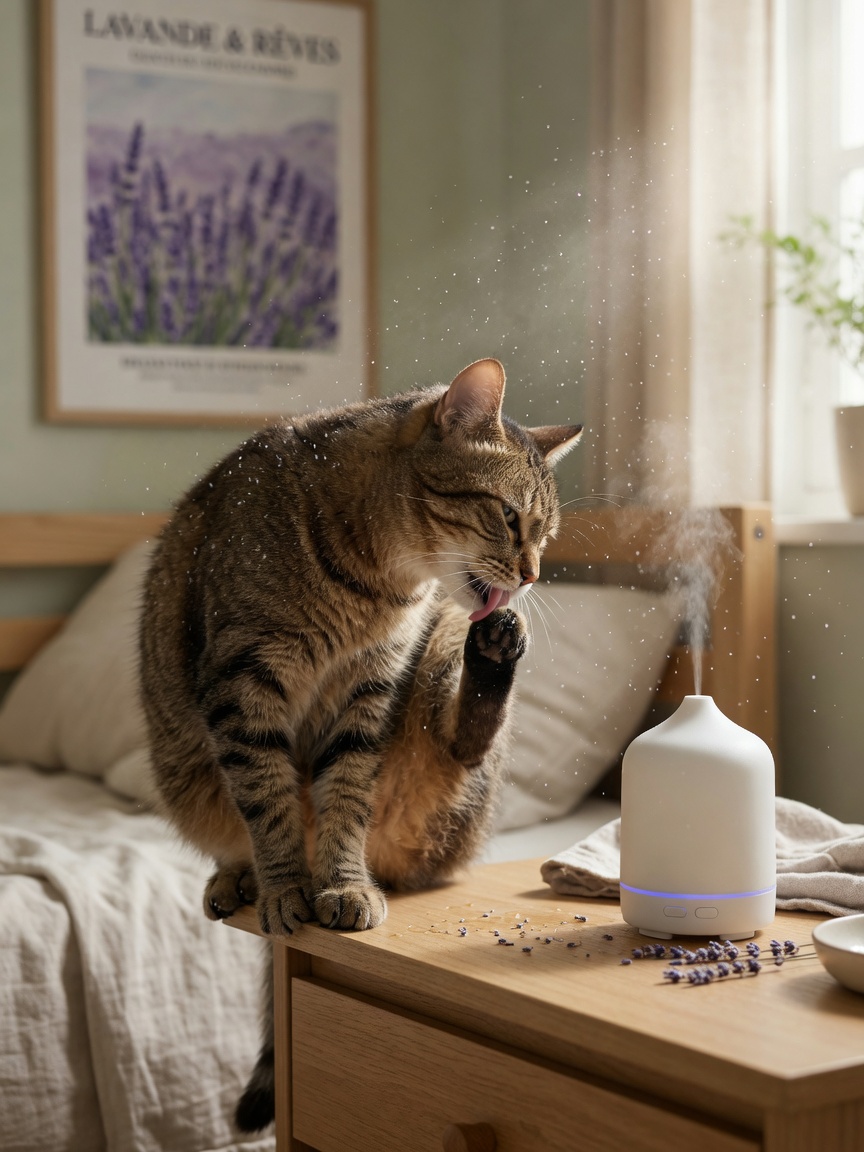
Diffusers
Ultrasonic and heat diffusers aerosolise essential oil particles into the air. Cats groom themselves constantly, meaning any particles that land on their fur will be ingested. A cat living in a room with a lavender diffuser running for several hours daily is experiencing repeated low-dose ingestion. Over time, this accumulates. Even passive reed diffusers in small rooms with poor ventilation create airborne concentrations sufficient to cause respiratory irritation and low-level linalool absorption through the mucous membranes.
Topical Contact
Some owners attempt to use diluted lavender oil on cats' fur to deter fleas or as a calming aid. This is dangerous. Cats groom any substance applied to their coat immediately, meaning "topical" application becomes oral ingestion within minutes. The skin also absorbs lipophilic compounds directly into the bloodstream, bypassing first-pass metabolism.
The Plant Itself
Chewing on lavender leaves or flowers delivers lower concentrations of linalool than essential oil, but the risk is not zero, particularly for cats who eat significant quantities. The ASPCA lists lavender as toxic to cats, noting gastrointestinal signs as the primary concern from plant ingestion.
Clinical Signs of Lavender Toxicity in Cats
Signs typically appear within 30 minutes to 2 hours of exposure and may include:
- Excessive drooling (hypersalivation)
- Nausea and vomiting
- Lethargy and weakness
- Loss of appetite
- Pawing at the mouth or face
- Muscle tremors or fasciculations
- Difficulty walking (ataxia)
- Laboured or rapid breathing
- Jaundice (yellowing of gums/eyes) with prolonged exposure — a sign of liver involvement
If you observe any of these signs, do not wait to see if they resolve. Contact your vet or the Veterinary Poisons Information Service (VPIS) immediately. Treatment is supportive and most effective when started early.
Common Misunderstandings
"But I used lavender on my cat once and nothing happened." Sub-clinical toxicity is real — your cat may have processed a very low dose without visible signs, but liver enzyme levels may have been transiently elevated. Cumulative exposure over weeks or months is the greater concern. The Guardian published an important piece on why essential oils are dangerous for cats, quoting veterinary toxicologists who specifically named lavender as a repeated offender in feline poisoning cases.
"Natural means safe." This is one of the most dangerous misconceptions in pet care. Cyanide, ricin, and aflatoxins are all natural. For cats, the natural origin of lavender does not mitigate its biochemical incompatibility with their metabolism.
What to Use Instead
If you are seeking calming support for an anxious cat, there are feline-safe options. Synthetic feline facial pheromone products (such as Feliway), available through vets and pet retailers, are clinically validated and carry no metabolic risk for cats. Veterinary-prescribed gabapentin or low-dose dexmedetomidine are appropriate options for acute stress situations. Discuss these with your vet rather than reaching for aromatherapy products.
For flea control, discuss spot-on products specifically licensed for cats with your vet. Many effective options exist that are both safe and evidence-based.
Keep your cat's environment enriched and stress-free without aromatherapy risks. Zooplus offers a full range of cat calming products, from pheromone diffusers to interactive enrichment toys. Explore cat calming options at Zooplus →
Key Takeaways
- Cats cannot safely metabolise linalool and linalyl acetate in lavender because they lack the glucuronidation enzyme UGT1A.
- All forms of lavender exposure — plant, essential oil, and diffusers — carry risk for cats.
- Diffusers are particularly dangerous because particles settle on fur and are ingested during grooming.
- Signs of toxicity include drooling, vomiting, ataxia, and in serious cases, liver damage.
- There is no safe lavender dose for cats — choose pheromone-based or veterinary-recommended calming products instead.
- Contact your vet immediately if you suspect lavender exposure.
References
- Court MH, Greenblatt DJ. "Molecular basis for deficient acetaminophen glucuronidation in cats: an interspecies comparison of enzyme kinetics in liver microsomes." Biochem Pharmacol. 1997;53(7):1041-1047. PMID 9111098
- Shrestha B, Reed JM, Starks PT, et al. "Evolution of a major drug metabolizing enzyme defect in the domestic cat and other felidae." PLOS ONE. 2011;6(8):e18046. PMID 21829456