
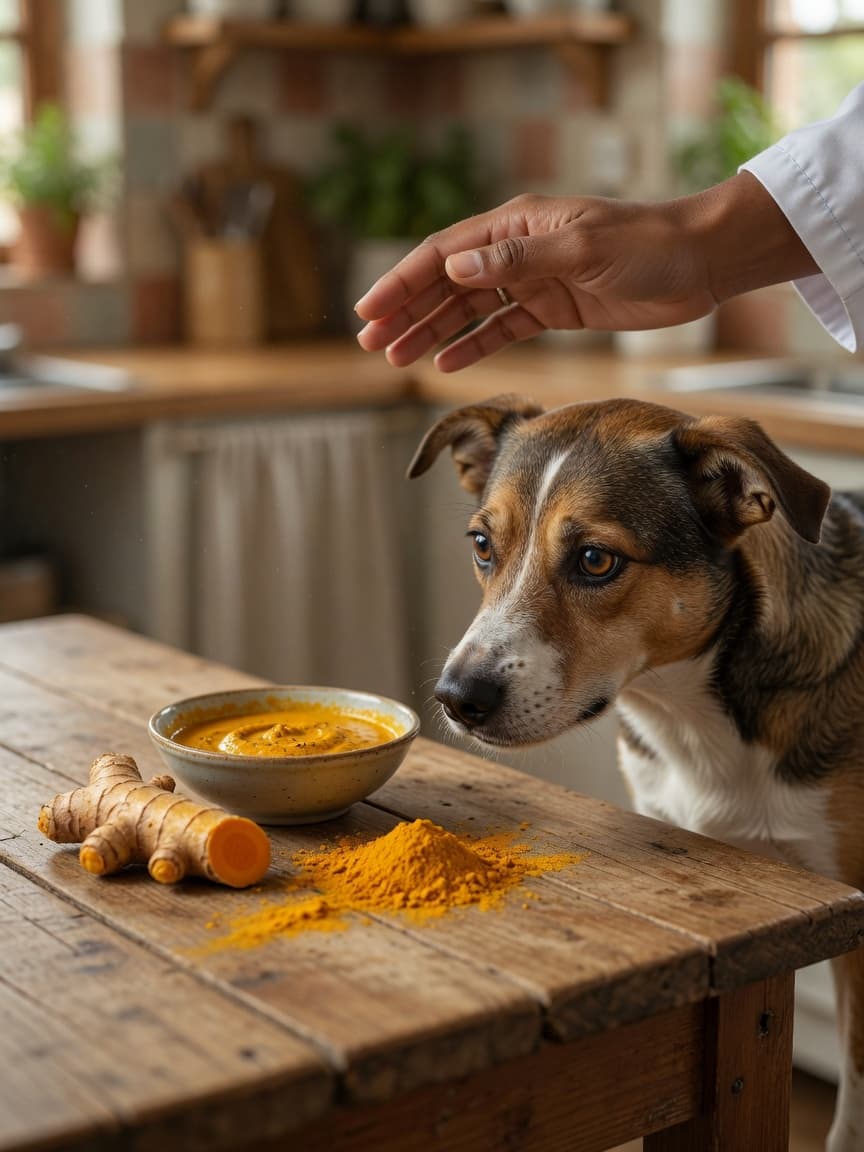
What Is Turmeric and What Is Curcumin?
Turmeric is a flowering plant in the ginger family whose root has been used in cooking and traditional medicine for thousands of years. The active compound most often credited with its health benefits is curcumin, a polyphenol that makes up roughly two to five per cent of dried turmeric by weight. Curcumin is responsible for turmeric's characteristic bright yellow colour and is the compound investigated in most research.
It is important to distinguish between turmeric and curcumin. Many studies use highly concentrated curcumin extracts rather than whole turmeric, meaning findings from curcumin research do not directly translate to feeding turmeric powder. Whole turmeric contains far less curcumin per gram than the extracts used in laboratory studies, which is one of several reasons why applying human or in vitro research to a dog being given a pinch of turmeric in its food involves considerable extrapolation.
What the Research Actually Shows
In Vitro and Animal Model Studies
The majority of curcumin research is conducted in cell cultures (in vitro) or in rodent models. These studies consistently show impressive anti-inflammatory, antioxidant, and even anticancer properties. In laboratory settings, curcumin inhibits the activity of NF-kB (a key inflammatory signalling molecule), reduces pro-inflammatory cytokines, and interferes with the growth of certain cancer cell lines.
These findings are genuinely interesting, but it is essential to understand their limitations. In vitro results frequently do not translate to clinical benefit in living animals. Many compounds look promising in a test tube and fail to produce meaningful effects in real patients. The leap from "curcumin killed cancer cells in a petri dish" to "turmeric treats cancer in dogs" is not scientifically justified.
Clinical Evidence in Dogs
Published clinical studies specifically examining turmeric or curcumin supplementation in dogs are very limited. A small number of studies suggest potential anti-inflammatory benefits in dogs with osteoarthritis, and there is some evidence of antioxidant activity in vivo. However, the evidence base is significantly thinner than for supplements like omega-3 fatty acids or ADAPTIL pheromones. Most claims circulating in the pet wellness space are based on extrapolation from human research, rodent studies, or theoretical biochemistry.
This does not necessarily mean turmeric does nothing for dogs, but it does mean that confident claims about specific benefits should be treated with caution. Limited research indicates possible anti-inflammatory activity; that is an accurate way to describe where the evidence currently stands.
The Bioavailability Problem
Even setting aside the question of whether curcumin works, there is a fundamental pharmacological challenge: curcumin is very poorly absorbed from the gastrointestinal tract. It is rapidly metabolised and excreted, meaning that even when swallowed in reasonable quantities, very little reaches the tissues where it would need to act.
In human research, this problem is partly addressed by combining curcumin with piperine — a compound found in black pepper — which enhances absorption by up to 2,000 per cent in some studies. This is the rationale behind golden paste recipes that include black pepper. Fat also improves absorption, as curcumin is fat-soluble, which is why golden paste typically includes a healthy oil as well.
Whether these strategies provide therapeutically meaningful blood levels of curcumin in dogs has not been rigorously studied. It is plausible that they improve bioavailability compared to plain turmeric powder, but the degree of improvement and whether it is sufficient to produce clinical effects remains uncertain.
Golden Paste: What It Is and How to Make It
Golden paste is a popular home preparation that attempts to address the bioavailability problem by combining turmeric with black pepper and a fat. A widely used basic recipe is as follows:
- 70 g organic turmeric powder
- 250 ml water (plus extra as needed)
- 70 ml cold-pressed coconut oil or olive oil
- 2 to 3 teaspoons freshly ground black pepper
Combine the turmeric and water in a small saucepan and heat gently, stirring continuously, until a thick paste forms — approximately seven to ten minutes. Remove from heat, add the oil and black pepper, and stir thoroughly until well combined. Allow to cool, then store in an airtight container in the refrigerator for up to two weeks. The paste can be added to food in small amounts.
Starting doses are typically around a quarter of a teaspoon for a small dog, half a teaspoon for a medium dog, and up to a teaspoon for a large dog, given once daily. If no adverse effects are observed, some sources suggest gradually increasing the dose, though there is no robust canine dosage guidance based on clinical trials.
Safe Dosage Considerations
Turmeric is generally considered safe for dogs in modest amounts — it is a food ingredient and most dogs tolerate it without issue. The most common side effects are gastrointestinal: loose stools, nausea, or stomach upset, particularly at higher doses. Starting low and increasing gradually reduces this risk.
At very high doses, curcumin has been shown to have pro-oxidant effects in some contexts — the opposite of the antioxidant activity touted at typical supplemental doses. This has not been demonstrated as a clinical problem at the quantities used in golden paste, but it is a reason to avoid dramatically exceeding standard supplemental amounts.
Drug Interactions: Important Warnings
Curcumin has known interactions with several categories of medication that are important for dog owners to be aware of.
- Blood thinners and anticoagulants: Curcumin has antiplatelet properties and can inhibit blood clotting. Dogs taking NSAIDs, aspirin, warfarin, or other medications that affect bleeding should not be given turmeric without veterinary approval. The combination may increase the risk of bleeding.
- Diabetes medications: Curcumin may lower blood sugar levels. Dogs being treated for diabetes with insulin or other glycaemic medications could experience unpredictable interactions, potentially leading to hypoglycaemia.
- Chemotherapy drugs: Some research suggests curcumin may interfere with the action of certain chemotherapy agents, either reducing efficacy or potentiating effects unpredictably. Dogs undergoing cancer treatment should not be supplemented without explicit oncologist guidance.
- Iron absorption: Curcumin can bind to iron and reduce its absorption. Dogs with iron-deficiency conditions or on iron supplementation may be affected.
When to Avoid Turmeric
- Dogs with gallbladder disease or bile duct obstruction — curcumin stimulates bile production and may worsen these conditions.
- Dogs with known bleeding disorders or those scheduled for surgery.
- Dogs on concurrent medication, without first consulting a vet.
- Pregnant dogs — curcumin may have uterine-stimulating properties at high doses, though this has not been conclusively demonstrated in dogs.
- Dogs with known oxalate urinary stones — turmeric is high in oxalates, which may exacerbate this condition.
An Honest Assessment
Turmeric and curcumin are not without scientific interest. The anti-inflammatory mechanisms are biologically plausible, and in vitro research supports the idea that curcumin may have genuine activity. However, the translation from laboratory findings to clinical benefit in dogs is not established by robust evidence. The bioavailability challenge is real, and the volume of rigorous canine-specific research is very small compared to the confidence with which turmeric is often promoted.
If you choose to give your dog turmeric, do so with realistic expectations and at modest doses, using golden paste to improve absorption. Be especially cautious if your dog takes any regular medication. And if you are hoping to address a specific health condition such as arthritis, your vet can guide you towards interventions with stronger evidence — including omega-3 supplementation and appropriate pain management — while you consider whether turmeric is a worthwhile addition.