
Positive Reinforcement Dog Training: The Science & How to Do It
If you have spent any time searching for dog training advice, you have likely encountered conflicting philosophies. Some trainers emphasize control and correction; others focus on rewards and relationship. The science, accumulated over nearly a century of behavioral research, points clearly in one direction: positive reinforcement produces faster learning, longer retention, and fewer behavioral side effects than punishment-based approaches.
This article breaks down the science in plain language and gives you a practical framework to start using it today.
The 4 Quadrants of Operant Conditioning
All learned behavior — in dogs and in humans — is shaped by consequences. B.F. Skinner formalized this in the mid-20th century as operant conditioning, which describes four ways consequences affect the frequency of a behavior:
- Positive Reinforcement (R+): Add something pleasant after a behavior → behavior increases. Dog sits, gets a treat, sits more often.
- Negative Reinforcement (R-): Remove something unpleasant after a behavior → behavior increases. Dog pulls on leash to escape discomfort, pulling increases.
- Positive Punishment (P+): Add something unpleasant after a behavior → behavior decreases. Dog jumps, gets a knee to the chest, jumping decreases (but anxiety may increase).
- Negative Punishment (P-): Remove something pleasant after a behavior → behavior decreases. Dog jumps for attention, owner turns away, jumping decreases.
Modern, welfare-positive dog training relies primarily on R+ and occasionally P- (such as removing attention for jumping). It avoids P+ because of its documented side effects.
Why R+ Works Best: The Science
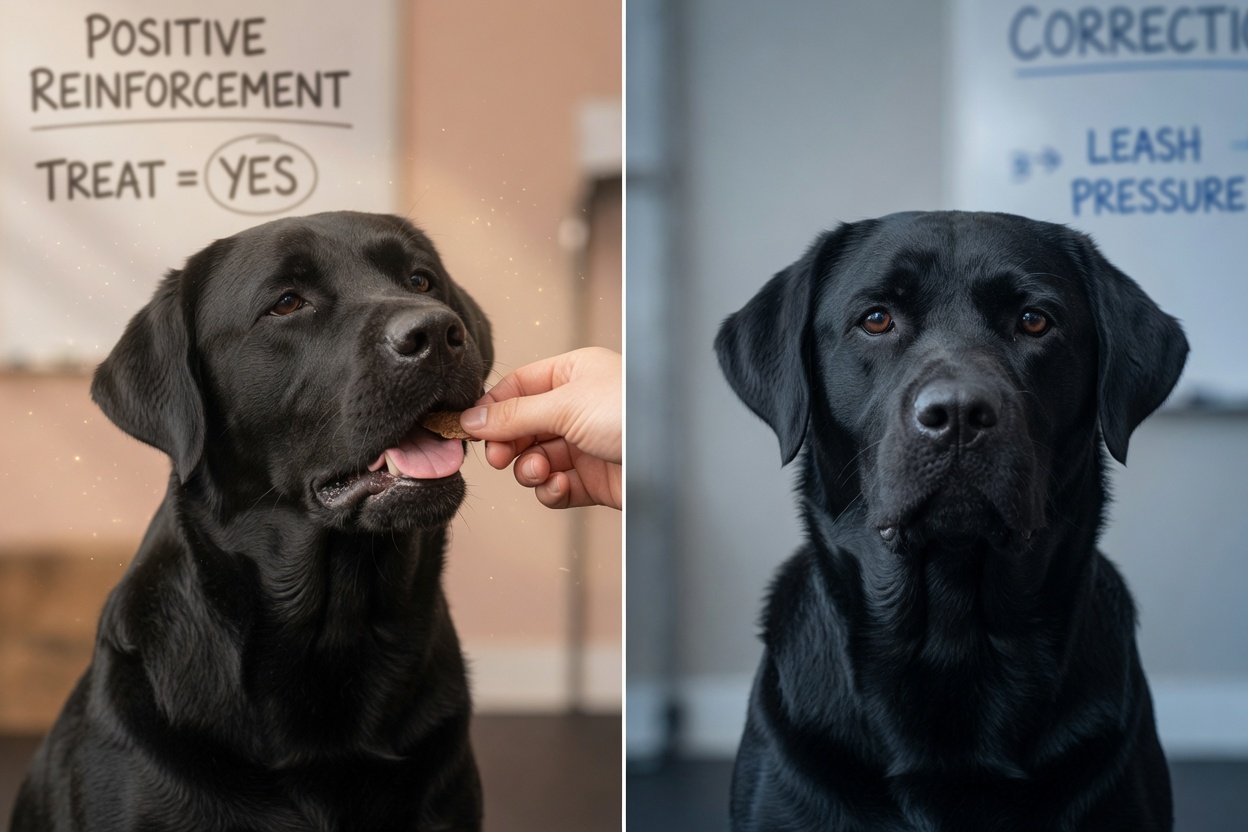
It is not a matter of opinion that positive reinforcement is effective — it is well-documented in peer-reviewed literature. A landmark study by Herron et al. (2009) found that confrontational training techniques (including hitting, alpha rolls, and staring down) frequently elicited aggression in dogs, while reward-based techniques produced no such responses (PMID: 19028069).
From a neuroscience perspective, rewards activate the mesolimbic dopamine system — the brain's learning and motivation circuitry. When a dog performs a behavior and receives a reward, dopamine is released, encoding that behavior as "worth repeating." Punishment, by contrast, activates stress pathways (cortisol and adrenaline), which can impair memory consolidation and create negative associations with the trainer, the training environment, or the cue itself.
Ivan Pavlov's classical conditioning research showed us that emotional responses are learned through association. Every training session is both operant (the dog learns what to do) and classical (the dog learns how to feel about it). Positive trainers use this dual pathway intentionally: cues and training environments become predictors of good things, not stress.
Types of Rewards: Building a Hierarchy
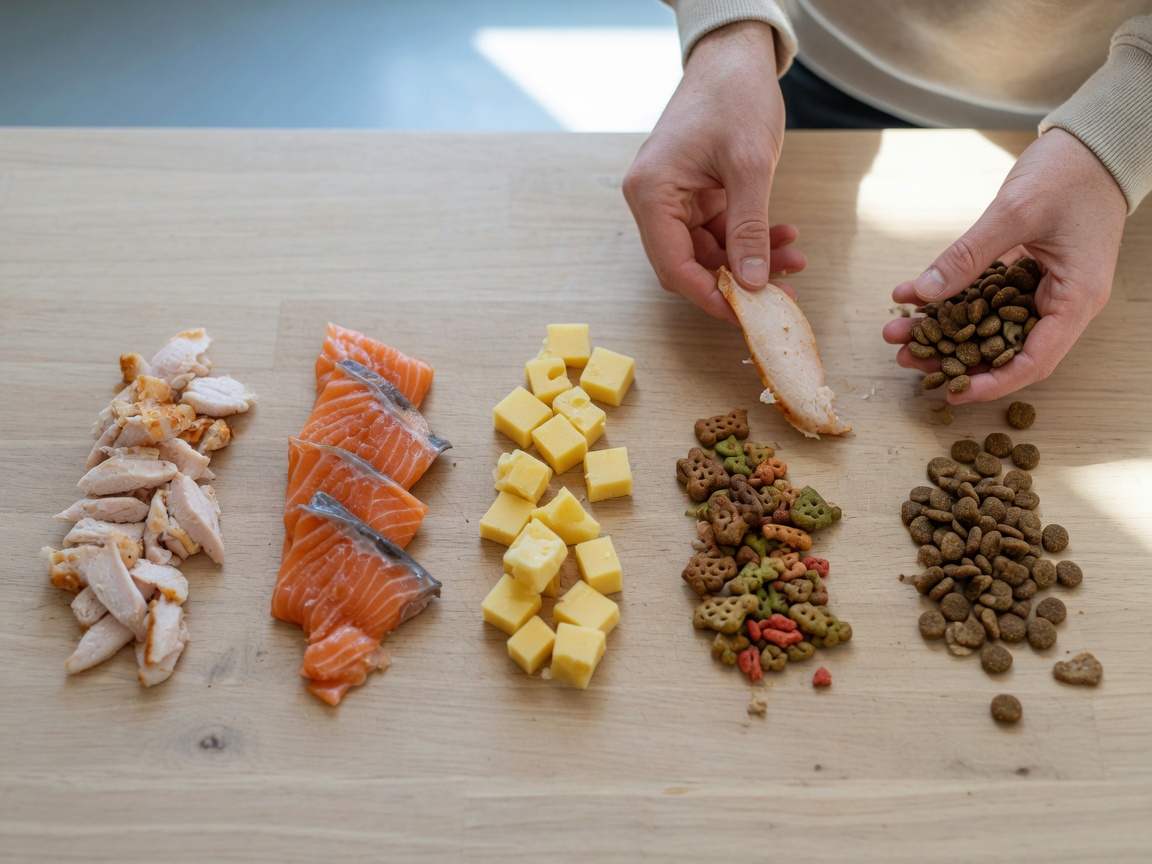
Not all rewards are equal, and individual dogs have individual preferences. Build a hierarchy for your dog:
- High-value food: Real meat (chicken, beef, salmon), cheese, hot dog pieces. Reserve for new behaviors, distracting environments, and reinforcing the hardest tasks.
- Mid-value food: Commercial training treats, kibble, small biscuits. Use for practice in low-distraction environments.
- Life rewards: Access to things the dog wants — going outside, greeting a person, chasing a ball. Powerful and free; use them by making the reward contingent on the behavior ("sit" → door opens).
- Play: A brief game of tug or fetch as a reward. Highly motivating for many dogs, especially working breeds.
- Praise and touch: Genuinely valued by social dogs, but rarely sufficient on their own for teaching new behaviors.
To keep motivation high during training sessions, Zooplus offers an excellent range of small, soft training treats in a variety of proteins — ideal for rapid-fire reward delivery without filling your dog up.
Timing and Rate of Reinforcement
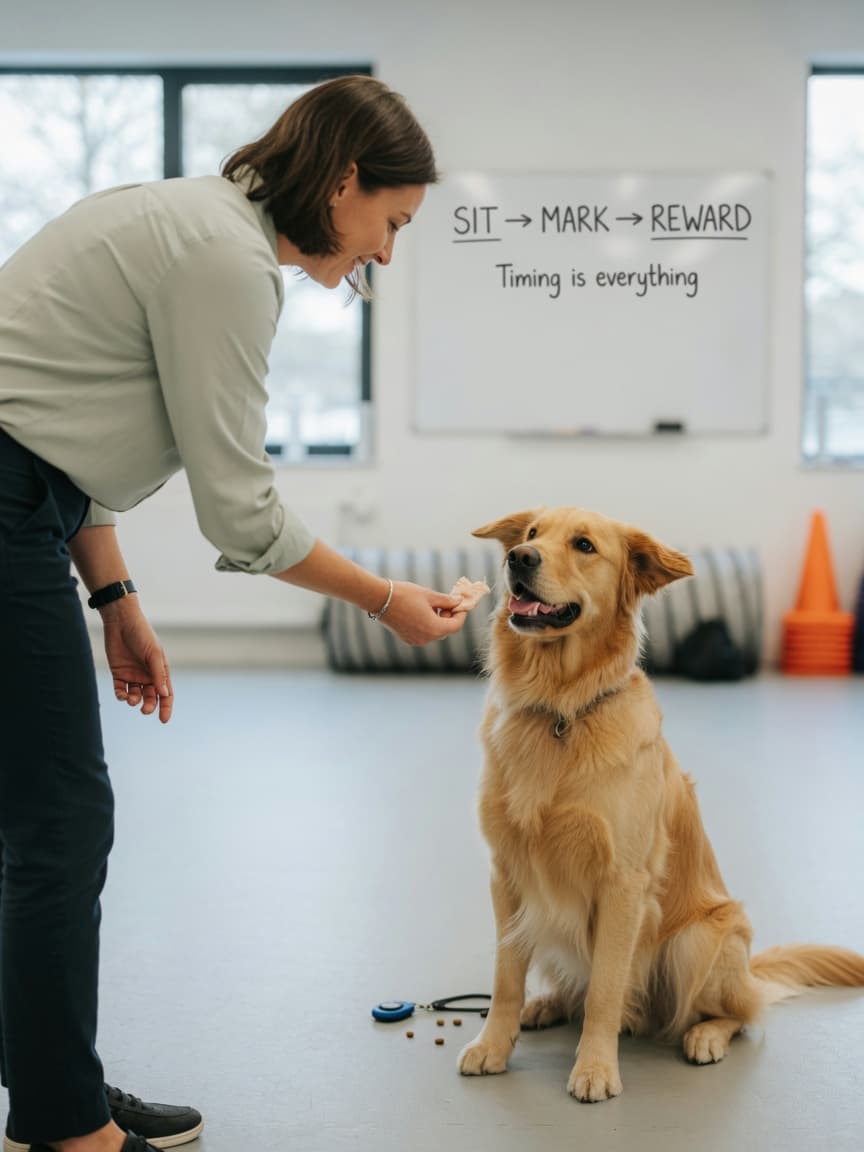
Timing is everything. The reward (or the marker signal — see clicker training) must arrive within 1–2 seconds of the desired behavior, or the dog may associate the reward with whatever they were doing at the moment of delivery, not the behavior you intended to reinforce.
Rate of reinforcement (ROR) refers to how often you reward during a training session. When teaching a new behavior, maintain a very high ROR — reward nearly every correct response. As the behavior becomes reliable, you can move to a variable schedule (rewarding some responses but not others), which actually produces more durable behavior. This mirrors what Skinner called the variable ratio schedule — the same principle that makes slot machines compelling.
Shaping, Luring, and Capturing
There are three main techniques for getting a behavior to happen so you can reinforce it:
- Luring: Using a treat to guide the dog into position (e.g., moving a treat from the dog's nose back over their head to get a sit). Fast to teach, but fade the lure quickly or you end up with a treat-dependent dog.
- Capturing: Waiting for the dog to offer a behavior naturally and rewarding it the instant it happens (e.g., reinforcing every time the dog naturally lies down until "down" becomes a reliable cue).
- Shaping: Rewarding successive approximations toward a final behavior. To teach "roll over," you might first reward looking to the side, then leaning, then rolling to the hip, then all the way over. This builds persistence and problem-solving in the dog.
Moving from Treats to Intermittent Rewards
A common concern is "will I need to carry treats forever?" The answer is no — once a behavior is learned, you shift to an intermittent (variable) reinforcement schedule. Continue to reward occasionally and unpredictably, and replace food rewards with life rewards (the leash goes on, the ball gets thrown, the door opens). The behavior remains strong because the dog can never be certain when the reward will come — optimism drives behavior.
Why Punishment Is Counterproductive
Beyond the welfare concerns, punishment is simply a less efficient training tool. It tells the dog what not to do without teaching what to do instead. It requires precise timing and calibrated intensity that most owners cannot deliver consistently. And its side effects — fear, avoidance, redirected aggression, and learned helplessness — are well-documented in the scientific literature (Hiby et al., 2004, PMID: 15279162).
The most effective trainers in the world — those working with dolphins, elephants, zoo animals, and competitive sport dogs — rely almost exclusively on positive reinforcement. There is no reason your dog deserves less.
Key Takeaways
- Positive reinforcement (R+) means adding something pleasant after a behavior to increase it — proven by over 80 years of behavioral science.
- Rewards activate the brain's dopamine system, encoding the behavior as worth repeating.
- Build a reward hierarchy: high-value food for hard tasks, life rewards for maintenance.
- Timing is critical: reward within 1–2 seconds of the desired behavior.
- Use luring, capturing, or shaping to get the behavior first — then reinforce it.
- Fade treats gradually using variable reinforcement — you will not need them forever.
- Punishment has documented side effects including fear and aggression — it teaches what not to do without showing what to do instead.