
Clicker Training for Dogs: Complete Beginner's Guide
You may have heard experienced trainers talk about the click the way pianists talk about perfect pitch — with a reverence that sounds a little mysterious to outsiders. But there is no mystery. The clicker works because of a well-understood principle of learning science, and once you understand the why, you will never train without it again.
What Is a Clicker and Why Does It Work?
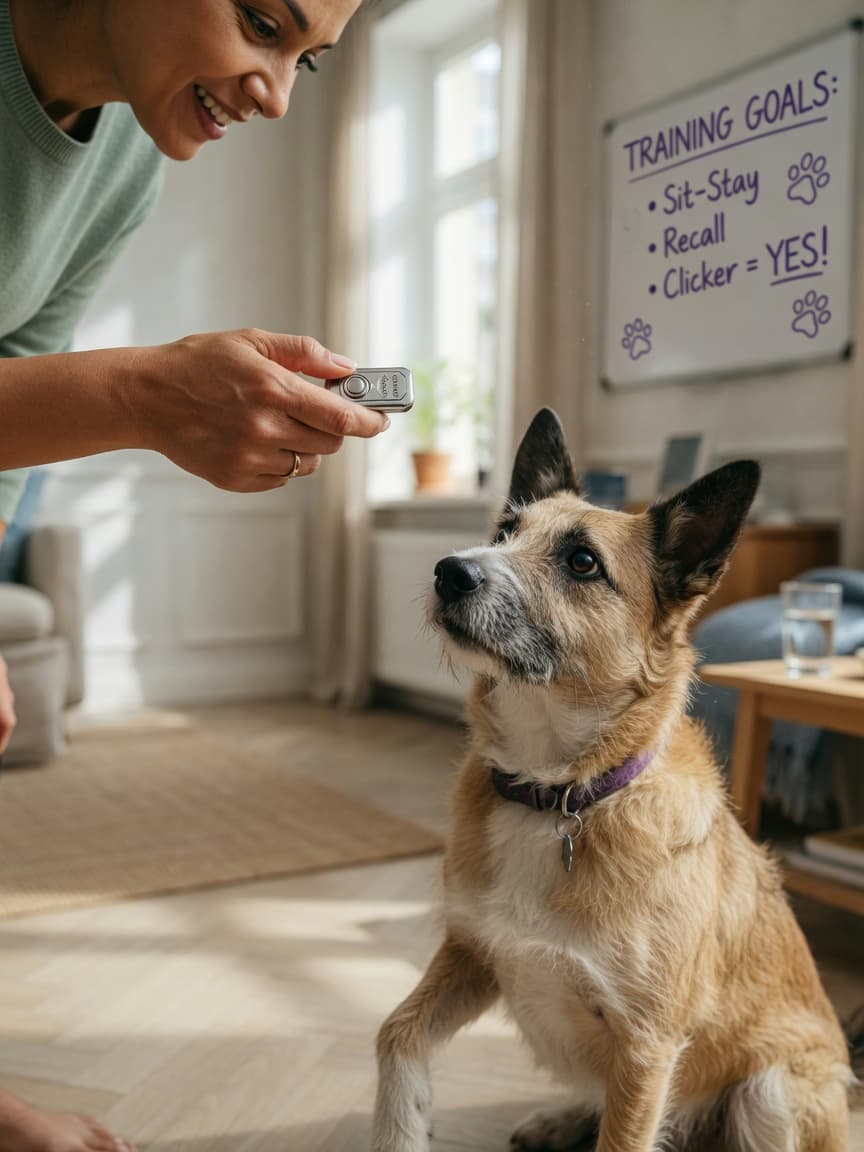
A clicker is a small handheld device with a metal strip that produces a short, sharp click when pressed. Its power lies in its precision and consistency: the sound is identical every time, instant, and impossible to confuse with anything else in the environment.
The clicker functions as a bridging stimulus — a signal that bridges the gap between the behavior and the reward. Because dogs learn by association (classical conditioning, Pavlov's contribution to behavioral science), and because a clicker can be delivered at the exact millisecond a behavior occurs, it communicates to the dog with a specificity that verbal praise or treat delivery alone cannot match.
Once the clicker is "loaded" (paired with food rewards), the sound of the click becomes a conditioned reinforcer — meaningful in itself, capable of marking behavior even when the treat arrives a few seconds later. Research into event markers in animal training consistently shows that precise timing of the marker leads to faster and more accurate behavior acquisition than delayed reinforcement alone.
Step 1: Loading the Clicker
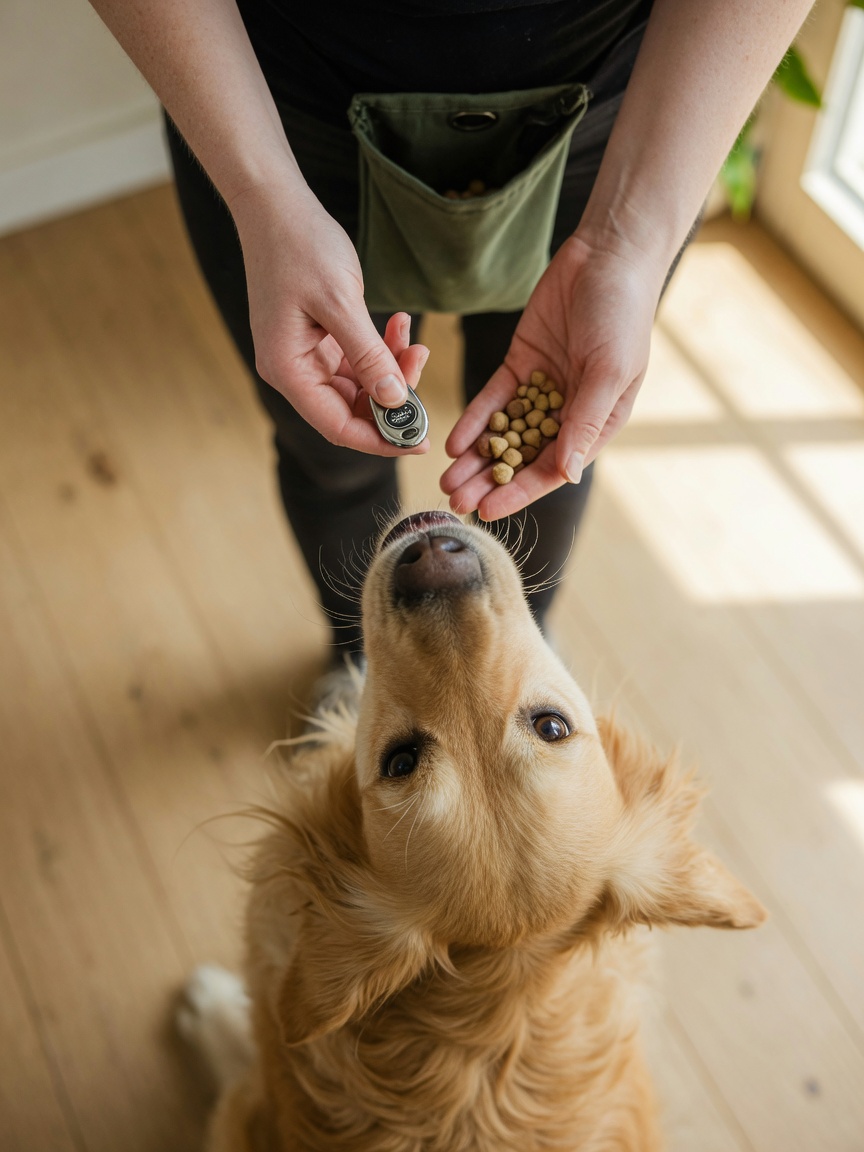
Before the clicker means anything to your dog, you must pair it with food. This is called "loading the clicker" and it is pure classical conditioning — you are teaching your dog that click = treat is arriving.
- Prepare 20–30 tiny, high-value treats (small pieces of chicken, cheese, or commercial soft treats).
- Without asking for any behavior at all, click once and immediately deliver a treat. Treat delivery should come within 1–2 seconds of the click.
- Pause briefly, then click and treat again. Repeat until all treats are gone.
- Do 2–3 short sessions like this before you start using the clicker for training.
- A loaded clicker creates a dog that turns toward you and looks expectant the moment they hear the sound.
Do not click while the treat is already in your hand — that teaches the dog to watch your hands, not listen for the click. Keep treats behind your back or in a pouch.
Step 2: The Golden Rule of Clicker Timing
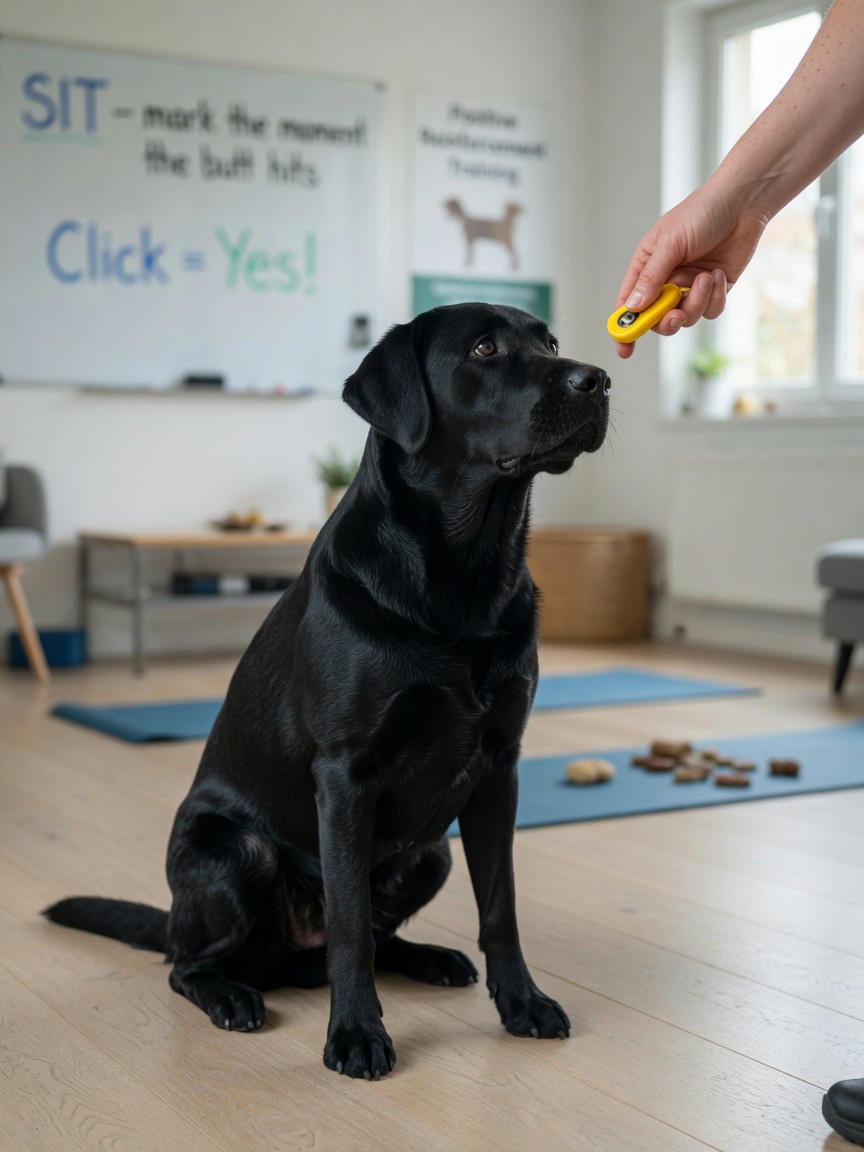
The click marks the exact moment of the correct behavior. Not the moment just after. Not when the dog is heading in the right direction. The precise instant the desired behavior is complete.
Think of it as a camera shutter. You are taking a picture of exactly what you want to see more of. If you are teaching "sit," the click comes the moment the dog's bottom touches the ground — not a second later when they start to get up again.
The treat always follows the click, even if you clicked at the wrong moment. Withholding the treat after clicking confuses the dog and weakens the marker. If you click accidentally, deliver the treat anyway — just be more careful next time.
Step 3: Rate of Reinforcement
When teaching a new behavior, aim for a rate of reinforcement of 8–10 correct repetitions per minute. If you are getting fewer, the criteria are probably too hard — break the behavior into smaller steps. If the dog is getting frustrated or disconnected, end the session and try again with an easier starting point.
Keep sessions short: 3–5 minutes is often enough for one behavior. Dogs learn in sessions, then consolidate during rest. Two short sessions a day outperform one long one.
5 First Behaviors to Teach with a Clicker
1. Sit
Hold a treat at your dog's nose and slowly move it back over their head. As their nose goes up, their bottom goes down. The moment it touches the ground: click and treat. After 5–10 successful repetitions, add the cue word "sit" just before the lure. Then begin fading the lure — make the hand motion smaller each session until the verbal cue alone produces the sit.
2. Down
From a sit, move a treat from the dog's nose straight down to the ground, then slowly forward. The dog should fold into a down to follow the treat. Click the moment their elbows touch the floor. Some dogs prefer you lure them from a standing position. Do whatever works for your individual dog.
3. Touch (Nose to Hand)
Present your flat, open palm about 15 cm from your dog's nose. Most dogs will sniff it out of curiosity. The moment their nose contacts your hand: click and treat. This becomes one of your most versatile tools — you can use "touch" to move the dog, redirect attention, and eventually teach heeling and other complex behaviors.
4. Spin
Hold a treat at your dog's nose and slowly lure them in a circle — all the way around until they are facing you again. Click and treat at the completion of the circle. Fade the lure into a small circular hand motion, then name it "spin" (or "around" for the opposite direction). Dogs love this trick and it is excellent for body awareness.
5. Paw (Shake)
Hold a treat closed in your fist at your dog's chest level. Wait. Many dogs will sniff, then paw at the closed fist trying to get the treat. The moment paw contacts hand: click, open fist, and deliver the treat. Once this is reliable, transfer to an open palm, then add the cue "paw" or "shake."
Shaping: 101 Things to Do with a Box
One of the most exciting things you can do with a clicker is a free-shaping session called "101 Things to Do with a Box." Place a cardboard box on the floor and click and treat any interaction your dog offers with it — sniffing it, touching it with a paw, stepping in it. Do not lure or guide; let your dog experiment.
This teaches your dog to offer behaviors and think creatively — a skill that makes every future training task faster to learn. Dogs who are trained this way become enthusiastic, persistent learners who try things rather than waiting to be shown what to do.
Zooplus stocks clickers, treat pouches, and small training treats — everything you need to get started or upgrade your training kit.
Common Mistakes to Avoid
- Clicking too late: You are marking the wrong moment. Practice your timing by clicking when a ball bounces, or when a dog on TV sits.
- Being stingy with treats: Training requires a high reinforcement rate, especially for new behaviors. Small, frequent rewards beat large, rare ones every time.
- Clicking without treating: Destroys the conditioned value of the marker. Always treat after a click, no exceptions.
- Sessions too long: Mental fatigue leads to frustration and poor performance. End on success, before the dog is tired.
- Skipping criteria steps: If your dog is failing more than 20% of the time, the task is too hard. Go back to a step they can succeed at and build back up.
- Using the clicker as attention-getting: The clicker is a marker of behavior, not a remote control. Never click to get the dog to come to you.
Key Takeaways
- A clicker is a bridging stimulus — it marks the exact moment of correct behavior with a consistent, precise sound.
- Load the clicker first: pair click with treat 20–30 times before using it for training.
- The click happens at the moment of the behavior — the treat follows the click.
- Always deliver a treat after a click, even if you clicked by mistake.
- Keep sessions short (3–5 min) and aim for 8–10 reinforcements per minute on new behaviors.
- Free shaping (101 Things with a Box) builds creative, confident, problem-solving dogs.