
A Cancer That Affects Far Too Many Cats
Mammary tumours are the third most common type of cancer diagnosed in cats, following lymphoma and skin tumours. They are also among the most serious. Unlike in dogs, where roughly half of mammary tumours are benign, the vast majority of feline mammary tumours — approximately 85 to 90 per cent — are malignant. This means they have a tendency to grow aggressively, spread to lymph nodes and the lungs, and prove difficult to treat once advanced. Early detection makes a profound difference to outcomes.
Who Is Most at Risk?

Unspayed female cats carry the highest risk by a significant margin. The development of mammary tumours in cats is strongly linked to oestrogen and progesterone exposure over time, which is why cats that have gone through repeated heat cycles without being spayed are disproportionately affected.
The average age of diagnosis is between ten and twelve years, though tumours can appear in younger cats. Siamese cats appear to be predisposed to mammary tumours and tend to develop them at a younger age than other breeds. Male cats can also develop mammary tumours, though this is rare.
The relationship between spaying and mammary cancer risk is one of the clearest in veterinary medicine. Cats spayed before their first heat cycle have a risk reduction of approximately 91 per cent. Spaying before the second heat cycle still reduces risk substantially. After that point, the protective effect diminishes, though spaying remains beneficial for many other health reasons.
Understanding the Anatomy
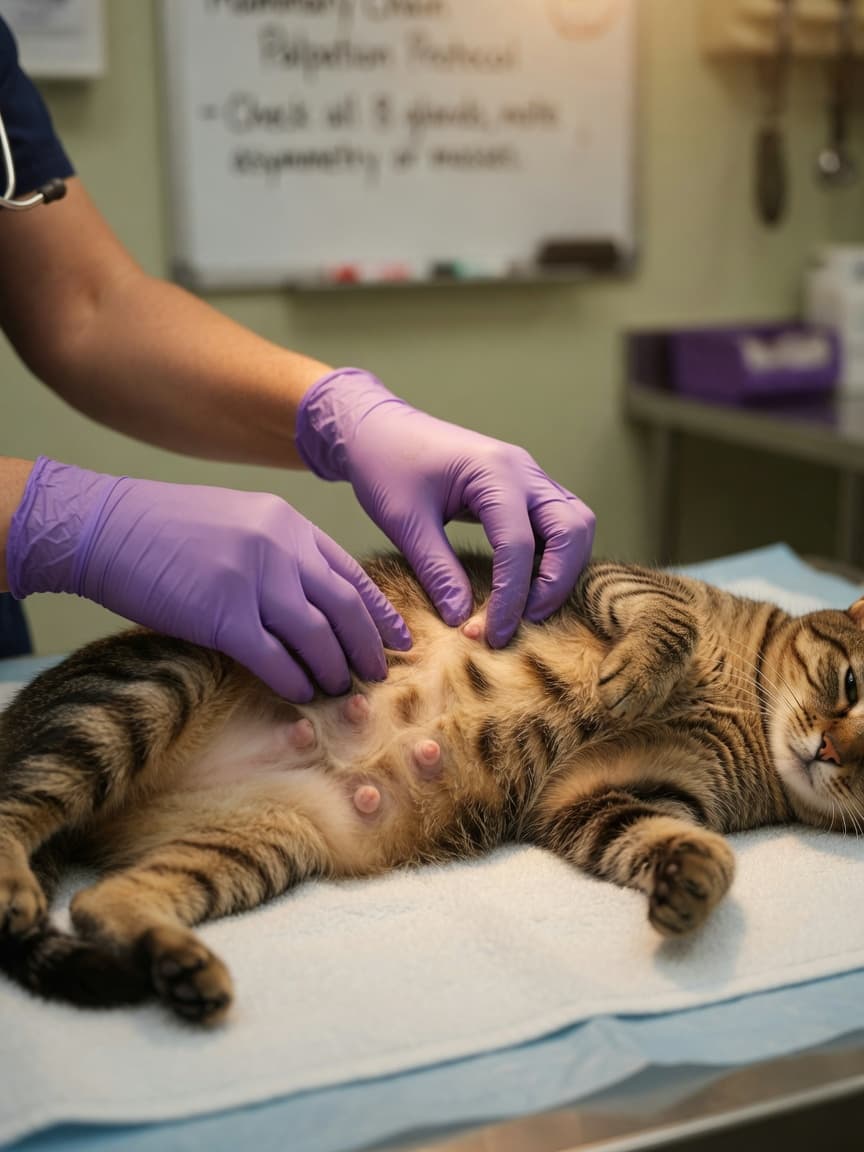
Cats have four pairs of mammary glands, running in two chains along the underside of the abdomen from the chest to the groin. Tumours can develop in any of these glands and may appear in multiple locations simultaneously. The glands closest to the groin are reported to be affected most frequently, though all should be checked regularly during grooming or handling.
What Are the Warning Signs?
The earlier a mammary tumour is detected, the better the prognosis. Knowing what to look and feel for is therefore genuinely important for every owner of an unspayed female cat, and for owners of older spayed cats where some residual risk may remain.
Signs that warrant immediate veterinary attention include:
- A lump, nodule, or thickening along the mammary chain — even if small or seemingly painless
- Swelling or firmness in the breast tissue
- Skin changes over a gland, including redness, ulceration, or puckering
- Discharge from a nipple
- A rapidly growing mass, or a mass that has changed in shape or texture over a short period
- Signs that the cat is in discomfort when the area is touched
It is worth noting that not all lumps in the mammary area are cancerous. Benign cysts, abscesses, and hyperplastic tissue can also occur. However, because the proportion of malignant tumours in cats is so high, every lump must be evaluated by a vet promptly. Do not adopt a wait-and-see approach.
How Are Feline Mammary Tumours Diagnosed?
Your vet will begin with a physical examination to assess the size, location, and texture of any masses and check whether nearby lymph nodes are enlarged. To determine whether a tumour is malignant and whether it has spread, further investigations are typically required.
Fine needle aspirate — where a small needle is used to collect cells from the lump — can provide useful preliminary information, though it is not always conclusive for mammary tumours. Surgical biopsy with histopathology (laboratory analysis of tumour tissue) gives the most reliable diagnosis and is usually performed at the time of surgery. Chest X-rays are important to assess whether metastasis to the lungs has occurred, as this significantly affects prognosis and treatment planning. Abdominal ultrasound may also be recommended.
Treatment Options
Surgery is the cornerstone of treatment for feline mammary tumours. The recommended approach is usually aggressive — rather than removing a single lump, many vets advocate for unilateral or bilateral mastectomy, removing an entire mammary chain or both chains. Research suggests that more extensive surgery is associated with longer survival times and lower recurrence rates compared to more conservative lumpectomy.
Chemotherapy may be recommended following surgery, particularly in cases where the tumour is large, the margins are not clean, or lymph node involvement is confirmed. Protocols vary, and your vet may refer you to a veterinary oncologist for specialist input.
Prognosis depends heavily on tumour size at the time of surgery. Cats with tumours smaller than 2 centimetres at the time of removal have a median survival time of around three years. Cats with tumours larger than 3 centimetres face a significantly worse outlook, with median survival often measured in months rather than years. This is why early detection matters so profoundly.
Monthly Checks at Home
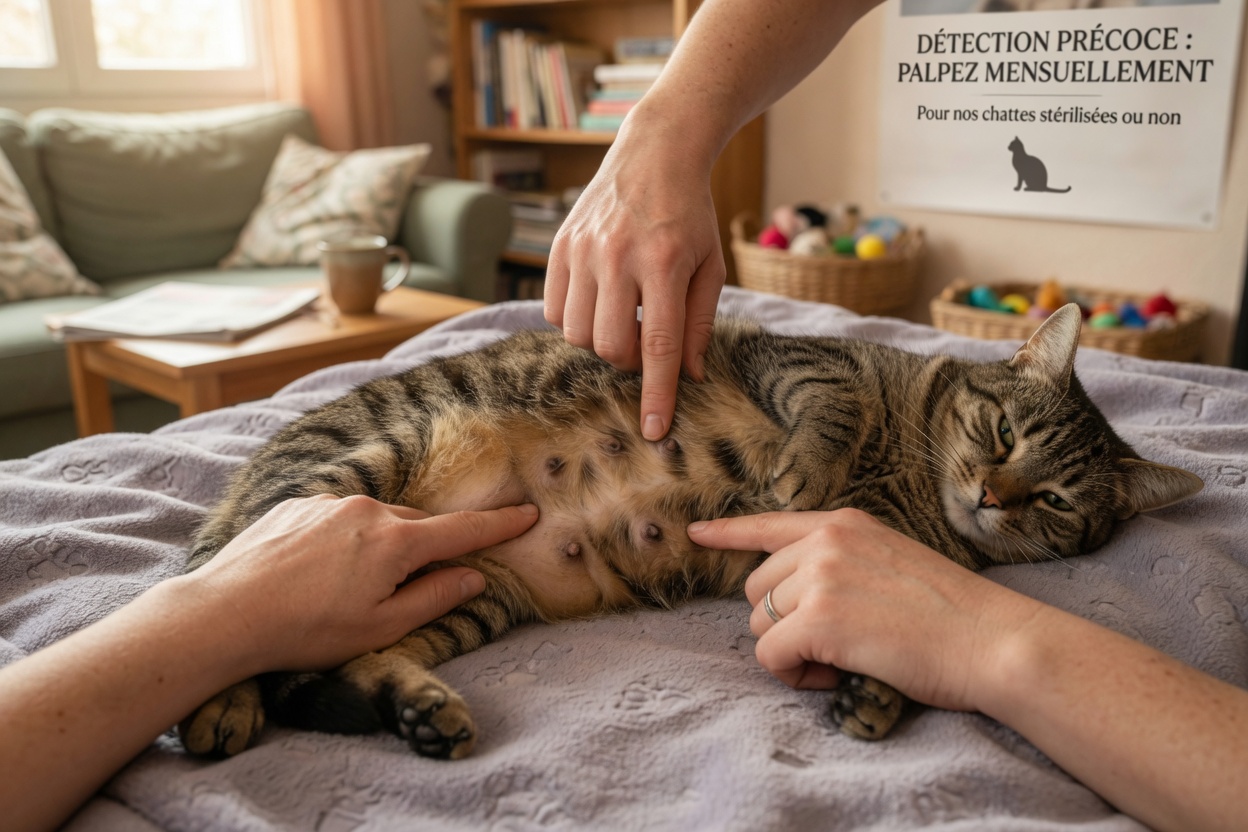
Incorporating a simple monthly check into your routine with your cat takes only a few minutes and could detect a tumour at its earliest, most treatable stage. With your cat relaxed and lying on her side, gently run your fingertips along the mammary chain from armpit to groin on each side, feeling for any lumps, firm areas, or asymmetry. Note any changes to the skin or nipples.
If you find anything unusual, do not delay in booking a veterinary appointment. In a disease where the malignancy rate is as high as it is in cats, swift action is always the right response.
The Preventive Case for Spaying
Given the severity and prevalence of feline mammary cancer, the preventive argument for early spaying is extraordinarily strong. No other single intervention comes close to matching the risk reduction that early spaying provides. If you have a young female cat who has not yet been spayed, this is perhaps the most compelling health reason to arrange the procedure sooner rather than later.