
Feather Plucking in Parrots: Medical Causes vs Behavioural Triggers
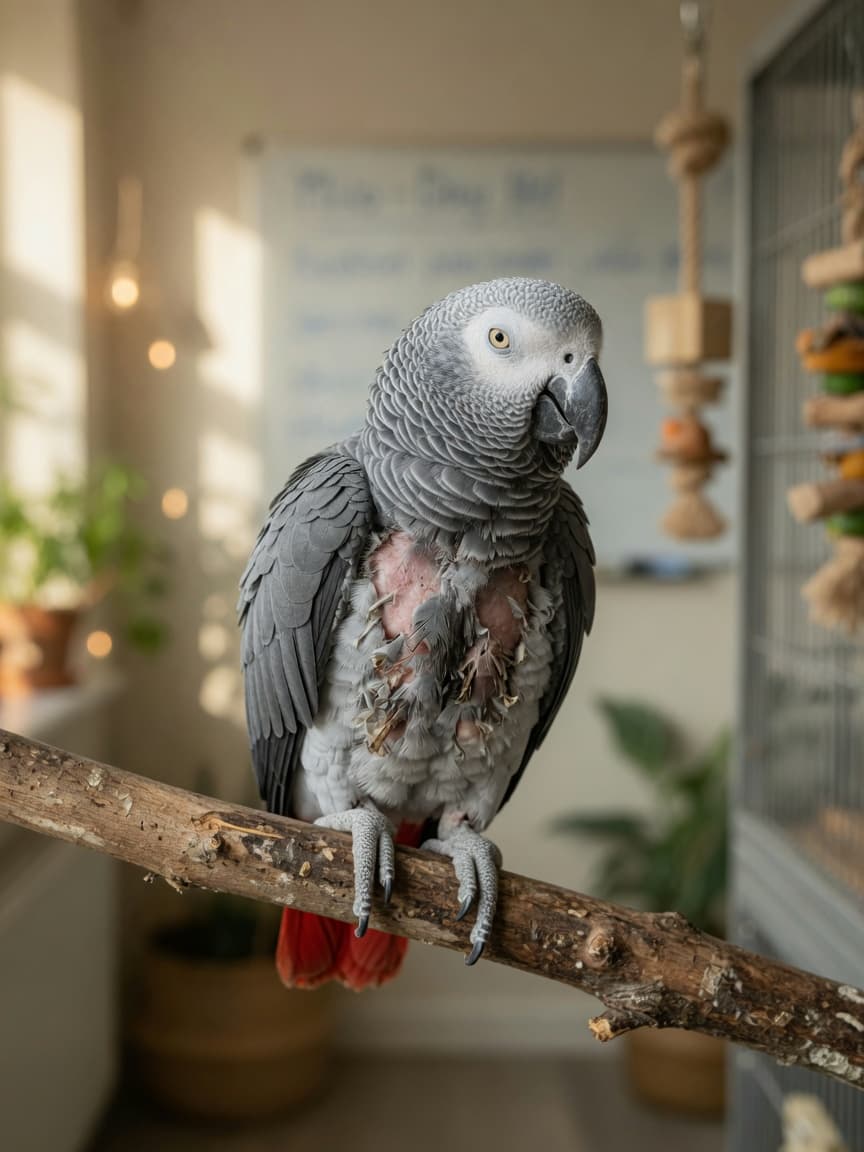
Feather plucking — or more accurately, feather destructive behaviour — is one of the most distressing things a parrot owner can witness. You notice patches of missing feathers, perhaps some damaged shafts, and suddenly your bird looks nothing like the vibrant creature you brought home. Before you can address the problem, however, you need to understand what is actually driving it. The cause is rarely obvious, and treating a behavioural issue as if it were a medical one (or vice versa) will get you nowhere.
What Counts as Feather Destructive Behaviour?
The term covers a spectrum of actions: chewing feather tips, stripping barbules, pulling feathers out entirely, or even barbering the feathers of cagemates. The bird may target its chest, flanks, inner wings, or thighs — areas it can reach easily but cannot see well. Crucially, the head is almost always spared, because a parrot cannot pluck its own head feathers. If you notice missing or damaged feathers on the head, the culprit is more likely a companion bird or, in rare cases, a skin condition affecting regrowth.
Medical Causes That Must Be Ruled Out First
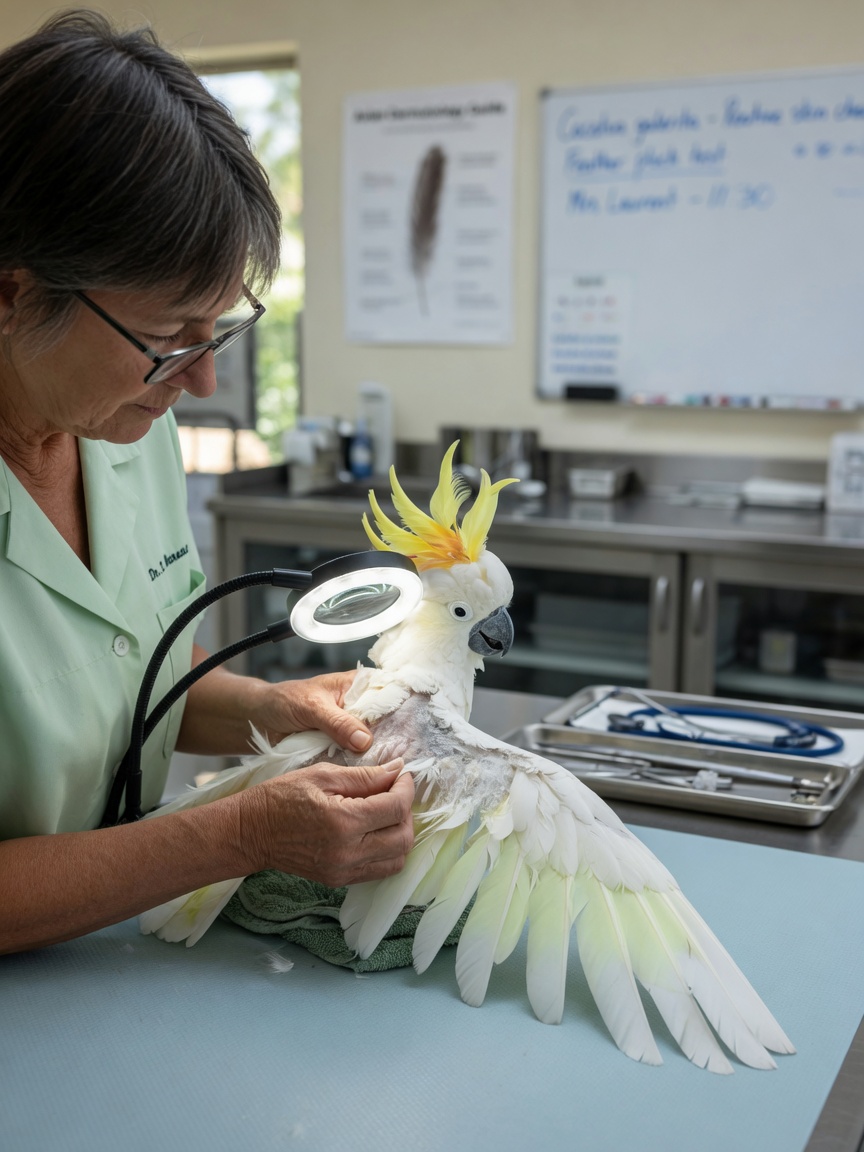
A thorough veterinary examination is non-negotiable before any behavioural intervention begins. A surprising number of cases that look purely psychological have an underlying physical driver.
Skin and Follicle Infections
Bacterial folliculitis, fungal dermatitis, and yeast overgrowth can all cause intense localised itching. The bird plucks or chews to relieve discomfort, and the damaged skin then becomes more susceptible to secondary infection, creating a difficult cycle to break. Skin scrapes and cytology will identify most of these.
Psittacine Beak and Feather Disease
PBFD, caused by circovirus, is one of the most serious diagnoses a parrot owner can receive. It disrupts normal feather growth, causing dystrophic, stress-barred, or clubbed feathers that the bird may attempt to remove. There is no cure, and the virus is highly contagious between birds. A PCR blood test will confirm or rule it out.
Internal Parasites and Systemic Illness
Giardia is a well-documented trigger in cockatiels and some conures, producing intense skin irritation even without obvious digestive symptoms. Liver disease, heavy metal toxicity (particularly from zinc or lead), and reproductive disorders in hens can all manifest as feather plucking before any other clinical signs appear.
Allergies and Nutritional Deficiencies
Diets high in seed and low in variety can lead to deficiencies in vitamin A, omega fatty acids, and amino acids — all of which affect skin and feather integrity. Food sensitivities, though harder to diagnose in birds, have also been implicated. Airborne irritants such as cigarette smoke, non-stick cookware fumes, and synthetic fragrances are frequently overlooked environmental triggers.
Behavioural and Psychological Triggers
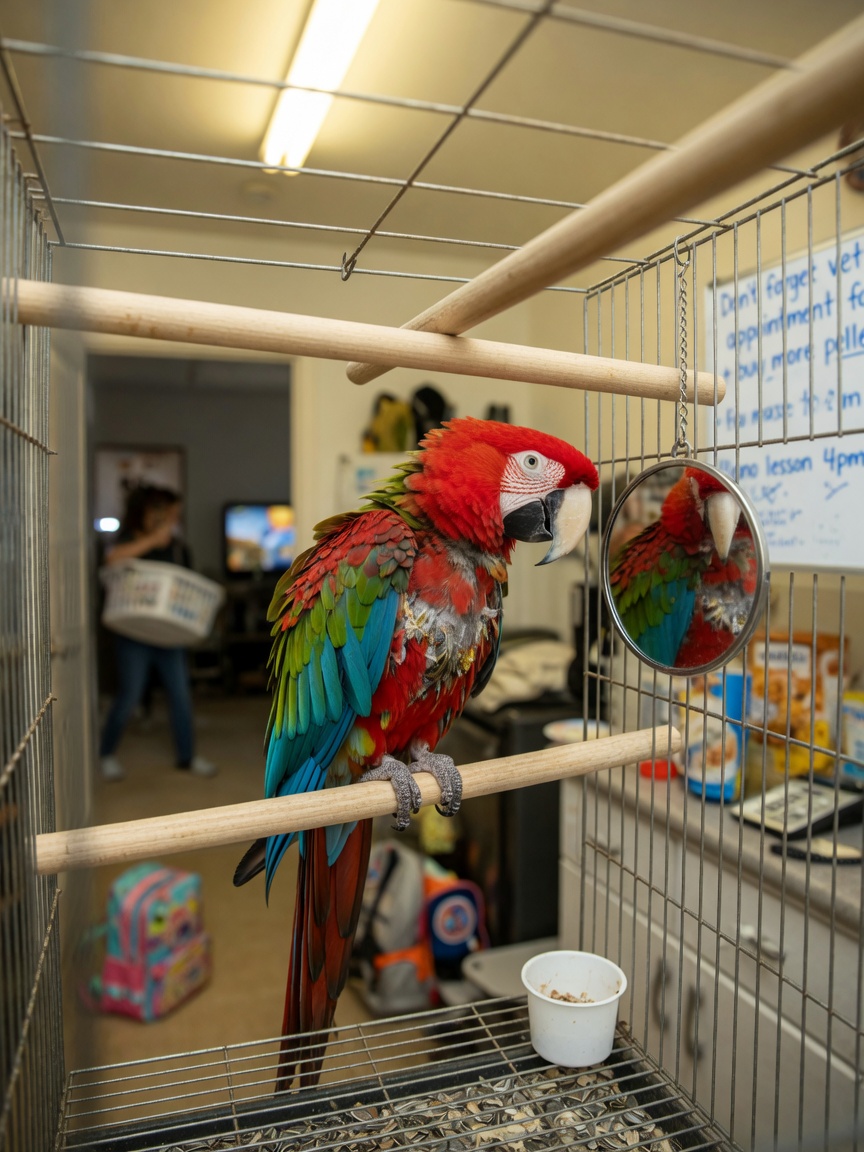
Once medical causes have been excluded or treated and plucking continues, the focus shifts to environment and psychology. Parrots are among the most cognitively complex animals kept as pets, and their emotional needs are routinely underestimated.
Boredom and Understimulation
A parrot left alone for eight hours a day with nothing but a mirror and two perches is an animal in a deeply impoverished environment. In the wild, parrots spend the majority of their waking hours foraging, socialising, flying, and problem-solving. Captivity compresses all of that activity into virtually nothing. Feather plucking can become a self-stimulatory behaviour — essentially, the bird creates its own sensation in the absence of anything meaningful to do.
Separation Anxiety and Over-Bonding
It sounds counterintuitive, but a parrot that is excessively attached to one person can be just as psychologically vulnerable as a neglected one. When that person leaves the room, the bird experiences genuine distress. Feather plucking often begins or worsens during life changes: a new job with longer hours, a house move, the arrival of a baby, or the loss of a companion animal.
Fear and Chronic Stress
Placement matters enormously. A cage positioned near a busy doorway, opposite a window where predatory birds are visible, or in a room with unpredictable noise levels can keep a parrot in a state of low-grade chronic stress. Over time, that stress expresses itself physically.
Sexual Frustration
Seasonally, many parrots experience hormonal surges that create frustration when there is no appropriate outlet. This is particularly common in species such as cockatoos and African greys during spring months.
What You Can Do
- Book an avian vet appointment before assuming the cause is behavioural. Request a full blood panel, skin examination, and PBFD test if not recently done.
- Audit the diet. Transition away from seed-dominant feeding towards pellets, fresh vegetables, leafy greens, and appropriate protein sources.
- Enrich the environment consistently. Rotate foraging toys, introduce novel textures and materials, and allow supervised out-of-cage time daily.
- Review placement of the cage. Avoid draughts, direct sun for extended periods, kitchens, and high-traffic areas with unpredictable movement.
- Avoid punishment of any kind. Shouting at or restraining a plucking bird increases stress and almost always makes the behaviour worse.
- Consider whether the bird has meaningful social contact. For highly social species, a compatible companion bird — introduced carefully — can make a significant difference.
Feather plucking rarely resolves quickly, and in chronic cases the follicles can be damaged to the point where full regrowth is no longer possible. The earlier the intervention, the better the outcome. Work with an avian veterinarian rather than attempting to diagnose or treat this at home, because the stakes — for a creature that may live forty years or more — are genuinely high.