
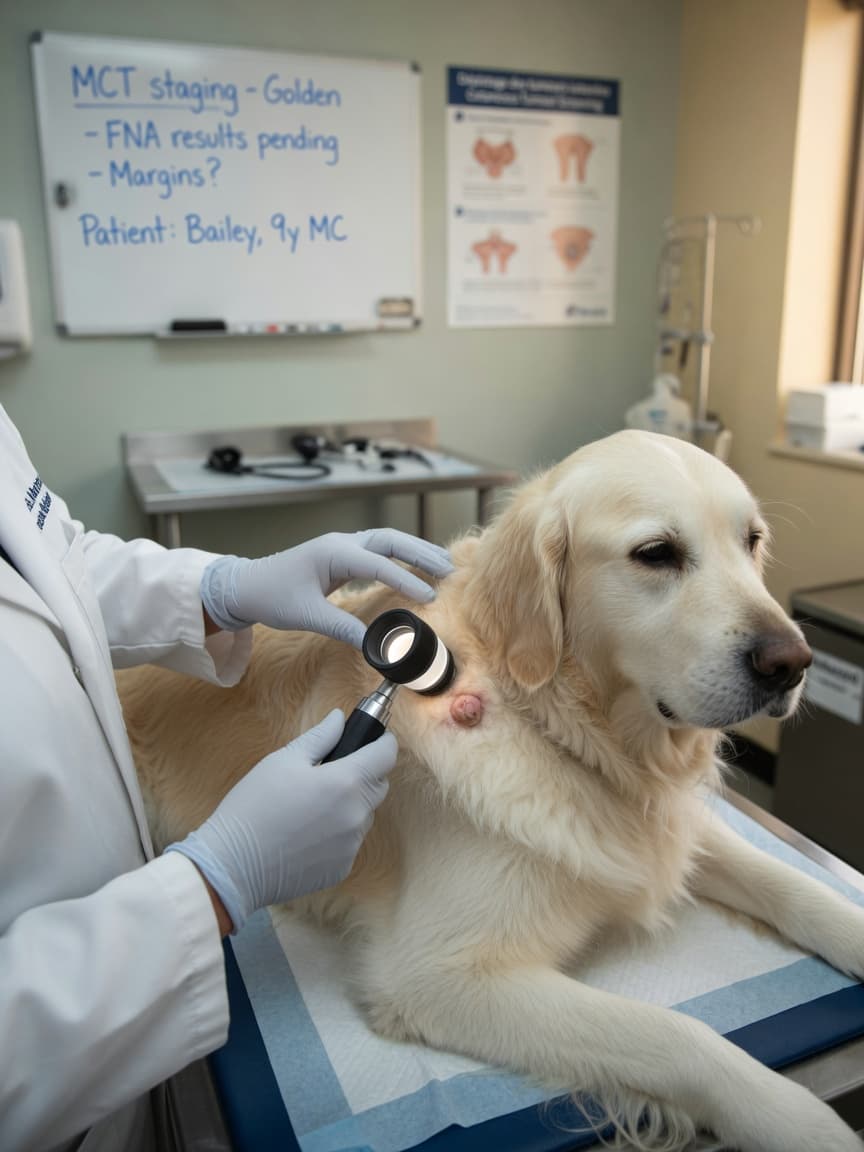
Mast Cell Tumours in Dogs: The Grade System and What It Means for Treatment
Mast cell tumours are the most common malignant skin tumours diagnosed in dogs, accounting for roughly 20% of all canine skin tumours. If your dog has been diagnosed with one, the first thing your vet will discuss is grading — and understanding what that means can help you make sense of the treatment options ahead.
What Are Mast Cell Tumours?
Mast cells are a normal part of the immune system. They play a role in allergic responses and wound healing, and they are found throughout the body, particularly in the skin, lungs, and digestive tract. When these cells begin to multiply abnormally, a mast cell tumour forms.
These tumours can look deceptively harmless — a small raised lump that waxes and wanes, sometimes looking like an insect bite or a cyst. They can also behave unpredictably, releasing histamine and other chemical compounds when disturbed, which can cause local redness, swelling, and in severe cases, systemic effects such as vomiting or drops in blood pressure.
Which Dogs Are Most at Risk?

While any dog can develop a mast cell tumour, certain breeds are significantly over-represented in diagnoses. Boxers, Bulldogs, Boston Terriers, Labrador Retrievers, and Golden Retrievers are among the most commonly affected. Pugs, Weimaraners, and Rhodesian Ridgebacks also appear on the higher-risk list.
Middle-aged to older dogs are most frequently diagnosed, though mast cell tumours can appear in younger animals too. There is no strong sex predisposition reported across the breed population as a whole.
The Grading System Explained
Grading is the cornerstone of mast cell tumour management because the grade directly influences both prognosis and treatment planning. There are two grading systems currently in use, and understanding the difference matters.
The Patnaik Three-Tier System
For many years, veterinary oncologists used the Patnaik system, which classifies tumours into three grades based on how the cells look under a microscope and how deeply they invade surrounding tissue.
- Grade I tumours are well-differentiated, confined to the superficial layers of skin, and carry an excellent prognosis. Surgical removal alone is often curative.
- Grade II tumours are intermediate. They are the most common grade diagnosed, and outcomes vary considerably depending on additional factors such as location, mitotic index, and whether margins are clean after surgery.
- Grade III tumours are poorly differentiated, aggressive, and carry a guarded to poor prognosis. These tumours are more likely to spread to lymph nodes and internal organs.
The Kiupel Two-Tier System
More recently, a two-tier system developed by Dr Kiupel has gained traction because it provides clearer prognostic information, particularly for the previously ambiguous Grade II category. Under this system, tumours are classified as either low grade or high grade based primarily on mitotic figures — essentially, how rapidly the cells are dividing.
High-grade tumours under the Kiupel system carry a significantly worse prognosis, with median survival times of around four months without aggressive treatment. Low-grade tumours behave much more favourably. Many pathology reports now include both grading systems, so ask your vet to walk you through what your dog's specific report says.
Staging: Looking Beyond the Tumour
Grading tells you about the tumour itself. Staging tells you whether the cancer has spread. For mast cell tumours, staging typically involves fine needle aspiration of nearby lymph nodes, abdominal ultrasound to assess the liver and spleen, and in higher-grade cases, a buffy coat smear to look for circulating mast cells in the blood.
Bone marrow aspiration is sometimes recommended for high-grade or disseminated cases. The more advanced the stage, the more systemic the treatment approach needs to be.
Treatment Options
Surgery
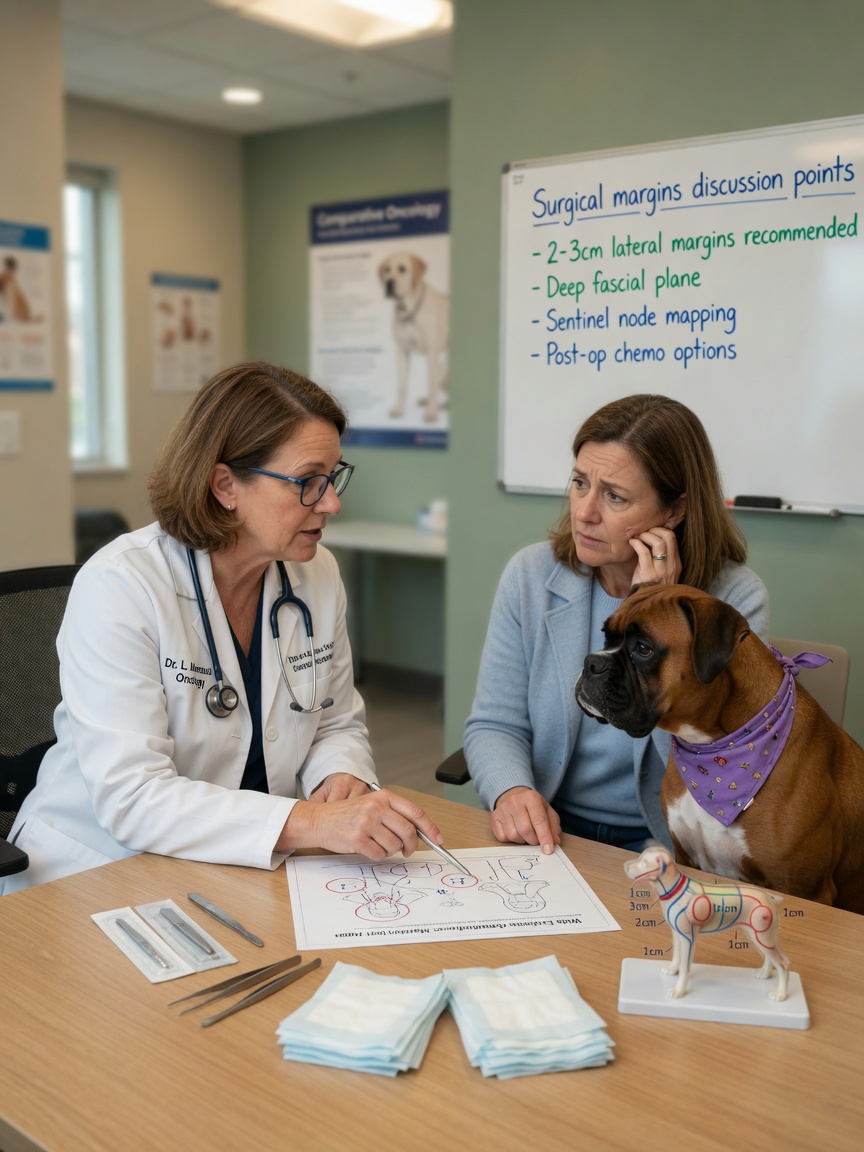
Surgical excision with wide, clean margins remains the first-line treatment for most localised mast cell tumours. Margins of at least two centimetres around the tumour are typically aimed for, though this is not always achievable depending on location — tumours on the face, paws, or groin present particular challenges.
Clean margins are a strong positive prognostic indicator. When margins are incomplete, re-excision, radiation therapy, or adjuvant medical treatment is usually recommended.
Radiation Therapy
Radiation is particularly useful for tumours in locations where surgical margins are difficult to achieve, or as an adjuvant therapy following incomplete excision. It is effective for local disease control and can provide durable remission in appropriate cases.
Medical Management
For incompletely excised or metastatic tumours, medical management plays a central role. Tyrosine kinase inhibitors — toceranib phosphate (Palladia) and masitinib (Kinavet) — are oral targeted therapies that have shown meaningful response rates in dogs with measurable mast cell disease. These are not chemotherapy in the traditional sense; they work by blocking specific molecular pathways that drive tumour cell growth.
Traditional chemotherapy agents such as vinblastine and lomustine are also used, particularly for high-grade or metastatic disease, often in combination protocols.
Supportive Care
Because mast cell tumours release histamine, antihistamines such as diphenhydramine or chlorphenamine and H2 blockers such as famotidine are frequently prescribed alongside treatment to protect the gastrointestinal tract and reduce systemic effects from tumour degranulation.
What Affects Prognosis?
Prognosis depends on a combination of factors: tumour grade and stage, the completeness of surgical excision, the location of the tumour, and whether the dog's lymph nodes or internal organs are involved. Mitotic index — the rate at which cells are dividing — is one of the strongest individual predictors of outcome.
Dogs with low-grade, completely excised mast cell tumours frequently go on to live normal lifespans without recurrence. For higher-grade or metastatic disease, the goal shifts toward disease control and quality of life, with median survival times varying widely depending on the treatment approach chosen.
Working closely with a veterinary oncologist gives you access to the most current protocols and the clearest picture of what to expect for your individual dog.