
What Are Cat Ear Mites?
Otodectes cynotis is the species responsible for the vast majority of ear mite infestations in cats across Europe. These tiny, eight-legged parasites live primarily within the ear canal, feeding on ear wax, skin debris, and tissue fluid. They are just visible to the naked eye as tiny white moving specks, though most owners never see them directly — it is the consequences of their presence that become apparent.
Ear mites are extraordinarily common, particularly in young cats, kittens, and cats with outdoor access. They are highly contagious between cats and dogs living in the same household, passing through direct contact during social grooming, play, and shared sleeping areas. They do not infest humans, though brief transient contact is possible.
The Life Cycle of Otodectes cynotis
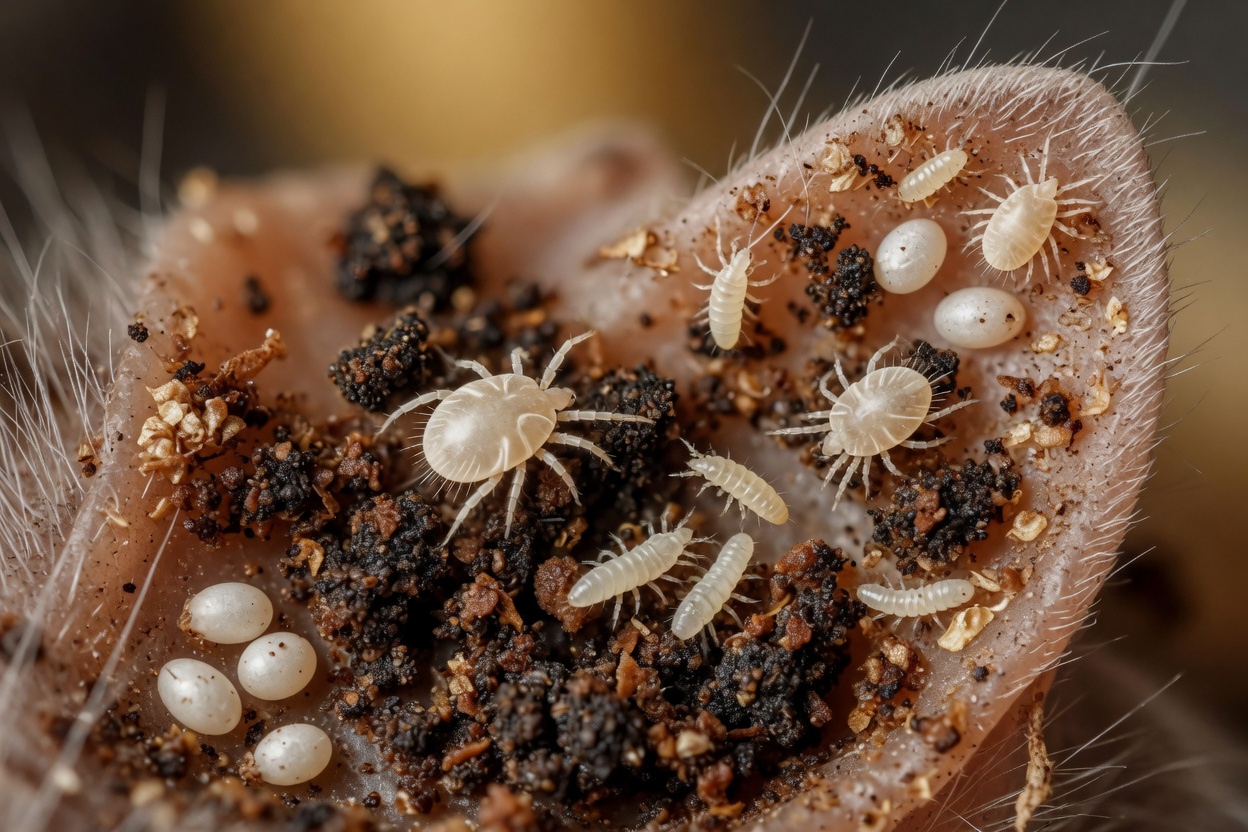
Understanding the mite's life cycle explains why some treatments fail — and why treating all pets in the household simultaneously is non-negotiable. The complete life cycle from egg to reproducing adult takes approximately three weeks and proceeds through four stages:
- Egg: Eggs are glued to the skin and debris inside the ear canal. They hatch within four days.
- Larva: The six-legged larva feeds for three to ten days before moulting.
- Nymph (two stages): Two nymphal stages follow, each involving feeding and moulting. The entire nymphal phase lasts approximately one week.
- Adult: Adult mites live for approximately two months. Females lay up to five eggs per day.
Crucially, mites can survive off the host in the environment — on bedding, blankets, and soft furnishings — for several days. This environmental reservoir must be addressed alongside treating all animals in the home, or re-infestation will occur.
Symptoms of Ear Mites in Cats

The presence of ear mites causes intense irritation and inflammation within the ear canal. Typical signs include:
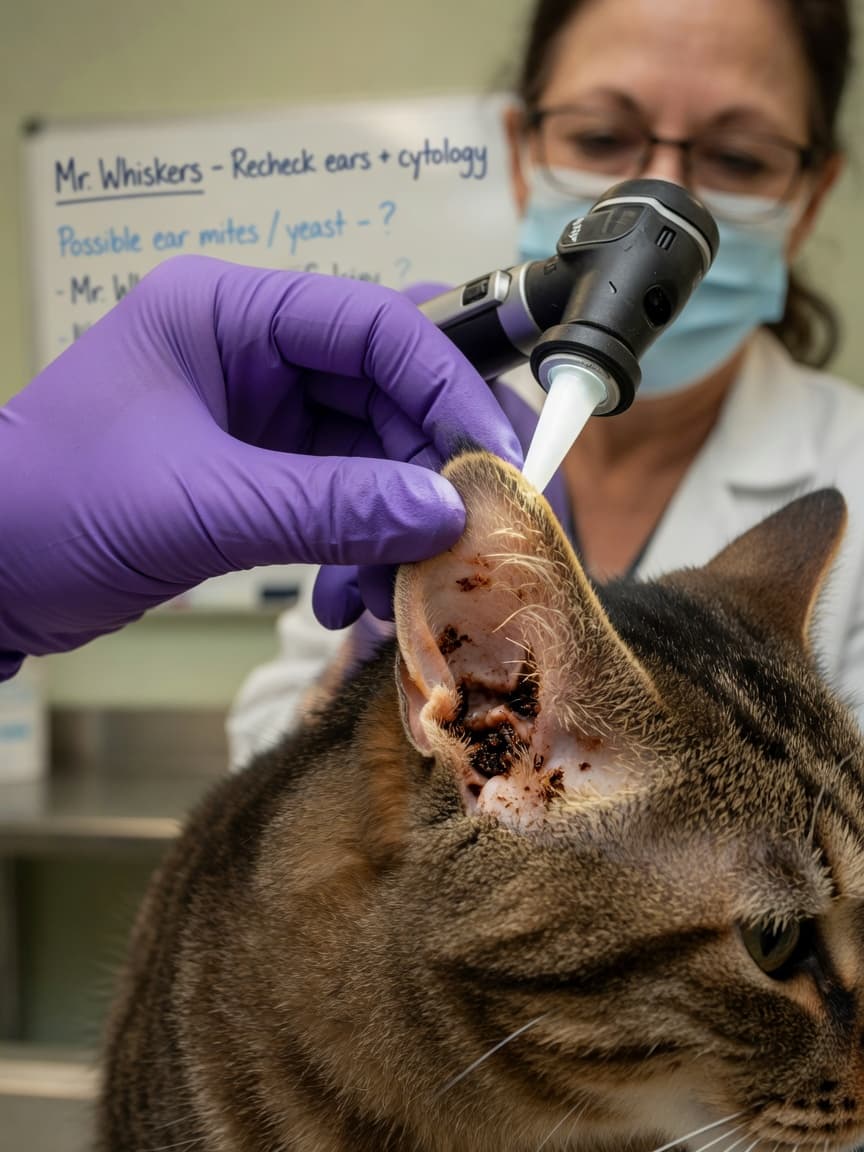
- Dark, crumbly discharge: Often described as resembling coffee grounds or dark brown wax, this is a mixture of wax, mite faeces, dried blood, and debris. It is one of the most characteristic signs of ear mite infestation.
- Vigorous head shaking: The intense irritation drives repeated, often violent head shaking in an attempt to dislodge the sensation.
- Constant scratching at the ears: Cats may scratch so intensely that they cause self-inflicted wounds around the ear base, leading to crusting and hair loss — an excoriation reaction.
- Odour from the ear
- Aural haematoma: In severe cases, the vigorous head shaking can rupture blood vessels within the ear flap (pinna), causing it to fill with blood — a painful condition requiring veterinary treatment.
- Ectopic infestations: In some cats, mites migrate out of the ear canal and infest the skin of the neck, rump, and tail base, causing generalised itching and scaling.
Diagnosis
Your vet will examine the ear canal with an otoscope and typically see the mites moving on the debris surface. A sample of the dark discharge can also be placed on a dark background under a bright light, where the white mites may be observed moving. Microscopic examination of a swab sample confirms the identification. In straightforward cases with a typical history and clinical signs, many vets are comfortable making a clinical diagnosis without further testing.
It is important to rule out other causes of dark, waxy ear discharge — particularly yeast (Malassezia) overgrowth — as the treatments differ. Ear cytology (microscopic examination of a stained ear swab) can definitively differentiate between the two.
EU-Licensed Treatments
Several highly effective treatments are licensed for ear mites in cats across the European Union. Modern spot-on preparations have largely replaced the older approach of daily ear drops applied for three to four weeks, which required high owner compliance to be effective.
Selamectin Spot-On
Selamectin (marketed as Stronghold in the EU, manufactured by Zoetis) is applied to the back of the neck as a spot-on and is licensed for the treatment of ear mites in cats. It works systemically — absorbed through the skin and distributed throughout the body — killing mites that feed on skin secretions. A single application is often curative, though a second application four weeks later is sometimes recommended in heavily infested animals. Selamectin also provides concurrent protection against roundworms and fleas.
Moxidectin/Imidacloprid Spot-On
The combination of moxidectin and imidacloprid (marketed as Advocate in the EU, manufactured by Elanco) is also widely used and licensed for ear mite treatment in cats. Moxidectin acts on the mite's nervous system, while imidacloprid provides flea control. As with selamectin, it is applied as a spot-on and acts systemically.
Topical Ear Treatments
Products containing ivermectin, thiabendazole, or pyrethrins applied directly into the ear canal are available but require prolonged daily use — typically 21–28 days — to break the life cycle. Compliance is the major challenge with this approach.
Treating All Household Pets
This step is non-negotiable and is the single most common reason for treatment failure. Every cat and dog in the household must be treated simultaneously, even if they show no signs of ear irritation. Mites can be present in sub-clinical numbers on an animal that shows no obvious symptoms, which will re-infest treated pets within weeks.
Choose a treatment appropriate for each species — never apply a cat product to a dog or vice versa without veterinary confirmation that it is safe, as some antiparasitic agents are toxic at different dosages across species.
Environmental Decontamination
While mites cannot survive long off the host, eliminating the environmental reservoir reduces the risk of re-infestation:
- Wash all pet bedding, blankets, and soft toys at 60°C
- Vacuum soft furnishings, carpets, and cat sleeping areas thoroughly
- Clean and spray the environment with a veterinary-approved household flea spray — many of these are also effective against mites
Zooplus stocks a range of spot-on parasite treatments and household environmental sprays suitable for multi-pet households, available across the EU with convenient home delivery.
Prevention
Cats with outdoor access or those that come into contact with unfamiliar animals are at ongoing risk of re-infestation. Monthly application of a broad-spectrum spot-on that covers ear mites — such as selamectin or moxidectin/imidacloprid — provides continuous protection. Regular visual inspection of the ears, combined with periodic veterinary ear checks, allows early detection before a full infestation develops. Keeping cats' ears clean and monitoring for the first signs of excess dark wax or head scratching enables prompt intervention and a much simpler treatment course.