
What Is Hydrocephalus?
Hydrocephalus — sometimes described colloquially as water on the brain — is a condition in which cerebrospinal fluid (CSF) abnormally accumulates within the ventricular system of the brain. The ventricles are fluid-filled spaces within the brain that normally contain a small, precisely regulated amount of CSF. When this fluid accumulates in excess, the resulting pressure can compress and damage surrounding brain tissue, leading to a range of neurological signs that vary in severity from subtle to profound.
It is important to understand that some degree of ventricular enlargement is considered a normal anatomical feature in certain toy and brachycephalic breeds, and the presence of larger than average ventricles on imaging does not automatically indicate clinically significant hydrocephalus. The distinction between incidental finding and active disease depends on whether clinical signs are present and attributable to the fluid accumulation.
Which Dogs Are Most Affected?

Hydrocephalus in dogs is predominantly a condition of small and toy breeds. Chihuahuas, Yorkshire Terriers, Maltese, Pomeranians, Pugs, English Bulldogs, Boston Terriers, and Lhasa Apsos are among those most commonly reported. These breeds share anatomical characteristics — domed skulls, shortened facial anatomy, and altered brain proportions — that predispose them to abnormal CSF dynamics.
The condition can also occur as an acquired problem in any breed, secondary to brain inflammation, infection, tumour, or trauma that obstructs CSF flow. Acquired hydrocephalus may develop in older dogs as well as puppies and young adults.
Congenital vs Acquired Hydrocephalus
Congenital Hydrocephalus
Congenital hydrocephalus is present from birth and is the form most associated with the toy breeds listed above. Signs typically emerge in young puppies and may be noticed from a few weeks to several months of age. The condition may be apparent from birth in severe cases, with obvious dome-shaped skulls and outward-diverging eyes (sometimes called sunset eyes, where the pupils appear angled downward and outward).
In milder congenital cases, signs may not become apparent until the puppy is several months old and begins failing to meet developmental milestones, or displays unusual behaviour that prompts veterinary attention.
Acquired Hydrocephalus
Acquired hydrocephalus develops as a consequence of another disease process. Brain tumours can physically block CSF drainage pathways. Inflammatory brain diseases, viral encephalitis, and bacterial meningitis can cause obstruction through inflammation and debris within the ventricular system. In these cases, identifying and treating the underlying cause is part of the therapeutic approach, alongside managing the hydrocephalus itself.
Clinical Signs

The neurological signs of hydrocephalus reflect damage to, or pressure on, the cerebral cortex and surrounding structures. They are variable between affected individuals, and severity tends to correlate with the degree of brain compression and whether the condition is progressive.
- Altered mental status: This is one of the most consistent findings. Affected dogs may appear vacant, unresponsive, or difficult to engage. Learning and training may be significantly impaired, with puppies failing to housetrain or learn basic responses.
- Seizures: Epileptic activity is a common and often distressing sign. Seizures may range from brief focal episodes to generalised convulsions.
- Vision changes: Cortical blindness — where the eye is structurally normal but the dog cannot interpret visual signals due to cortical damage — may occur. Affected dogs may bump into objects, appear startled by sudden movement, or fail to track moving toys.
- Gait abnormalities: Circling, aimless wandering, stumbling, or falling are commonly reported.
- Behavioural changes: Unusual aggression, excessive vocalisation, apparent confusion, or marked changes in temperament may signal cortical dysfunction.
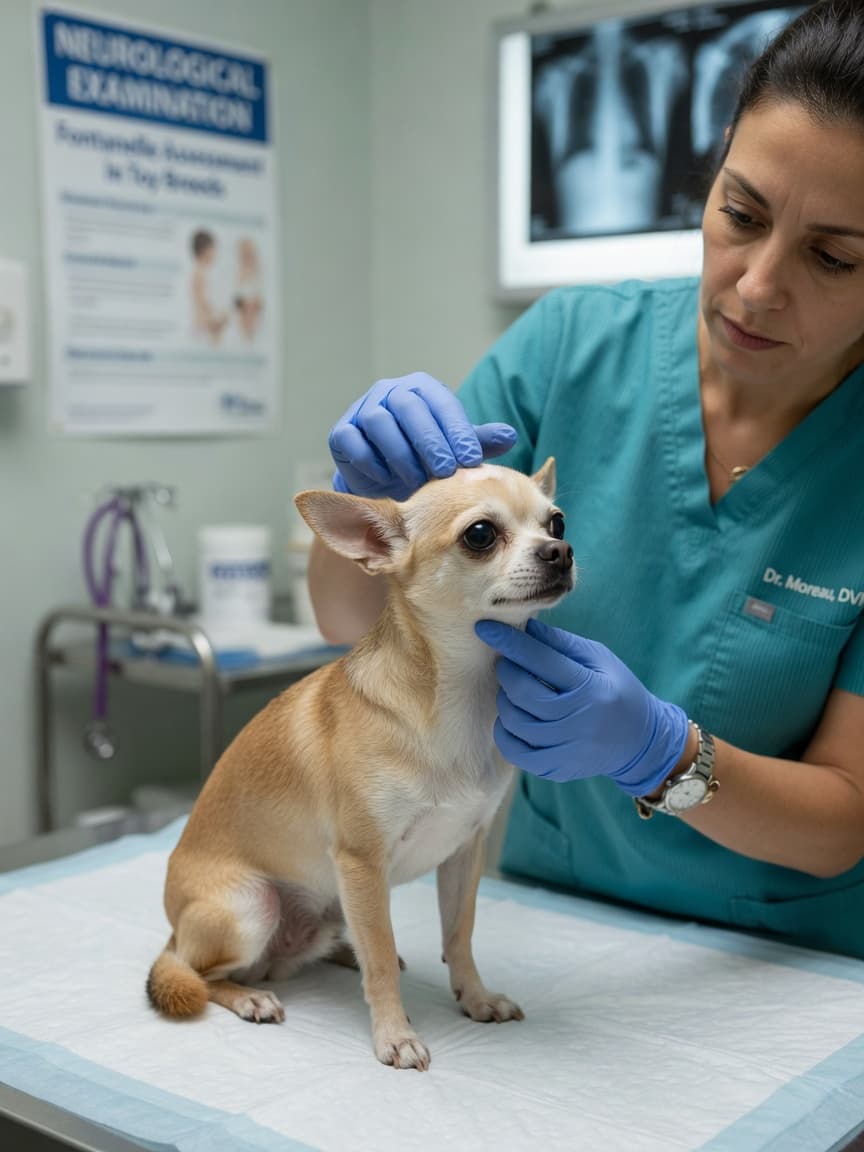
- Enlarged dome-shaped skull: In congenital cases, the skull may be visibly enlarged and domed, with a soft spot (persistent open fontanelle) palpable at the top of the head.
Diagnosis
Imaging is central to the diagnosis of hydrocephalus. MRI provides the most detailed information about ventricular size, brain compression, and underlying causes such as tumours or inflammatory lesions. Ultrasound through an open fontanelle — a technique that works only while the fontanelle remains open in young dogs — provides a useful, less invasive initial assessment tool in suspected congenital cases.
CT scanning can also demonstrate ventricular enlargement and is more readily available than MRI in many practices. CSF analysis via spinal tap is sometimes performed to investigate for underlying inflammatory or infectious causes, though this must be done with caution in cases of elevated intracranial pressure.
Medical Management
Medical treatment aims to reduce the production of cerebrospinal fluid and, in some cases, reduce inflammation within the brain. It is most effective in mild to moderate cases and in dogs who are not rapidly deteriorating.
- Corticosteroids: Prednisolone is frequently used to reduce brain oedema and inflammation, and may decrease CSF production to some degree. Long-term use requires careful management of side effects.
- Omeprazole: As with syringomyelia, this proton pump inhibitor is used on the basis of its potential to reduce CSF production, though robust clinical evidence remains limited.
- Furosemide: This loop diuretic has also been used to reduce CSF production in some cases.
- Anti-seizure medications: Where seizures are a feature, anticonvulsant therapy with drugs such as phenobarbital or potassium bromide is indicated.
Surgical Treatment
For dogs that do not respond adequately to medical management, or where signs are severe and progressive, surgical intervention is possible. The most established surgical technique is ventriculoperitoneal shunting, in which a small catheter is surgically placed within the dilated ventricle and tunnelled under the skin to the abdominal cavity, where excess CSF is continuously drained and absorbed. This procedure can produce dramatic improvements in some cases, with dogs who were profoundly affected showing significant neurological recovery.
Shunting is, however, a technically demanding procedure with potential complications including shunt blockage, infection, and shunt malfunction requiring revision surgery. It is performed by specialist veterinary neurosurgeons, and outcomes vary depending on how much irreversible brain damage occurred before treatment.
Prognosis and Long-Term Care
The prognosis for hydrocephalus depends on the severity of clinical signs, the underlying cause, how much brain damage has already occurred, and how well the condition is managed. Mildly affected dogs maintained on medical therapy can live for several years with a reasonable quality of life. Dogs with severe signs or rapidly progressive disease carry a more guarded prognosis.
Long-term care involves regular veterinary monitoring, consistent medication management, and careful attention to quality of life indicators. Affected dogs may have cognitive limitations that require patient, adapted training approaches. A low-stress home environment, consistent routines, and realistic expectations are all part of living successfully with a dog with hydrocephalus.
For breeders and owners of predisposed breeds, awareness of clinical signs and early veterinary assessment when abnormalities are noticed gives the best chance of intervention before irreversible neurological damage occurs.