
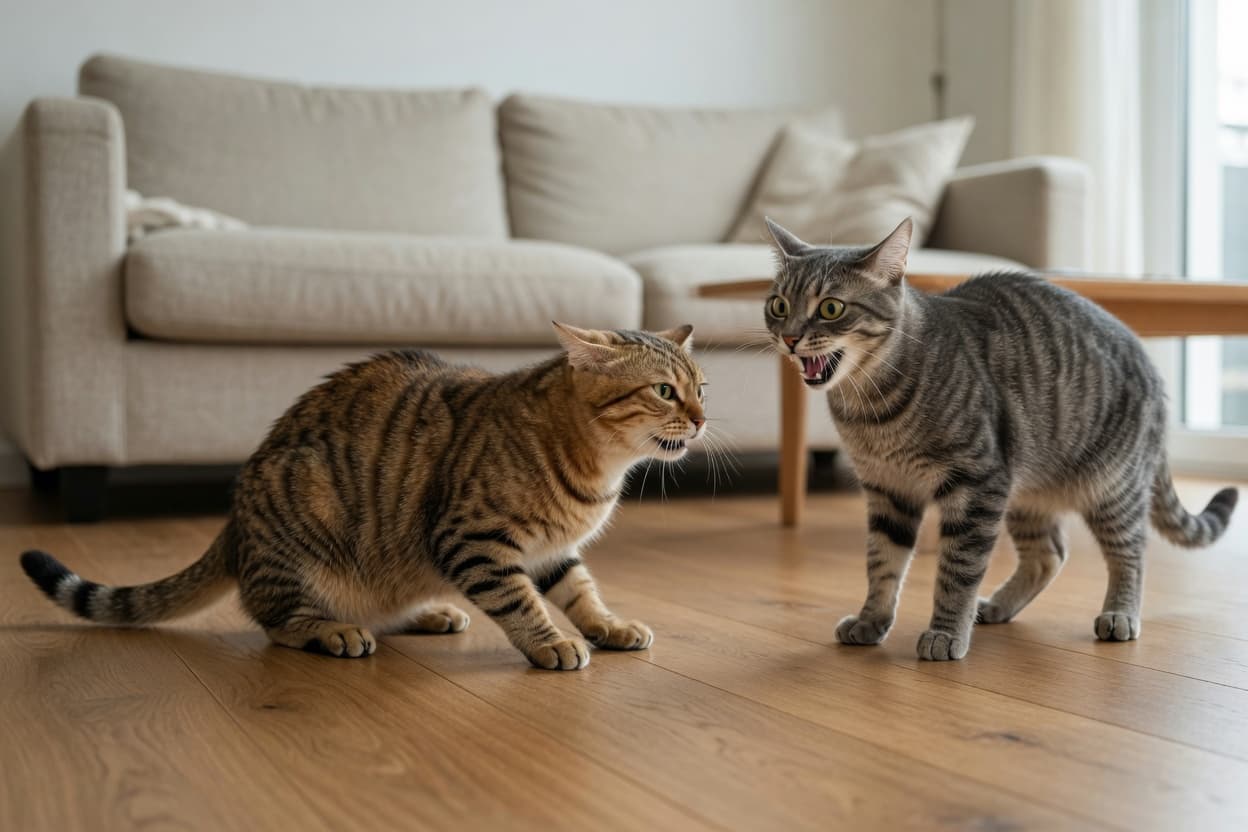
Cat Aggression Toward Other Cats: Understanding and Managing Multi-Cat Households
Cats are often described as asocial, but that is not quite accurate. They are more precisely described as facultatively social — capable of forming stable social groups under the right conditions, but not obligated to do so and highly sensitive to the circumstances in which they are expected to coexist. When those conditions are not met, the result is inter-cat aggression: one of the most common and most damaging welfare problems in multi-cat homes.
Types of Inter-Cat Aggression
Not all cat aggression is the same, and distinguishing between types is important for choosing the right approach.
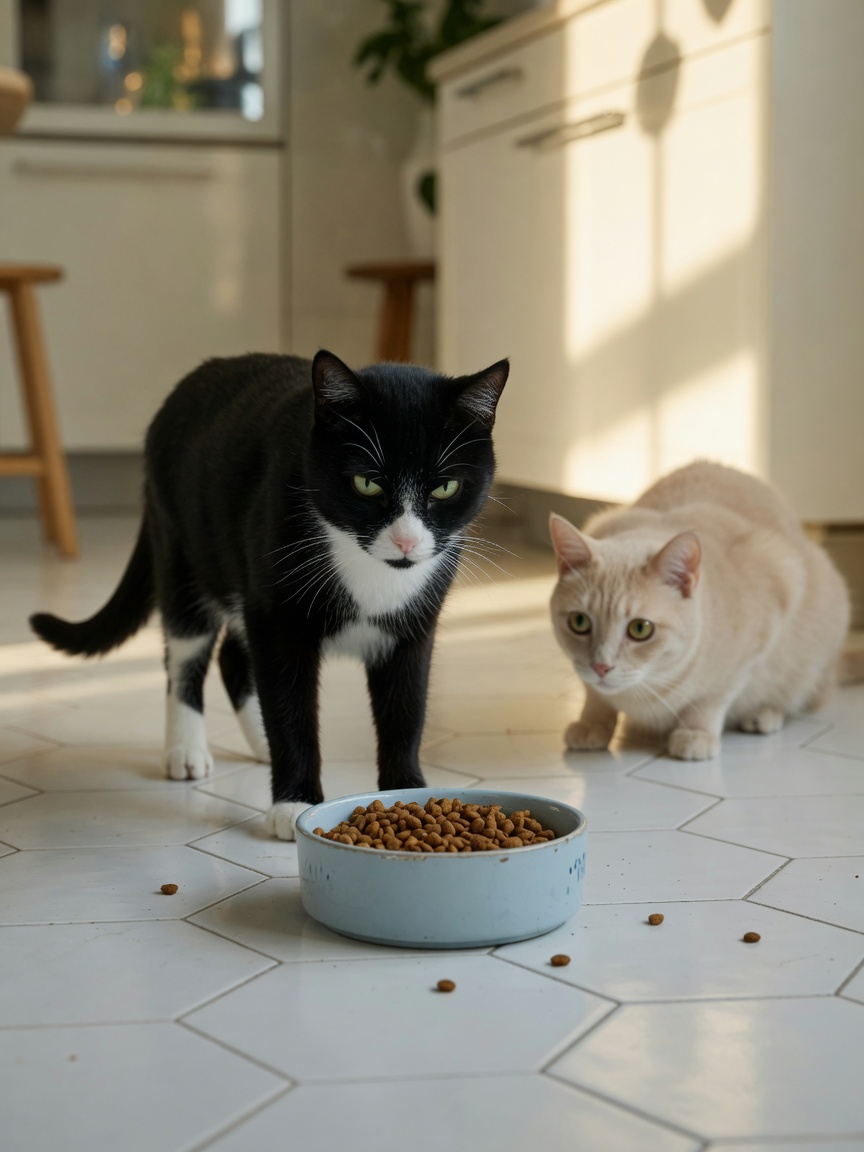
Status-related or resource-related aggression occurs when cats compete for valued resources — food, resting places, litter trays, or human attention. In these cases, the aggressor is typically motivated by control of a specific resource rather than generalised hostility, and the situation often escalates gradually over time rather than emerging suddenly.
Territorial aggression is most commonly triggered by the introduction of a new cat into an established resident's territory. The resident cat experiences the newcomer as an intruder, and the newcomer's presence activates a threat response regardless of how friendly either individual might be in isolation. This type of aggression can be severe in the early stages of introduction and requires careful management.
Redirected aggression is frequently misdiagnosed. A cat that becomes highly aroused by an external stimulus — a cat visible through a window, for example — may redirect that aggression onto the nearest available target, which is often a housemate. The apparent attack seems unprovoked, which confuses owners who do not connect it to the triggering event that may have occurred minutes or even hours earlier. Redirected aggression can be dramatic in intensity and may seriously damage the relationship between cats who were previously compatible.
Play aggression in young or underenriched cats can escalate beyond what the target is willing to tolerate. It is distinguished from genuine aggression by the absence of growling, hissing, and piloerection, and by a pattern of taking turns chasing rather than one cat consistently pursuing another.
Reading the Signals
Understanding feline body language is essential for assessing the severity of inter-cat tension. Overt aggression — chasing, fighting, vocalisation — is easy to identify but represents only the visible end of a spectrum. Passive aggression and chronic social stress are far more common and equally damaging to welfare.
Signs of a cat being chronically socially stressed by a housemate include: blocking access to resources (sitting near the food bowl or litter tray in a way that prevents the other cat approaching), staring, slow deliberate movement toward the other cat, and displacement of the subordinate cat from preferred resting locations. The subordinate cat may respond by hiding, reducing food intake, over-grooming, or developing stress-related physical illness.
It is worth noting that cats who appear to "ignore" each other are not necessarily living harmoniously. True compatibility involves mutual tolerance of proximity, shared use of resources without tension, and occasionally allogrooming or resting in contact. Many multi-cat households contain cats that are managing chronic stress rather than genuinely coexisting well.
Resource Management as the Primary Intervention
The most effective and evidence-supported intervention for inter-cat conflict is resource management. Competition over scarce or poorly positioned resources drives a significant proportion of inter-cat tension, and addressing this alone can dramatically reduce aggression without any other intervention.
- Provide a minimum of one resource of each type per cat, plus one additional. Food stations, water bowls, litter trays, and high-value resting spots should all meet this minimum.
- Position resources in separate locations that cannot be guarded simultaneously by a single cat. A dominant cat stationed at a central resource hub can prevent subordinate cats from meeting basic needs entirely.
- Feed cats in separate locations to eliminate mealtime conflict. Many owners feed cats side by side, inadvertently creating a high-stakes proximity event twice daily.
- Ensure that all cats have access to vertical escape routes and concealed resting places throughout the home. A subordinate cat with no retreat option is a cat under severe chronic stress.
Introducing a New Cat Correctly
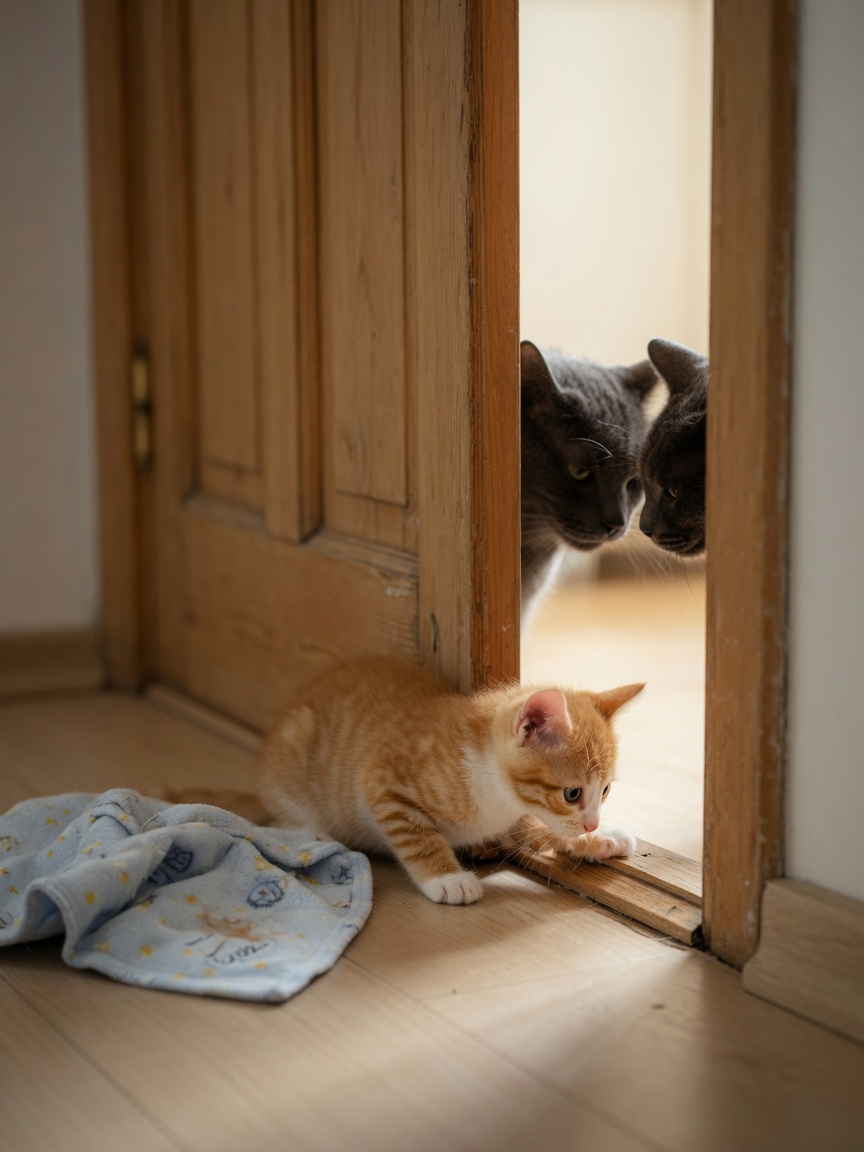
The single most preventable cause of long-term inter-cat conflict is a rushed introduction. Allowing cats to meet immediately almost always creates a negative first impression that is difficult to reverse. The gold standard protocol involves a gradual introduction over a minimum of two to four weeks.
The new cat should be housed in a separate room with all necessary resources for the first period. Scent exchange — swapping bedding between the resident and newcomer, feeding both cats on opposite sides of a closed door — allows olfactory familiarity to develop before any visual contact. Visual contact through a barrier, such as a cracked door or a baby gate with a mesh insert, is introduced only once both cats are eating calmly near the door. Supervised face-to-face contact in a neutral space follows, always under close observation and with the ability to separate immediately if tension escalates.
Rushing any stage sets the introduction back significantly. Patience at the outset is far less costly than months of conflict resolution later.
When Conflict is Established
Where inter-cat aggression is already entrenched, a full reintroduction — separating the cats and beginning the protocol from scratch — is often the most effective approach. This is labour-intensive but has a substantially better outcome than attempting to manage conflict between cats that have already formed a negative associative history with each other.
Pheromone products formulated for multi-cat households (such as Feliway MultiCat, which contains a synthetic version of the cat-appeasing pheromone) have a modest evidence base for reducing inter-cat tension and are worth using as an adjunct. They do not resolve underlying resource competition or incompatible social relationships, but they can lower tension sufficiently for other strategies to work.
In cases of severe, persistent aggression that does not respond to environmental management, referral to a board-certified veterinary behaviourist is strongly recommended. In some cases, the honest conclusion is that particular cats are genuinely incompatible and that rehoming one individual is the kindest outcome for both animals.