
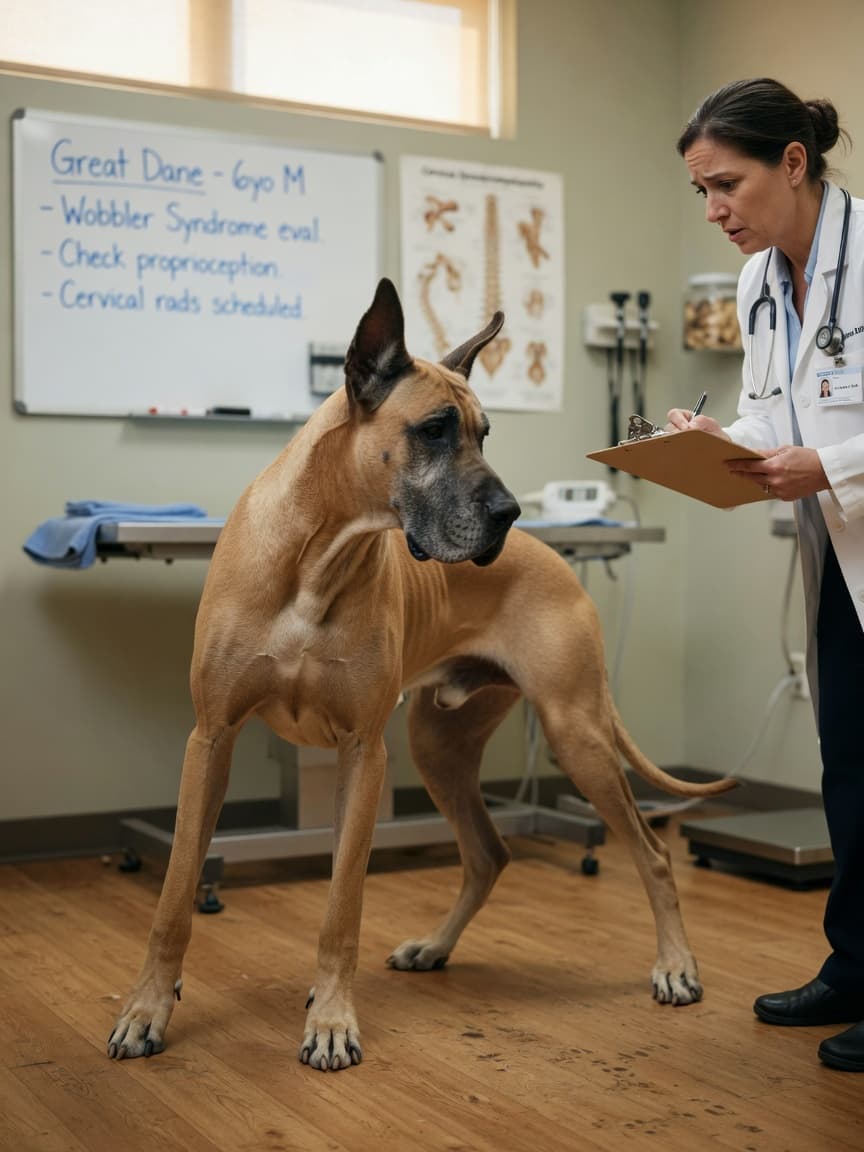
The Staggering Gait That Should Never Be Ignored
A large dog walking with a characteristic swaying, uncoordinated hindlimb gait — as though perpetually off-balance — is a recognisable and distressing sight. In Great Danes and Dobermanns, this picture is a hallmark of cervical spondylomyelopathy, commonly called Wobbler syndrome. It is one of the most challenging neurological conditions encountered in these breeds, with a complex pathology, significant treatment decisions to navigate, and an outcome that depends heavily on early recognition and specialist management.
What Wobbler Syndrome Is — and Why These Breeds
Cervical spondylomyelopathy encompasses a group of conditions involving instability, malformation, or disc-related compression in the cervical (neck) region of the spine, resulting in spinal cord compression and the progressive neurological deficits that follow. Two distinct disease subtypes predominate, and they tend to affect different breeds in different ways.
In Great Danes and other giant breeds, the condition typically presents in young dogs — often between one and three years of age — and is associated with osseous or bony malformation of the vertebrae, particularly the caudal cervical vertebrae. This is sometimes referred to as the juvenile form. In Dobermanns, the condition more commonly presents in middle-aged to older adults and is driven primarily by disc herniation and soft tissue hypertrophy at multiple cervical levels, classically described as the disc-associated form.
The precise aetiology remains an area of active research. Rapid growth rates and nutritional factors during development have been implicated in giant breeds. Hereditary predisposition is strongly suspected in Dobermanns, where the condition is unfortunately common — some estimates suggest it affects a substantial proportion of the breed by middle age.
Clinical Signs and How They Progress
The characteristic gait
The hindlimb ataxia that gives this condition its colloquial name is usually the most striking early sign. Affected dogs appear drunk or wobbly, crossing their hindlimbs, stumbling, or swaying during normal walking. This occurs because compression at cervical spinal cord levels disrupts the ascending proprioceptive pathways — the neurological system that tells the brain where the limbs are in space.
Forelimb involvement
As the condition progresses, or in dogs with severe compression, forelimb signs emerge. Short-strided forelimb gait, scuffing of the toenails, and a general stiffness or rigidity in movement reflect involvement of the motor pathways supplying the front limbs. Some dogs are noted to hold their head low, reluctant to flex the neck, reflecting cervical pain. In advanced cases, dogs may become non-ambulatory in both hindlimbs and forelimbs.
Signs are often insidious in onset, progressing over weeks to months, though acute deterioration can occur — particularly in disc-associated cases where sudden extrusion of disc material can cause rapid neurological decline.
Diagnosis: Imaging Is Non-Negotiable
Physical examination and neurological assessment localise the problem to the cervical spinal cord, but definitive diagnosis and surgical planning require advanced imaging. MRI is the preferred modality, providing detailed visualisation of disc material, soft tissue hypertrophy, spinal cord compression, and any signal change within the cord itself — the latter an important prognostic indicator. CT myelography remains a viable alternative and provides excellent bony detail relevant for surgical planning.
A defining and challenging feature of Wobbler syndrome is that compression is typically present at multiple vertebral levels. Identifying which levels are truly dynamic — worsening with flexion or extension of the neck — versus which are incidental findings on static imaging is important and may influence the surgical approach chosen. Dynamic or stress imaging, performed under anaesthesia with the neck in different positions, is used in specialist centres to address this question.
Treatment Options: A Complex Decision
Conservative management
Medical management using anti-inflammatory drugs, analgesia, and strict exercise restriction can stabilise some patients, particularly those with mild signs or where surgical risk is considered prohibitive. Neck brace use has been advocated by some clinicians to restrict cervical movement and reduce dynamic compression. Conservative management does not address the underlying structural problem, however, and a significant proportion of medically managed dogs experience disease progression.
Surgical decompression
For dogs with moderate to severe neurological deficits, progressive signs, or those failing to respond to conservative management, surgery offers the best chance of meaningful improvement. Multiple surgical approaches have been described and continue to evolve. Ventral slot decompression removes disc material from the front of the spinal canal. Dorsal laminectomy approaches the cord from above, removing portions of bone to relieve dorsal compression. Vertebral distraction and fusion techniques aim to decompose unstable segments whilst addressing disc space pathology simultaneously.
The so-called domino effect — in which surgical stabilisation at one level leads to accelerated degeneration at adjacent segments — is a recognised long-term concern and an area of ongoing debate in veterinary neurology. The decision about how many levels to address surgically, and by which technique, is genuinely complex and should only be made by a board-certified veterinary neurologist or neurosurgeon with full review of the individual dog's imaging.
Outcomes and realistic expectations
Surgical outcomes in Wobbler syndrome are variable and less predictable than in, for example, thoracolumbar IVDD. Improvement rates following surgery are reported in approximately eighty percent of cases in some series, but the degree of improvement varies widely. Dogs with severe or prolonged compression, or with spinal cord signal change on MRI, carry a more guarded prognosis. Recurrence and continued progression despite surgical intervention occur in a meaningful minority of cases. This reality requires an honest and informed conversation between owners and the specialist team before proceeding.
Living With a Dog Affected by Wobbler Syndrome
Whether a dog is managed conservatively or surgically, long-term adaptations are usually required. Ramps to avoid neck extension during feeding, raised food and water bowls to a comfortable height, harness walking to avoid collar pressure on the neck, and surface modifications to prevent slipping are all practical measures that reduce mechanical stress and improve daily safety.
Physiotherapy and hydrotherapy play a meaningful role in maintaining muscle mass, proprioceptive function, and quality of life both post-operatively and in medically managed patients. A qualified canine rehabilitation therapist familiar with neurological cases should be part of the care team where possible.
What Every Owner of an At-Risk Breed Should Know
- Any Great Dane or Dobermann showing hindlimb wobbling, crossing of the limbs, or unexplained neck stiffness should be assessed by a vet promptly
- Seek referral to a veterinary neurologist — general practice assessment alone is insufficient for diagnosis and treatment planning in Wobbler syndrome
- Insist on MRI or CT myelography before any treatment decision is made
- Ask your neurologist specifically about dynamic compression and whether stress imaging has been performed
- Understand that both conservative and surgical management carry risks and limitations — there is no universally correct answer
- Begin physiotherapy and environmental adaptations regardless of which treatment path is chosen
- Monitor for deterioration closely and communicate any changes to your veterinary team without delay
Wobbler syndrome demands specialist input, careful imaging, and an individualised approach. For the breeds most affected, awareness and early action are the most meaningful things an owner can provide.