
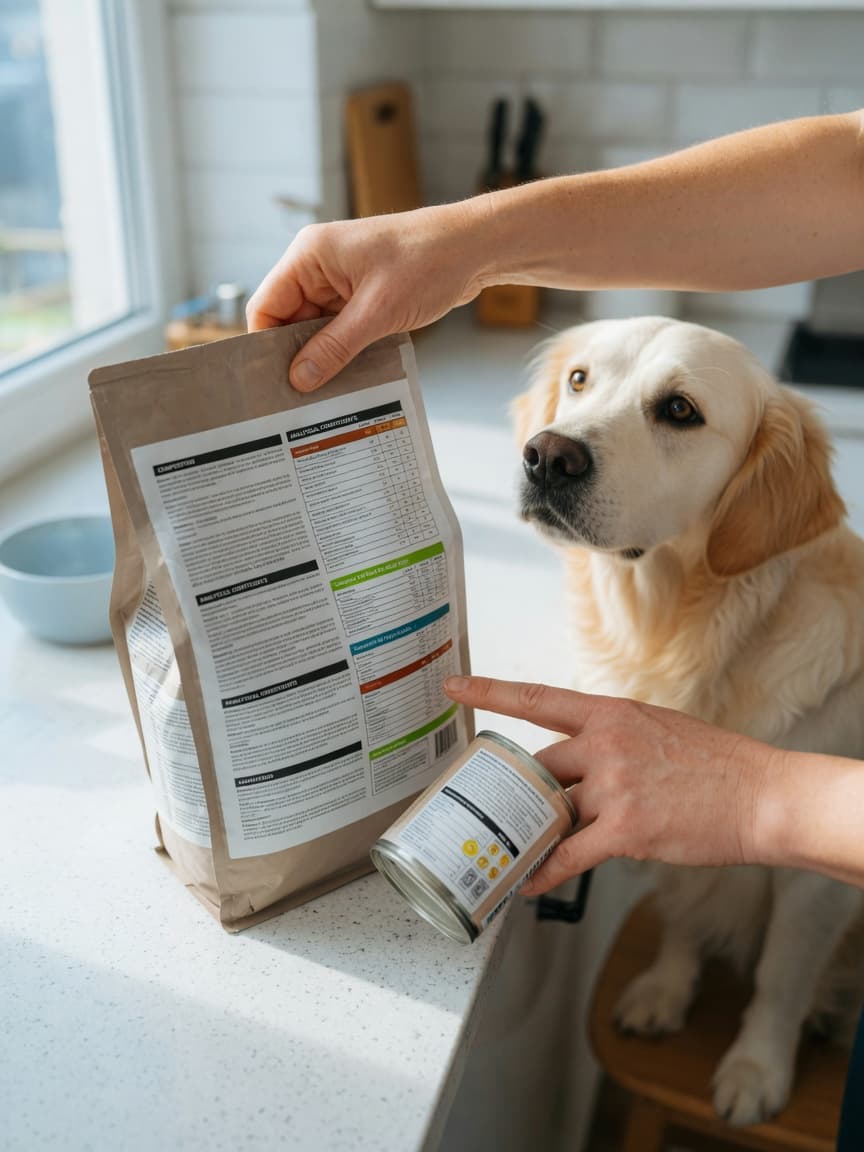
Why Labels Are Deliberately Difficult to Read
Pet food labelling in the UK and EU is governed by regulation, but the rules leave significant room for ambiguity. Manufacturers are required to list certain information, but they are not required to make it easy to interpret. Understanding the structure of a pet food label is one of the most practical skills a pet owner can develop — it allows you to cut through the front-of-pack claims and evaluate what is actually inside the bag or tin.
Front-of-Pack Claims: Ignore Them First
The front of any pet food packaging is an advertising space. Terms like "natural," "premium," "holistic," "ancestral," and "biologically appropriate" have no legal definition in pet food labelling. A product can display these words regardless of what its ingredient list contains. Train yourself to move past the front panel immediately and go straight to the ingredient list and guaranteed analysis on the back or side of the pack.
The Ingredient List: What the Rules Require
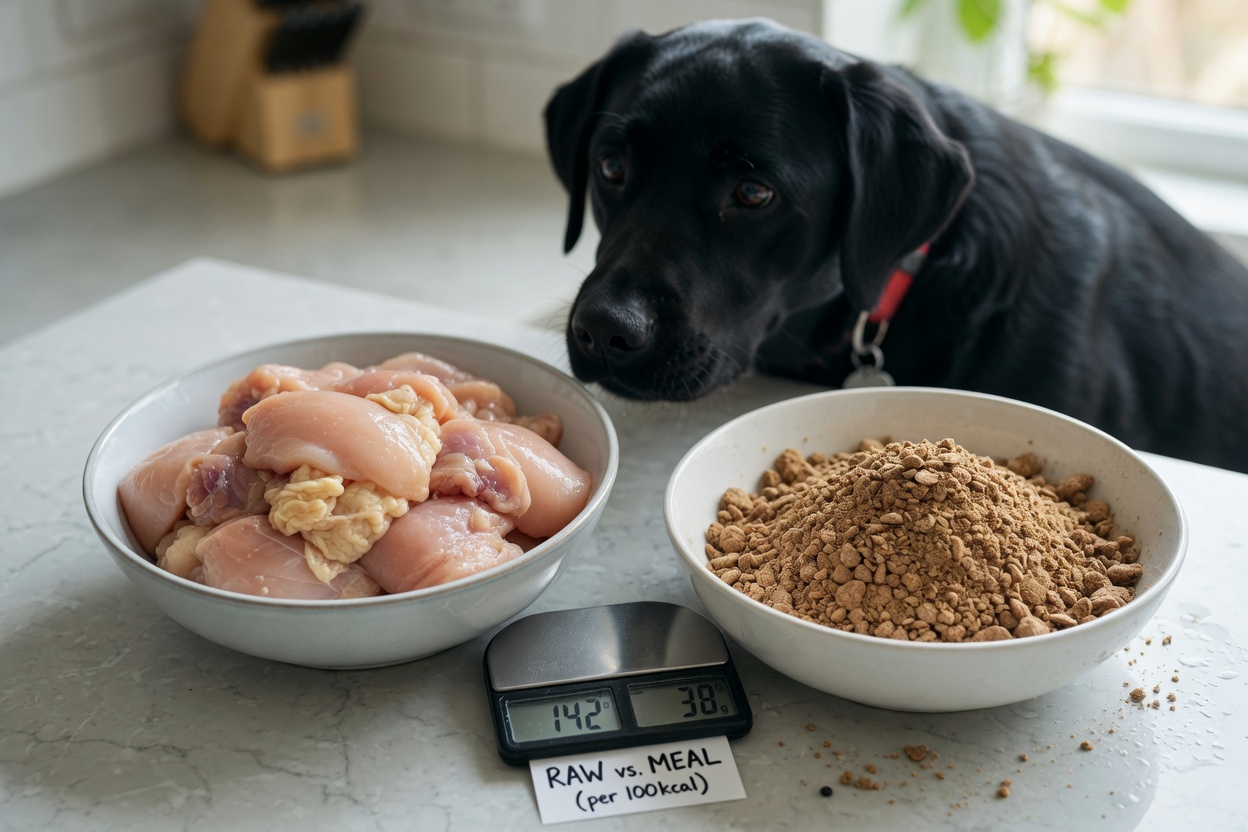
Under EU and UK pet food legislation, ingredients must be listed in descending order by weight as they are incorporated into the recipe. This sounds straightforward but involves several important nuances.
Fresh vs Dry Ingredients
Fresh or raw ingredients are listed at their weight before processing, which includes their moisture content. Fresh chicken, for example, is approximately 70% water. Once cooked, the actual protein contribution is considerably lower than the position on the ingredient list suggests. A food listing "chicken meal" rather than "fresh chicken" as its first ingredient may actually deliver more protein, because chicken meal has already been rendered and dehydrated — it contains roughly 65% protein by weight compared to around 18% for fresh chicken.
Ingredient Splitting
This is a common tactic to make protein sources appear more prominent. If a manufacturer splits one ingredient into multiple sub-forms — for example, listing "peas," "pea protein," and "pea flour" separately — each appears lower on the list than if they were combined. When you see the same base ingredient appearing in multiple forms, mentally combine them to get a realistic sense of their total contribution.
Category Names vs Named Ingredients
EU and UK regulations permit the use of category names such as "meat and animal derivatives" instead of named species. This allows manufacturers to change the composition of the food without updating the label, which is useful for managing supply chain costs but unhelpful for owners trying to identify potential allergens. Named ingredients — "chicken," "salmon," "lamb" — are preferable, particularly for dogs or cats with known sensitivities.
The Guaranteed Analysis Section
The guaranteed analysis declares minimum or maximum values for crude protein, crude fat, crude fibre, and moisture. In the EU and UK, the term used is "analytical constituents." This section allows basic comparison between products, but requires careful interpretation.
Comparing on a Dry Matter Basis
Moisture content varies enormously between food types. A wet food might be 78% moisture; a dry kibble might be 10%. Comparing crude protein percentages directly between a wet and a dry food is meaningless without adjusting for moisture. To compare on a dry matter basis, subtract the moisture percentage from 100 and divide the nutrient value by the result. A wet food with 8% protein and 78% moisture contains 8 divided by 22, which equals approximately 36% protein on a dry matter basis — comparable to many dry foods.
What Crude Protein Does Not Tell You
The crude protein figure is derived by measuring nitrogen content and applying a conversion factor. It does not distinguish between digestible and indigestible protein sources. A food could theoretically inflate its protein percentage using poorly digestible ingredients. This is why protein source matters as much as protein percentage.
Additives and Preservatives
EU and UK regulations require that additives be listed by category name and, in some cases, the specific compound. Technological additives include preservatives, antioxidants, and stabilisers. Nutritional additives include added vitamins and minerals, which must be listed with their quantities.
- Natural preservatives such as mixed tocopherols (vitamin E) and rosemary extract are generally preferable to synthetic options
- BHA (butylated hydroxyanisole) and BHT (butylated hydroxytoluene) are synthetic antioxidants with contested safety data at high doses — their use has declined but they remain legal
- A long list of added vitamins and minerals is not inherently alarming, but a very extensive list may indicate a low-quality base formula being corrected through supplementation
Decoding the "Complete" vs "Complementary" Distinction
This is one of the most important distinctions on any label and one that many owners overlook. A "complete" food is formulated to provide all the nutrients a pet needs as their sole diet. A "complementary" food — which includes most treats, mixers, and many wet pouches — is not nutritionally balanced on its own and must be fed alongside a complete food. Feeding a complementary food as a primary diet will result in nutritional deficiencies over time.
Feeding Guidelines Are Starting Points
Feeding guides printed on packaging are calculated for an average dog or cat of a given weight and life stage. They do not account for whether your pet is neutered, their activity level, their metabolism, or whether they are receiving additional treats. Treat the guide as a starting point and adjust based on your pet's body condition score over several weeks.
Practical Label-Reading Checklist
- Skip the front panel and go directly to the ingredient list and analytical constituents
- Check whether the food is complete or complementary
- Look for named protein sources rather than category descriptions
- Watch for ingredient splitting across multiple forms of the same base ingredient
- Adjust the protein and fat figures for moisture before comparing wet and dry foods
- Verify that the food carries a statement of nutritional adequacy or has undergone feeding trials
Understanding labels will not make every purchasing decision easy, but it will ensure that your decisions are based on what is actually in the food rather than what the manufacturer wants you to believe about it.