
Puppy Teething: Timeline, Pain Relief & Protecting Your Furniture
Key Takeaways
- Puppies begin teething at around 3 weeks old and finish by roughly 6 months of age.
- Baby teeth (deciduous teeth) are replaced by 42 permanent adult teeth.
- Safe chew toys and cold compresses are the most effective at-home pain relief methods.
- Look for the VOHC (Veterinary Oral Health Council) seal on dental products — it is the gold standard for proven oral-health benefit.
- Retained baby teeth, excessive bleeding, or severe reluctance to eat are all reasons to visit your vet.
- Redirecting chewing behaviour early is far easier than correcting it later.
Understanding the Puppy Teething Timeline
Most new puppy owners are caught off guard by just how early the teething process begins. Puppies are born toothless, but the first tiny deciduous (baby) teeth start to erupt at around 3 to 4 weeks of age. By the time your pup is 8 weeks old — the typical age for rehoming — all 28 baby teeth are usually in place.
The real drama begins between 3 and 6 months, when those baby teeth loosen and fall out to make room for the adult set. Here is a rough week-by-week breakdown of what to expect:
- Weeks 3–4: Incisors (the tiny front teeth) begin to push through the gums.
- Weeks 5–6: Canine teeth and premolars follow.
- Week 8: All 28 deciduous teeth are in. Your puppy goes home with you around this point.
- Months 3–4: Baby incisors start to loosen and fall out. Adult incisors emerge.
- Months 4–5: Canines and premolars are replaced. This is often the most uncomfortable phase.
- Month 6: Molars — which have no baby-tooth equivalent — erupt at the back of the mouth. By the end of this month most puppies have all 42 permanent adult teeth.
According to the American Kennel Club (AKC), larger breeds sometimes complete this process a little faster than smaller breeds, but 6 months is a reliable benchmark for the vast majority of dogs.
Recognising Teething Symptoms
Unlike human babies, puppies rarely cry out in pain during teething, which means you have to watch for subtler signs. Common teething symptoms include:
- Increased chewing on anything within reach — furniture, shoes, hands, electrical cables.
- Drooling more than usual.
- Slight bleeding on the gums where a tooth is erupting or falling out — small red spots on chew toys are normal.
- Swollen or red gums around the emerging tooth.
- Reduced appetite if gum soreness makes eating uncomfortable.
- Whining or irritability, particularly when chewing hard food.
- Finding tiny teeth on the floor or in bedding — it is perfectly normal for puppies to swallow their baby teeth.
Research published in the Journal of Veterinary Dentistry (PubMed) confirms that eruption discomfort in puppies is real and that behavioural changes during this period are physiologically driven, not simply a training problem. If your puppy seems unusually distressed, a brief vet check is always worthwhile.
Safe & Effective Pain Relief Methods
The good news is that several simple, at-home remedies can offer genuine relief during the teething phase.
1. Cold and Frozen Chews
Cold temperatures numb inflamed gum tissue and provide immediate comfort. Try these approaches:
- Soak a clean cloth in water, twist it into a rope shape, freeze it, and offer it to your puppy for 10–15 minutes at a time.
- Freeze puppy-safe broth (low-sodium, no onion or garlic) in an ice-cube tray and let your pup gnaw on a cube.
- Refrigerate — don't freeze solid — rubber chew toys to give them a satisfying cold firmness without the risk of cracking a tooth.
2. Specially Designed Teething Toys
Dedicated puppy teething toys are purpose-built to be safe on developing teeth and sore gums. The ASPCA recommends choosing toys that yield slightly under pressure — if you cannot dent the toy with your thumbnail, it is too hard for a teething puppy and risks fracturing an adult tooth as it comes in.
For high-quality options that ship across the UK and Europe, Zooplus's dog toy range includes a wide selection of rubber and nylon teething toys designed specifically for puppies — including flavoured options that encourage prolonged chewing and redirect attention from your furniture. Look for toys labelled for puppies or small/young dogs.
3. Appropriate Chews and Dental Treats
Edible dental chews can soothe gums while also helping to maintain early oral hygiene habits. When selecting any dental product for your puppy, look for the VOHC (Veterinary Oral Health Council) seal of acceptance. The VOHC independently evaluates products and awards its seal only to those that have been proven in clinical trials to reduce plaque or tartar — it is the gold standard benchmark recognised by vets worldwide. Avoid hard pressed rawhide, cooked bones, and antlers during the teething period as these can fracture fragile emerging teeth.
4. Gentle Gum Massage
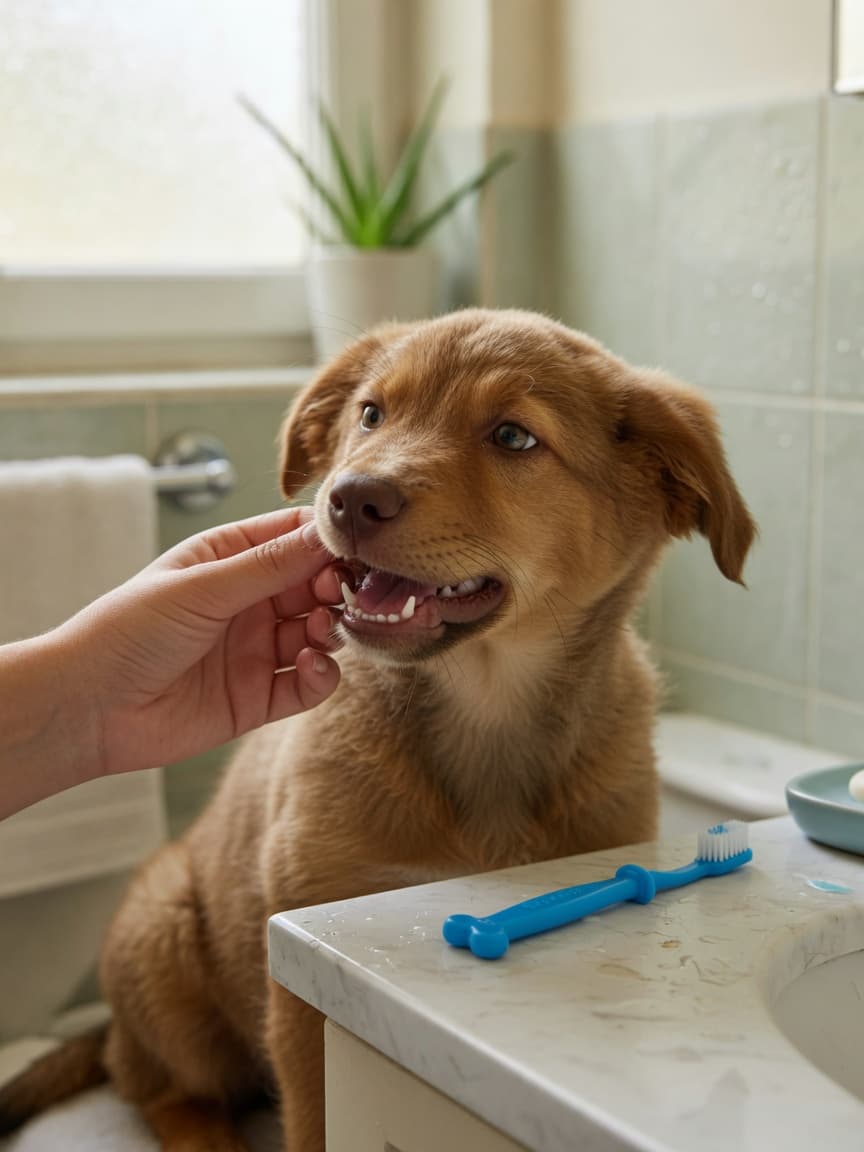
Using a clean finger or a finger-brush, gently rub your puppy's gums for 30 to 60 seconds. This helps relieve pressure and — crucially — gets your dog accustomed to having their mouth handled, which makes adult dental care far easier. Start slowly and always reward your pup afterwards.
Protecting Your Furniture and Belongings
Redirection is everything. A puppy that chews your sofa is not misbehaving — it is following a biological drive. Your job is to make the right option (their toy) more appealing than the wrong option (your table leg).
- Rotate toys regularly. Novelty is highly motivating. Introduce a new chew toy every few days to keep your puppy engaged.
- Use bitter sprays. Pet-safe bitter apple sprays, applied to furniture legs and cables, create an unpleasant taste that deters most puppies. Reapply every few days.
- Puppy-proof the environment. Remove or cover electrical cables. Temporarily relocate items you care about. Use baby gates to restrict access to rooms with expensive furniture.
- Supervise and redirect. Whenever you catch your pup chewing something forbidden, calmly remove them and immediately offer an appropriate chew toy, then praise when they take it.
- Exercise and mental stimulation. A tired puppy chews less destructively. Regular play sessions and short training bursts reduce the overall chewing impulse.
As The Guardian has reported in its coverage of the post-pandemic puppy boom, destructive chewing is one of the most common behavioural complaints from first-time owners — and in the vast majority of cases, it resolves naturally once adult teeth are fully in and appropriate outlets have been established.
When Adult Teeth Come In: What to Expect
Once all 42 adult teeth are through — usually by the time your puppy reaches 6 months — the compulsive need to chew typically reduces significantly. However, it is worth knowing what "normal" looks like during this transition:
- Adult teeth are noticeably larger and whiter than the needle-sharp baby teeth they replaced.
- Slight gum redness around newly erupted molars is normal for a week or two.
- The urge to chew does not disappear entirely — it simply becomes more manageable and habit-based rather than pain-driven.
This is also the ideal moment to establish a proper dental hygiene routine. Daily brushing with a dog-specific enzymatic toothpaste, combined with VOHC-approved dental chews, can prevent the periodontal disease that affects an estimated 80% of dogs over 3 years of age, according to data cited by the PDSA.
When to See a Vet
Most teething is uneventful, but there are situations that warrant a professional assessment:
- Retained baby teeth: If a baby tooth has not fallen out by the time its adult replacement has fully erupted, the two teeth will crowd each other and push the adult tooth out of alignment. This is particularly common in small breeds. Your vet may recommend extraction under a brief anaesthetic.
- Excessive or persistent bleeding: A small amount of blood on a chew toy is normal. Ongoing bleeding from the gums, or gums that look swollen and dark red, should be evaluated.
- Severe reluctance to eat: If your puppy stops eating for more than 24 hours, pain management or a dietary adjustment may be needed.
- Missing teeth in the adult set: If by 7 months your vet can identify gaps where adult teeth should have erupted, dental X-rays can confirm whether teeth are impacted beneath the gum line.
- Signs of infection: Foul-smelling breath beyond normal puppy breath, discharge from the gums, or a puppy that is lethargic and off food together may indicate a gum infection.
A study in BMC Veterinary Research (PubMed) found that early-life dental anomalies, including retained deciduous teeth, are significantly associated with later periodontal complications in dogs — reinforcing the value of routine veterinary dental checks during the first year of life.
Building Good Dental Habits From Day One
The teething period, disruptive as it is, represents a genuine window of opportunity. Puppies that learn to accept teeth-brushing, enjoy dental chews, and receive regular mouth handling during this stage grow into dogs with far better oral health outcomes. Start gently, keep sessions short, and always end on a positive note with a treat or play.
If you are looking for a durable everyday chew toy to carry your puppy through the teething months and beyond, the Zooplus puppy toy selection offers rubber chews, rope toys, and interactive feeders that suit different chewing styles and breed sizes — a practical starting point for building a rotation your pup will love.
The Bottom Line
Puppy teething is a completely normal developmental process that runs from roughly 3 weeks to 6 months of age. With the right combination of cold chew toys, appropriate dental treats, consistent redirection, and a little patience, you can get through this phase with your furniture — and your sanity — largely intact. Use this window to build positive dental habits, keep an eye out for retained teeth or unusual symptoms, and lean on your vet if anything does not look right. The chewing frenzy is temporary; good oral health is for life.
References
- Gracis M. (2015). "Oral and dental development in puppies." Journal of Veterinary Dentistry. Available at: https://www.ncbi.nlm.nih.gov/pmc/articles/PMC4494319/
- Hale FA. (2015). "Deciduous tooth retention in dogs and cats." BMC Veterinary Research. Available at: https://pubmed.ncbi.nlm.nih.gov/25943121/