
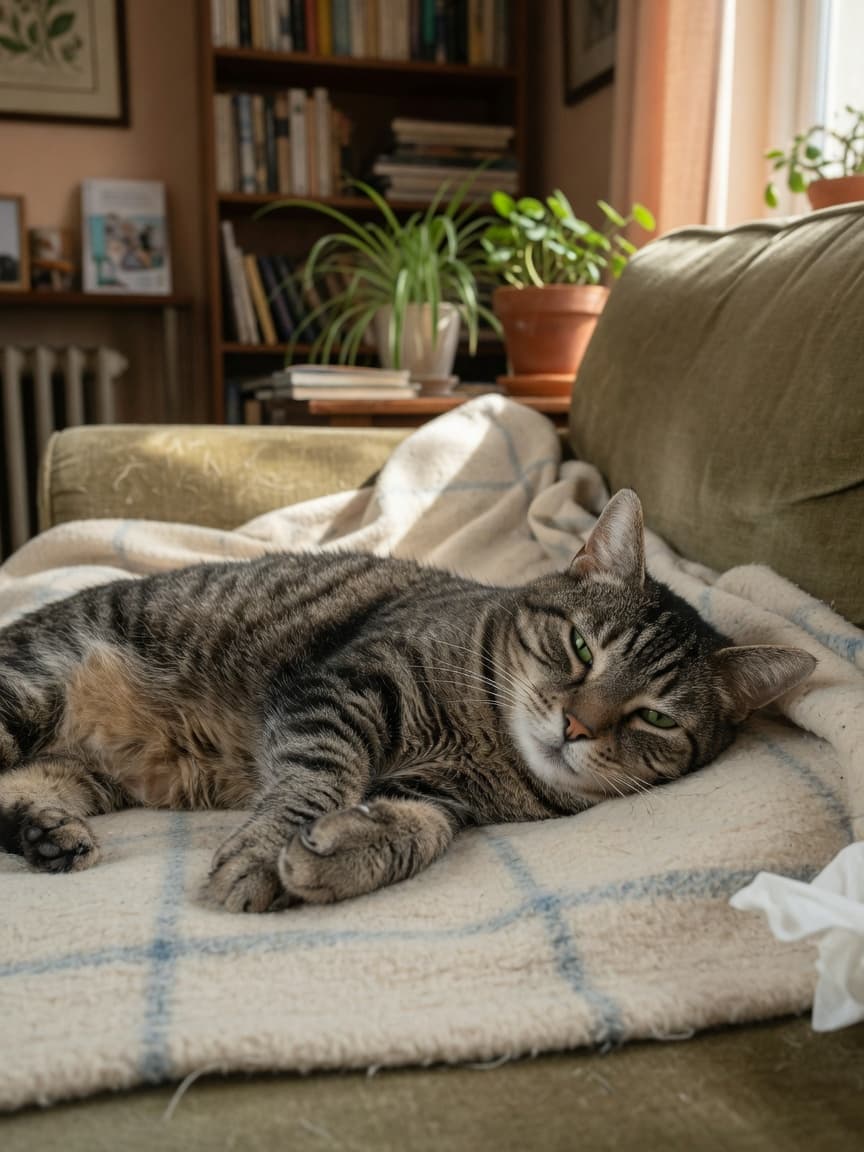
The Hidden Suffering of Ageing Cats
Cats are exceptionally good at concealing pain. This trait, which presumably evolved to avoid appearing vulnerable to predators, means that a cat experiencing significant chronic discomfort will often continue to eat, groom, and behave relatively normally until the burden becomes severe. By the time limping, crying, or visible distress appears, a cat may have been in pain for a considerable time. For senior cats — where arthritis, dental disease, neuropathy, and cancer are all common — developing the ability to recognise subtler pain signals is one of the most important skills an owner can acquire.
Why Cats Express Pain Differently
Unlike dogs, who tend to vocalise and seek comfort when in pain, cats more typically withdraw, become still, and reduce activity. This can easily be interpreted as "slowing down with age" rather than recognised as a pain response. Additionally, cats often maintain relatively normal behaviour when observed — stress and scrutiny can temporarily override pain expression — meaning brief veterinary consultations may not capture what owners see at home over time.
Chronic pain also differs from acute pain in its presentation. A cat who has sprained a leg cries and guards the limb obviously. A cat with slowly progressive arthritis adapts its behaviour incrementally over months, and neither the cat nor the owner notices any single dramatic change. This makes systematic, regular assessment essential rather than optional.
Validated Pain Assessment Tools
Several validated tools exist for assessing pain in cats, designed to be used both by veterinary professionals and owners at home.
The Feline Grimace Scale
Developed and validated by researchers at the University of Montreal, the Feline Grimace Scale (FGS) assesses five facial action units: ear position, orbital tightening, muzzle tension, whisker position, and head position. Each is scored from 0 (absent) to 2 (obvious), giving a maximum score of 10. A score of four or above suggests moderate to severe pain requiring intervention. The scale has been shown to be reliable and sensitive, and a free standardised training guide with photographic examples is publicly available from the researchers. It takes fewer than two minutes to apply and can be used by owners from photographs taken at home.
The CEPS and CMPS-Feline
The Cat Grimace Scale and the Composite Measure Pain Scale for cats (CMPS-Feline) incorporate both facial expression and behavioural elements — posture, response to touch, activity level, and vocalisation. These multidimensional tools capture a broader picture of the pain experience and are particularly useful in clinical settings where the cat can be observed and gently examined.
Owner-Completed Outcome Measures
For monitoring chronic pain at home, owner-completed quality of life and activity questionnaires provide important longitudinal data. The Feline Musculoskeletal Pain Index (FMPI) and similar instruments ask owners to rate mobility, activity, and behaviour over the preceding week, generating a score that can be tracked over time. These tools are particularly useful for assessing response to treatment when clinical signs are subtle.
Behavioural Signs of Chronic Pain in Senior Cats
Beyond formal scoring tools, owners should be alert to the following behavioural changes, which commonly indicate chronic pain in older cats:
- Reduced jumping height or reluctance to jump onto previously frequented surfaces
- Difficulty using the litter tray, particularly trays with high sides
- Changes in grooming patterns — either matted fur from inability to reach areas, or overgrooming a painful site
- Reduced interaction with family members or increased irritability when touched
- Changes in sleep location — choosing ground-level spots previously ignored
- Altered facial expression, particularly a tense muzzle or partially closed eyes at rest
- Stiff or stilted gait, particularly after rest
- Reduced appetite, which in cats can itself be a consequence of chronic pain
Keeping a simple behaviour diary over two to four weeks, noting any of the above, is a highly effective way to identify patterns that individual observations might miss.
Common Causes of Chronic Pain in Senior Cats
Degenerative joint disease — arthritis — is present radiographically in the majority of cats over ten years old, affecting the elbows, hips, stifles, and spine most commonly. Despite this prevalence, it remains widely under-treated. Dental disease causes significant ongoing pain in many senior cats. Neuropathic pain, including diabetic neuropathy and pain associated with nerve compression from spinal changes, is increasingly recognised. Internal organ pain from conditions such as pancreatitis, urinary disease, or cancer can be persistent and difficult to localise.
Responding to Pain: Treatment Options
Pain management in cats requires care because many analgesics safe in other species are toxic to cats, whose liver metabolism differs significantly. Non-steroidal anti-inflammatory drugs (NSAIDs) can be used in cats with normal kidney function and with veterinary monitoring, but require regular blood testing for long-term use. Meloxicam is the most widely used NSAID in feline pain management in the United Kingdom.
Buprenorphine, a partial opioid agonist, is effective for moderate to severe pain and can be administered at home in some cases as a buccal (gum) preparation. Gabapentin has gained significant traction for feline neuropathic pain, anxiety, and as part of multimodal pain management, and is generally well tolerated. Amantadine may be added for chronic pain states that have sensitised the nervous system.
Non-pharmacological approaches including environmental modification — ramps, steps, heated beds, low-sided litter trays, and raised food bowls — reduce the physical demands on painful joints and improve quality of life independently of medication. Physiotherapy and gentle laser therapy are available through some specialist veterinary practices and have evidence supporting their use in feline musculoskeletal pain.
The most important step is to ensure pain is taken seriously and investigated fully. A senior cat who has quietly adapted to ongoing discomfort can experience meaningful improvements in quality of life once effective pain management is in place — and that improvement is often visible within days of beginning treatment.