
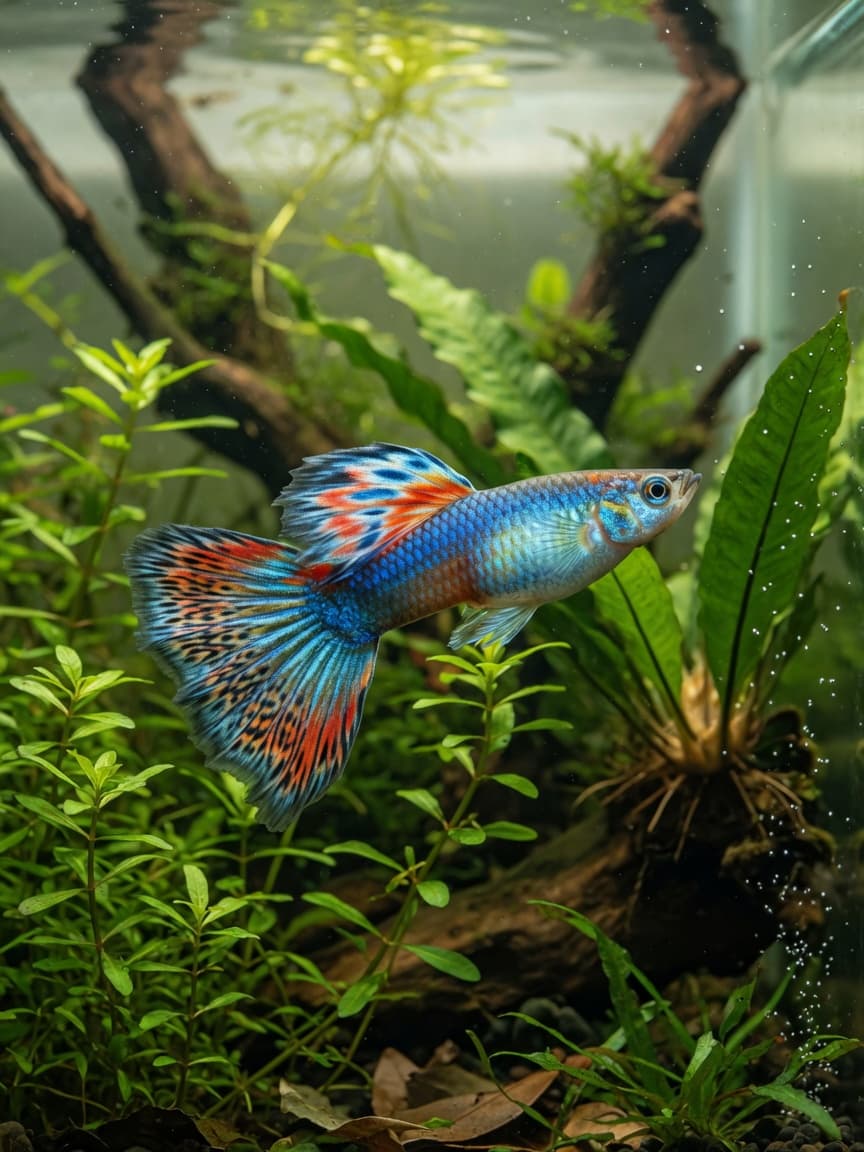
Guppy Care Guide: Breeding, Feeding & Common Diseases
By Julia Wrenfield, Pet Wellness Researcher
Tank Requirements
The minimum recommended tank size for a small group of guppies is 40 litres, though 60–80 litres gives far more water stability and room to manage the inevitable fry population. Guppies are active swimmers and appreciate horizontal space over vertical height.
Filtration should provide a gentle current — guppies are not strong swimmers, and high-flow filters stress them, particularly females heavy with fry. A sponge filter or a hang-on-back filter with a spray bar diffuser is ideal. Dense planting (real or artificial) provides cover, reduces aggression, and gives fry hiding places.
Guppies do best with a consistent temperature of 24–26°C. They tolerate 22–28°C, but fluctuations — more than 2°C in a day — suppress immune function and invite disease outbreaks. A reliable heater with a built-in thermostat is not optional in any climate that sees cool evenings.
Water Parameters
Guppies originate from hard, slightly alkaline waters in Trinidad and Venezuela. Optimal parameters:
- pH: 7.0–8.0 (slightly alkaline preferred)
- Hardness: 8–20 dGH (hard water; they struggle in very soft water)
- Ammonia: 0 ppm
- Nitrite: 0 ppm
- Nitrate: below 20 ppm (weekly water changes of 20–25%)
- Temperature: 24–26°C
If your tap water is very soft, adding crushed coral to the filter or using a small amount of marine salt (1 teaspoon per 10 litres) is beneficial. Guppies process salt well; most of their pathogens do not.
Feeding Guppies: Variety Is Not Optional
Guppies are omnivores with a strong preference for protein. A diet of generic tropical flakes alone — while they will survive on it — results in dull coloration, slower growth, higher disease susceptibility, and reduced fry survival rates. The difference between a well-fed guppy and a flake-only guppy after six months is visible to the naked eye.
An effective feeding rotation:
- Staple (daily): high-quality micro-pellets or tropical flakes with at least 45% protein and astaxanthin or spirulina for color enhancement
- Protein boost (3x per week): frozen baby brine shrimp, frozen daphnia, or micro bloodworms. Baby brine shrimp are particularly important for fry and breeding females
- Vegetable matter (2x per week): blanched spinach, spirulina flakes, or algae wafer pieces — supports gut health and immune function
Feed two small meals per day — only what is consumed within 90 seconds. Guppies are prone to bacterial blooms from excess food decomposing in the substrate.
Breeding: What Actually Happens
Guppies are livebearers — females gestate fertilized eggs internally and give birth to free-swimming fry. Females can store sperm for up to six months, meaning a single mating can produce multiple broods without further male contact. Gestation lasts 21–30 days depending on temperature; warmer water shortens gestation.
A single female can produce 20–80 fry per brood. In a community tank without fry separation, the vast majority will be eaten within hours — by other guppies as well as any other fish present. If you want fry to survive:
- Use a breeding box or transfer the pregnant female (look for the dark gravid spot near the anal fin expanding to almost black) to a separate tank shortly before birth
- Provide dense floating plants — hornwort, java moss — in the main tank as cover
- Remove the female from the fry after birth; she will eat them
Fry should be fed crushed flakes, liquid fry food, or — best of all — baby brine shrimp nauplii from day one. Growth is rapid; fry reach sexual maturity in approximately 3 months.
Male-to-Female Ratio: Managing Harassment
Male guppies harass females relentlessly. A single male can stress a single female to death through constant pursuit over days, preventing her from eating, resting, or recovering between pregnancies. The recommended ratio is one male to two or three females minimum — ideally 1:3 or 1:4 in a small tank. In a heavily planted tank with good cover, a 1:2 ratio is manageable.
A stressed female shows clamped fins, reduced appetite, hiding behavior, and darkened color. If you see this, add more females or remove males temporarily. A male-only tank is also a viable option if breeding is not the goal — males display beautiful coloration without the reproductive stress dynamic.
Common Diseases
Fin Rot
Fin rot is the most common guppy disease and is almost always caused by poor water quality — particularly elevated ammonia or nitrite, cold temperatures, or physical fin damage from fin-nipping tankmates. The fins fray, develop dark or white edges, and recede progressively.
Treatment: correct water parameters first. A 25% water change immediately, temperature adjustment to 26°C, and removal of any fin-nipping fish. Mild cases resolve without medication. Severe cases (fin rot reaching the body) require antibacterial treatment (antibiotics in countries where available; Indian almond leaf extract or aquarium salt as gentler options).
Ich (White Spot Disease)
Ichthyophthirius multifiliis — ich — presents as white salt-grain-sized spots across the body and fins. Fish scratch against surfaces (flashing). It is introduced via new fish, plants, or equipment and spreads rapidly at temperatures below 24°C.
Treatment: raise temperature to 28–30°C (this accelerates the parasite lifecycle, making it vulnerable to treatment); add aquarium salt (1 tablespoon per 10 litres); use a proprietary ich treatment containing malachite green or formalin if the outbreak is severe. Treat for the full recommended period even if spots disappear early — the tomont stage (encysted parasite) survives off-host.
Wasting Disease (Guppy Disease / Camallanus)
Guppy disease — technically caused by various internal parasites including Camallanus roundworms, microsporidian parasites, and sometimes Spironucleus — is one of the most frustrating conditions in the hobby. Affected fish waste away despite apparently eating normally, develop a curved spine ("bent spine syndrome" in some strains), produce white or colorless feces, and eventually become skeletal before dying.
Camallanus worms may be visible as thin red threads protruding from the vent. These require treatment with levamisole or fenbendazole — neither of which is easy to obtain without veterinary access in many European countries. Prevention through quarantine of all new fish for a minimum of 4 weeks in a separate tank is strongly advised. Once Camallanus is established in a tank, eradication is lengthy and difficult.
Guppy Lifespan and Realistic Expectations
Guppies live 1.5 to 3 years with good care. Wild-type strains and lightly domesticated varieties tend toward the upper end; heavily inbred fancy strains (Moscow Blues, Albinos, show-grade varieties) often have compressed lifespans due to genetic homogeneity and the health costs of extreme fin development. Buying from reputable breeders rather than chain pet stores significantly improves baseline health and lifespan.
- Minimum tank: 40 litres; 60–80 L preferred for stability and population management
- Water: pH 7.0–8.0, hard, 24–26°C, ammonia and nitrite at 0 at all times
- Feed a varied diet — protein (brine shrimp, bloodworms), quality flakes, and vegetable matter
- Male-to-female ratio: 1:2 minimum, 1:3 preferred — male harassment kills females
- Females store sperm up to 6 months; separate fry immediately if raising them
- Most common diseases: fin rot (fix water quality first), ich (raise temperature + salt), wasting/Camallanus (quarantine all new fish)
- Lifespan 1.5–3 years; wild-type and non-inbred strains outlive fancy varieties
- Always quarantine new fish for 4 weeks before adding to the main tank
References
- Breden F, Ptacek MB, Rashed M, Taphorn D, Figueiredo CA. "Molecular phylogeny of the live-bearing fish genus Poecilia (Cyprinodontiformes: Poeciliidae)." Copeia. 1999;3:678–688. PMID: 10494573
- Shinn AP, et al. "Gyrodactylus (Monogenea) infections in freshwater ornamental fish: a review." Parasitology. 2015;142(8):1014–1028. PMID: 25703646