
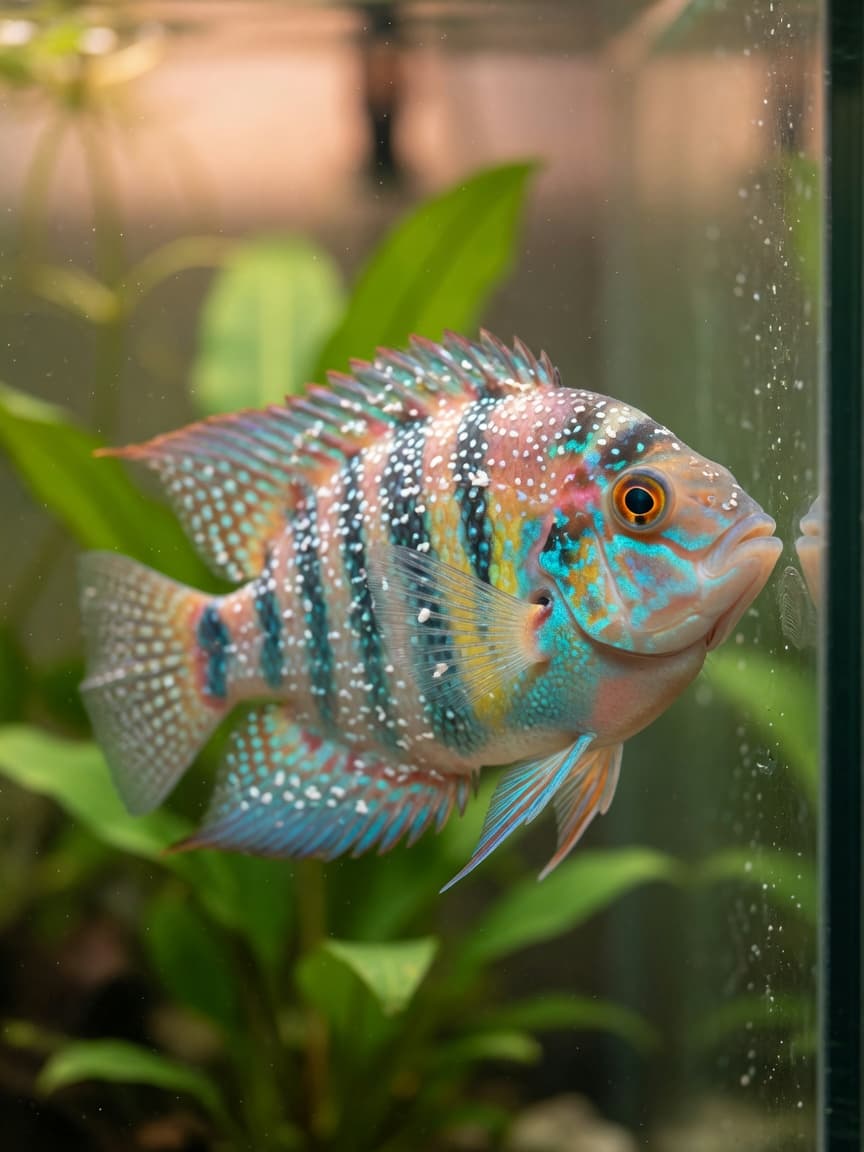
Ich (White Spot Disease) in Fish: Treatment & Prevention
By Julia Wrenfield, Pet Wellness Researcher
White spot disease — ich — is the most common fish disease in the hobby, and it kills more pet fish than any other single pathogen. The reason beginners are blindsided by it has nothing to do with bad luck and everything to do with a parasite lifecycle that is specifically designed to be invisible during its most dangerous phase. Understanding how ich actually works is the difference between effective treatment and helplessly watching your fish die one by one.
The Lifecycle of Ichthyophthirius multifiliis
Ichthyophthirius multifiliis (ich) is a ciliate protozoan with a three-stage lifecycle, and this lifecycle is the reason casual treatment fails.
Stage 1 — Trophont (feeding stage, on the fish): This is the white spot you can actually see. The parasite burrows under the fish's skin and mucous membranes, feeding on tissue. At this stage, the parasite is physically protected by the fish's own skin and is almost completely immune to medication. Treatments applied during this stage have virtually no effect on the trophont itself.
Stage 2 — Tomont (reproductive stage, on surfaces): Once mature, the trophont drops off the fish and attaches to the substrate, tank walls, decorations, and filter equipment. It encysts and begins dividing, producing up to 2,000 daughter cells (tomites) per cyst. This stage is also relatively resistant to chemical treatment because of the protective cyst wall.
Stage 3 — Theront (free-swimming stage, in the water): Theronts hatch from cysts and swim actively seeking a host fish. This is the only stage genuinely vulnerable to medication and elevated temperature. Theronts that do not find a host within 24–48 hours die, but those that do find a host burrow in and begin the cycle again — potentially with hundreds of new trophonts per original cyst.
The practical implication: you are treating the theronts in the water column, not the spots on the fish. This is why treatment must continue for a full cycle — typically 10–14 days at normal temperature — until all tomonts have hatched and their theronts are exposed and killed.
Recognizing Ich: Symptoms Beyond the Spots
The classic presentation is white granular spots resembling grains of salt scattered across the fins and body. But fish often show behavioral symptoms before spots are visible to the naked eye:
- Flashing: The fish rubs its body rapidly against the substrate, decorations, or glass. This is the fish reacting to irritation under the skin before trophonts are large enough to see.
- Clamped fins: The fish holds its fins tight against its body rather than extended normally — a general stress signal, but often early ich.
- Lethargy and loss of appetite: Fish with heavy infestations stop eating and hover near the surface or in corners.
- Rapid gill movement: Ich on the gills (gill ich) is especially dangerous and can cause death before body spots are obvious. Fish will breathe rapidly and struggle at the surface.
Temperature Treatment: The Safest First-Line Option
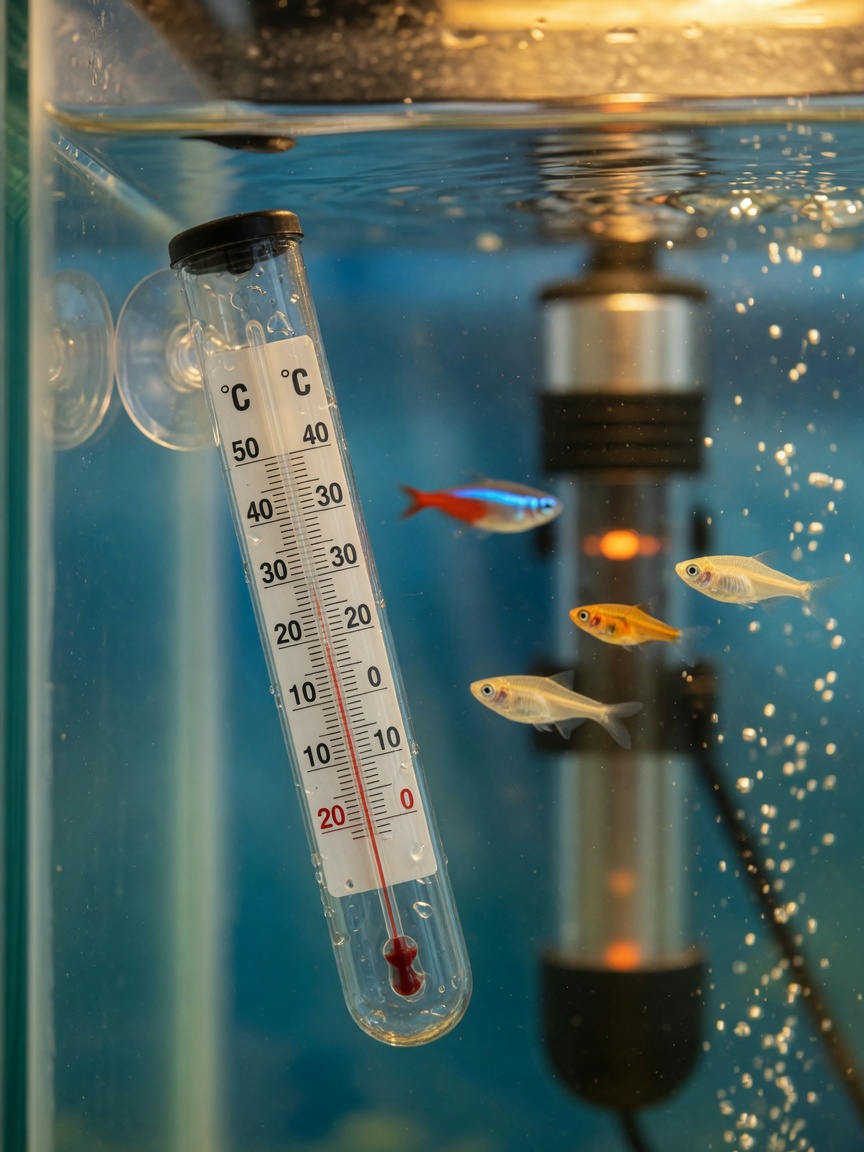
Raising water temperature is a highly effective and chemical-free treatment, exploiting the fact that the parasite's lifecycle accelerates dramatically with heat — but the theronts' survival window shortens at the same time.
Raise your tank temperature by 1°C per hour (to avoid shocking the fish) to 29–30°C for most tropical species. Do not exceed this for bettas or scaleless fish. At 30°C, the full lifecycle completes in approximately 3–4 days rather than the 10–14 days at 24°C, meaning theronts hatch sooner and are killed (either by the heat itself, which is lethal above 32°C, or by subsequent medication) while the treatment window is still active.
Increase aeration significantly when raising temperature — warm water holds less dissolved oxygen. An airstone or a second filter outlet pointed at the surface surface is essential during heat treatment.
Salt Treatment
Aquarium salt (sodium chloride, not table salt with iodine) at 1–3 grams per liter disrupts the osmoregulation of theronts and provides mild stress relief to infected fish. Salt treatment is effective as a complement to temperature treatment, but should not be used with species that cannot tolerate salinity: corydoras catfish, loaches, and most scaleless species are sensitive and should be treated with lower doses (1g/L maximum) or not at all.
Medication
Several chemical treatments are effective against ich theronts. The most widely available include:
- Malachite green with formalin: The most effective combination available without prescription. Follow dosing instructions precisely — overdosing is harmful to fish. Remove activated carbon from the filter before treatment (it will absorb the medication).
- Copper-based treatments: Highly effective but toxic to invertebrates, snails, and plants at therapeutic doses. Not suitable for reef or planted tanks. Copper levels must be tested with a dedicated copper test kit, as the therapeutic window is narrow.
- Herbal/natural treatments: Products containing plant extracts (such as clove oil derivatives) exist and are gentler but significantly less reliable. Use pharmaceutical-grade treatments when a full tank is at risk.
The Quarantine Tank: Your Most Important Prevention Tool
Ich enters your tank on new fish, on live plants, and on any wet equipment transferred between systems. A simple quarantine tank — even a 20-liter tub with a sponge filter and heater — prevents the vast majority of ich outbreaks in established aquariums.
New fish should be quarantined for a minimum of four weeks before entering your display tank. Four weeks is not arbitrary: it is long enough to complete two full ich lifecycles at normal temperature, meaning any introduced ich will have manifested, gone through its stages, and be identifiable before it ever reaches your main tank. Treating ten fish in a quarantine tank is infinitely simpler than treating a 200-liter display tank full of live plants and invertebrates.
After the Outbreak: Preventing Recurrence
Ich does not spontaneously appear from nothing — it always enters on something. After resolving an outbreak, audit how it entered: a new fish without quarantine, a plant from a pet store tank, a decoration moved from another system. Address the source. Going forward, a four-week quarantine for every new addition eliminates nearly all disease introduction risk.
Fish that survive ich are not immune. Unlike some pathogens, ich does not confer lasting immunity. A recovered fish can be reinfected immediately on reexposure, which is another reason to treat the entire tank system and not just move sick fish to a separate container while leaving the main tank untreated.
Key Takeaways
- Ich has three lifecycle stages; only the free-swimming theront stage is vulnerable to medication — treat the whole tank, not just the sick fish.
- Flashing and clamped fins often appear before white spots are visible — catch it early.
- Raise temperature to 29–30°C to accelerate the lifecycle and shorten the treatment period.
- Always remove activated carbon from the filter before adding any ich medication.
- A 4-week quarantine for all new fish is the single most effective prevention measure.
- Salt treatment is a useful complement but harmful to corydoras, loaches, and scaleless species.
- Treat for the full recommended duration even after white spots disappear — parasites are still completing their lifecycle on tank surfaces.
References
- Dickerson HW. "Ichthyophthirius multifiliis and Cryptocaryon irritans (Phylum Ciliophora)." Fish Diseases and Disorders, Vol. 1. CAB International, 2006. Related immunology research: PMID 16293618.
- Matthews RA. "Ichthyophthirius multifiliis Fouquet and ichthyophthiriosis in freshwater teleosts." Advances in Parasitology, 2005;59:159-241. PMID 16182865.