
Resource Guarding in Dogs: What It Is & How to Address It
By Julia Wrenfield, Pet Wellness Researcher — June 25, 2026
- What it is: Normal canine behavior that exists on a severity spectrum
- What dogs guard: Food, bones, toys, resting spots, people, space
- What NOT to do: Alpha rolls, "show them who's boss," taking items forcefully — all make it worse
- Best approach: Trading game, positive associations, "drop it" training
- When to seek help: Any guarding that has escalated to biting
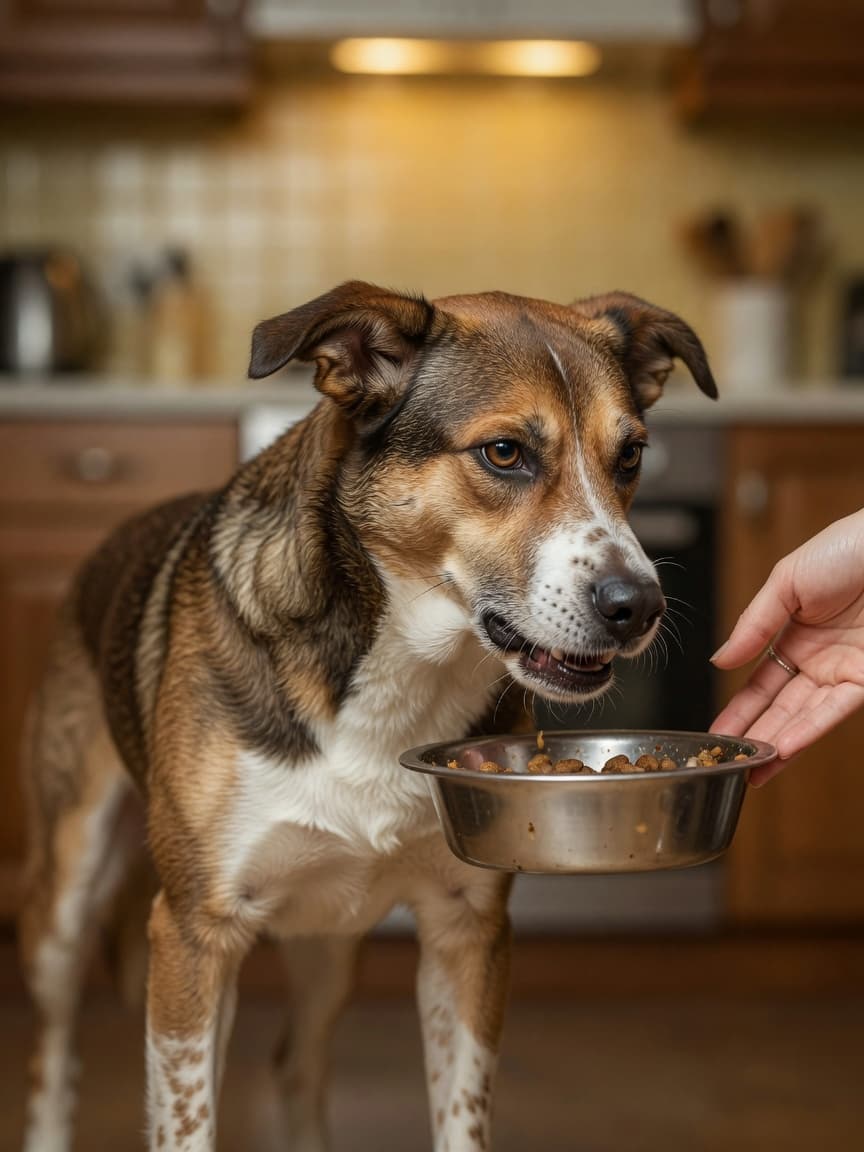
Resource guarding — growling, snapping, or biting when someone approaches an item the dog values — is one of the most common behavioral problems that brings dogs to shelters or leads to surrender. It is also one of the most misunderstood. Resource guarding is a normal dog behavior with evolutionary roots in competition for food and survival resources. Understanding this changes everything about how we respond to it.
That does not mean resource guarding is acceptable or should be ignored. On a spectrum from mild (freezing over a bowl) to severe (biting), it presents real safety risks. But addressing it requires understanding, not confrontation.
What Is Resource Guarding?
Resource guarding is any behavior a dog uses to maintain possession of something they value in the presence of a perceived competitor. In the wild, this behavior is adaptive — a dog who successfully guards a food item survives. In a home environment, the behavior can be dangerous but is not a sign of "dominance" or a broken dog. It is simply a normal behavior that needs to be managed and modified for safety.
The behavior is maintained by reinforcement: if the dog growls and you back off, the dog learns that growling works to preserve the resource. This is not manipulation — it is basic operant learning.
What Do Dogs Guard?
Almost anything can become a guarded resource, but common items include:
- High-value food: Meals, bones, chews, rawhides, bully sticks, stolen food
- Toys and objects: Especially novel or particularly prized items
- Resting places: Sofas, beds, particularly comfortable spots
- People: A dog may guard "their" person from other pets or family members
- Space: Crates, doorways, cars
- Found objects: Garbage, socks — items the dog knows they should not have are often guarded intensely
Warning Signals: The Guarding Spectrum
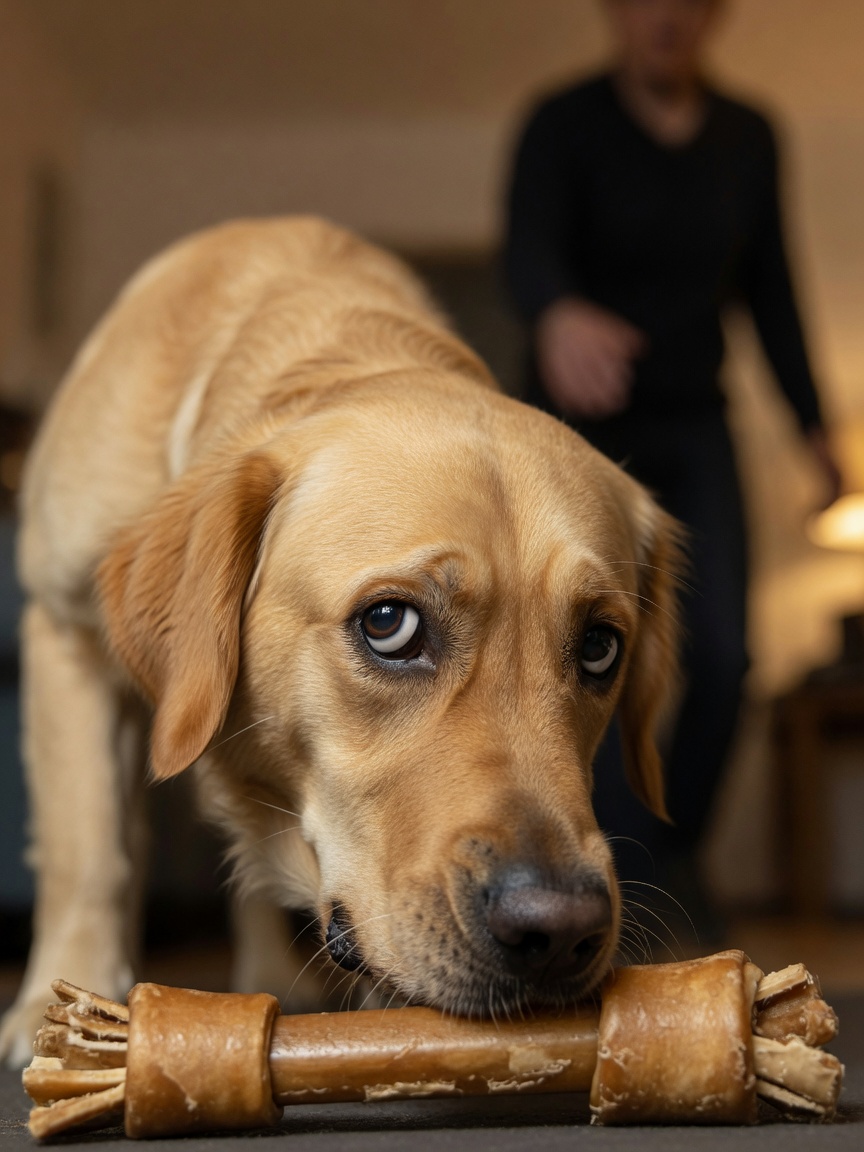
Resource guarding presents as a graduated series of signals. Many owners miss the early signals and only notice when the dog reaches growling or snapping — which can lead to punishment that removes the warning without addressing the problem.
| Signal | Description | Severity |
|---|---|---|
| Eating faster | Gulps food when someone approaches bowl | Mild |
| Freezing or stiffening | Body goes still over the resource | Mild–Moderate |
| Hard eye / whale eye | Whites of eyes showing, hard stare | Moderate |
| Hovering over resource | Dog positions body over or very close to item | Moderate |
| Growling | Low, continuous growl when approached | Moderate–Severe |
| Snapping (no contact) | Air snap as final warning | Severe |
| Biting | Contact bite, skin broken | Requires professional help |
What NOT to Do
The instinctive response to resource guarding is to assert dominance — take the item away to "show the dog who's in charge." This approach is not just ineffective; it is dangerous and counterproductive. Research and clinical experience consistently show that confrontational responses to guarding increase the likelihood and severity of bites.
- Do not take items forcefully — this confirms to the dog that people approaching means losing the resource, intensifying guarding next time.
- Do not alpha roll or physically punish — punishment suppresses the growl (warning) without changing the underlying emotional state, creating a dog that bites with no warning.
- Do not repeatedly approach the dog while they eat to "desensitize" them without a positive association — this creates a dog that becomes progressively more tense during meals.
- Do not yell or startle — adding more negative emotion to an already tense situation accelerates escalation.
The Trading Game Protocol
The trading game teaches the dog that humans approaching a resource predicts something better happening, not the loss of the item. This changes the dog's emotional response from defensive to anticipatory.
How to teach the trading game:
- Start with a low-value item the dog is mildly interested in but will not guard intensely (a toy, not a bone).
- Approach calmly, drop a high-value treat on the floor near (not in front of) the dog. Walk away. Repeat many times.
- Gradually begin reaching toward the item while dropping treats. The dog should begin to look up expectantly rather than stiffen.
- Once comfortable, pick up the item, immediately deliver treats, then give the item back. The dog learns: giving up the item = gets treats and gets item back.
- Gradually work up to higher-value items only once the dog is relaxed and happy with lower-value trades.
Teaching "Drop It"
A reliable "drop it" cue is a management essential. Teach it during calm play, not in a guarding situation:
- During tug, present a treat at the dog's nose. The moment they release the toy to get the treat, mark "yes!" and deliver the treat.
- Add the cue "drop it" just before presenting the treat.
- Offer the toy back immediately — this teaches that dropping does not mean losing.
- Practice daily in non-guarding contexts to build the habit before you ever need it in a real situation.
Management for Safety
While training is underway, management prevents guarding episodes from occurring (and being reinforced). Practical steps:
- Feed high-value chews in a safe space (crate, separate room) where the dog will not be approached.
- Keep children and other pets away from the dog during meals and high-value chew sessions.
- Teach children never to approach a dog who has food or a chew — this is a household safety rule, not optional.
- Pick up items when the dog is not present rather than attempting to take them while the dog has them.
- Resource guarding is a normal canine behavior, not dominance — understanding this changes the entire approach.
- Punishment removes the growl warning without removing the aggression — it creates a biting dog with no warning.
- The trading game changes the dog's emotional response: approaching people predicts good things happening.
- Management (separated feeding, no-approach rules) prevents guarding rehearsal during treatment.
- Any guarding that has resulted in a bite requires a certified behavior consultant.
References
- Wrubel KM, Moon-Fanelli AA, Maranda LS, Dodman NH. (2011). Interdog household aggression: 38 cases (2006–2007). Journal of the American Veterinary Medical Association, 238(6), 731–740. PMID: 21385103
- Herron ME, Shofer FS, Reisner IR. (2009). Survey of the use and outcome of confrontational and non-confrontational training methods in client-owned dogs showing undesired behaviors. Applied Animal Behaviour Science, 117(1–2), 47–54.
- Overall KL. (2013). Manual of Clinical Behavioral Medicine for Dogs and Cats. Elsevier Mosby.