

7 Basic Dog Commands Every Dog Must Know (With Training Steps)
Teaching your dog a reliable set of core commands is one of the greatest gifts you can give them. Well-trained dogs are safer, calmer, and enjoy richer lives — they get to go more places, meet more people, and spend more time off-leash. And the training process itself, done right, deepens the bond between you and your dog in a way that nothing else quite matches.
Below you will find all seven essential commands — Sit, Stay, Down, Come, Leave It, Heel, and Place — with step-by-step lure-mark-reward instructions, common mistakes, and troubleshooting tips. Keep sessions to 5–10 minutes maximum; dogs learn best in short bursts rather than long drills.
How to Structure Every Training Session
Before diving into individual commands, follow this universal session structure:
- Warm up: Ask for one behavior your dog already knows well (confidence boost).
- Work: Practice the target behavior 5–10 repetitions per session.
- Cool down: End on a success — ask for something easy, then release with a cheerful "All done!"
- Frequency: Two to three short sessions per day beats one long marathon session every time.
Use a marker signal — either a clicker or a short word like "Yes!" — to mark the exact moment your dog performs the correct behavior. The marker bridges the gap between the behavior and the reward, making learning dramatically faster.
Recommended: High-value training treats and a quality clicker make a measurable difference in session speed. Browse training treats and clickers at Zooplus — great variety at competitive prices.
1. Sit — The Foundation of Everything
Why it matters: Sit is the default "please" behavior. It teaches impulse control and gives your dog a polite way to ask for things instead of jumping or barking.
Step-by-Step
- Hold a treat at your dog's nose.
- Slowly move it back over their head — most dogs will rock back into a sit naturally.
- The moment their bottom touches the ground, mark ("Yes!") and reward.
- After 5 reliable repetitions, add the verbal cue "Sit" just before you begin the lure.
- Gradually fade the lure over sessions — move to an empty hand, then to a hand signal alone.
Common mistake: Pushing down on the dog's back. This creates confusion and resistance — let the lure do the work.
Troubleshooting: If your dog backs up instead of sitting, practice against a wall to limit backward movement.
2. Stay — The Art of Impulse Control
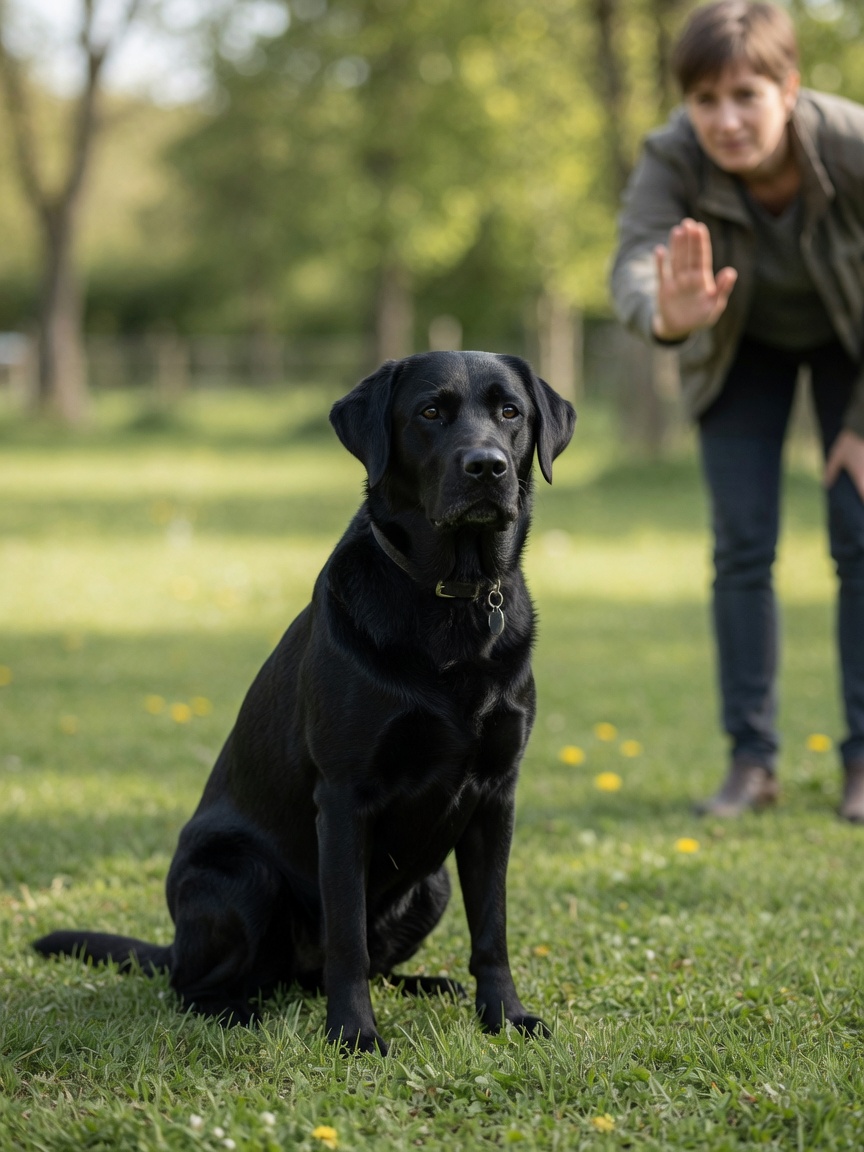
Why it matters: Stay keeps your dog safe at doors, roads, and vet clinics. It also builds the frustration tolerance that makes dogs easier to live with generally.
Step-by-Step
- Ask for a Sit.
- Open your palm like a stop sign toward the dog and say "Stay."
- Wait one second, mark, reward. Release with "Free!" or "OK!"
- Build duration first (longer pauses), then add distance (one step back), then add distraction. Never increase two variables at once.
- Always return to the dog to reward — don't call them out of a Stay early in training.
Common mistake: Drilling long stays too soon. Start with one second and be generous.
Troubleshooting: If the dog breaks Stay, simply reset — no scolding. Just shorten the duration and rebuild.
3. Down — Calm Settles the Room
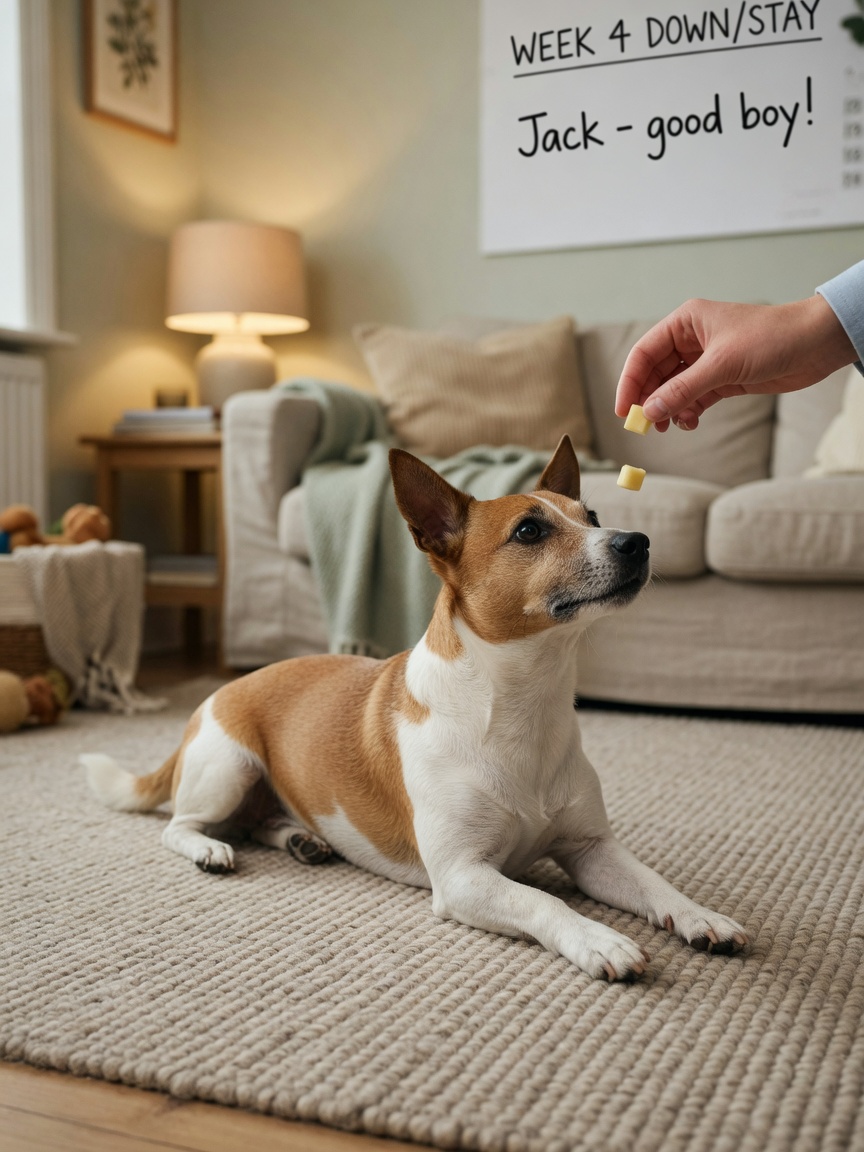
Why it matters: Down is more physically relaxing than Sit and is excellent for long-duration calming in restaurants, waiting rooms, and family gatherings.
Step-by-Step
- Ask for a Sit first.
- Hold a treat at the dog's nose and slowly lower it straight to the floor between their front paws.
- Many dogs will follow the treat down into a sphinx position — mark and reward immediately.
- If the dog stands instead of lies down, try luring under your slightly raised knee or under a coffee table to encourage folding down.
- Add the verbal cue "Down" once the motion is reliable.
Common mistake: Saying "Down!" to a dog that is jumping up — use a separate cue for that (e.g., "Off") to avoid confusion.
4. Come — The Lifesaving Recall
Why it matters: A reliable recall can save your dog's life. It is arguably the most important behavior you will ever teach.
Step-by-Step
- Start in a low-distraction environment, just a few feet away.
- Crouch down, open arms, say your recall word (e.g., "Come!" or their name + "here!") in a happy, inviting voice.
- When they arrive, mark and give several treats in a row — a "jackpot" — plus verbal praise and petting.
- Never call your dog to scold them, end playtime abruptly, or do anything unpleasant. Make coming to you the best thing in the world.
- Gradually add distance and distraction. Use a long-line (5–10 m) for practicing outdoors safely.
Common mistake: Using the recall cue when you are not prepared to reward generously. Every unpaid recall erodes reliability.
5. Leave It — The Self-Control Command
Why it matters: Leave It prevents your dog from eating dropped medications, toxic food, or dead wildlife on walks.
Step-by-Step
- Place a low-value treat in your closed fist. Let the dog sniff and paw — ignore all attempts.
- The moment they pull away even slightly, mark and reward with a different, higher-value treat from the other hand.
- Repeat until the dog moves away readily, then add the cue "Leave it."
- Progress to a treat on the floor covered by your foot, then uncovered with your foot hovering nearby, then at a distance.
- Final proofing: practice on walks with real-world distractions.
Troubleshooting: If your dog is stealing from your hand-lure, keep your fist tighter. Patience wins here.
6. Heel — Polite Walking at Your Side
Why it matters: Heel (or loose-leash walking) makes daily walks enjoyable rather than a battle. Dogs that pull drag owners — sometimes literally.
Step-by-Step
- Start indoors with no leash. Lure your dog to your left side with a treat held at your hip.
- Take one step, mark and reward if they stay beside you. Build to two steps, then three.
- Add the cue "Heel" as they begin moving into position reliably.
- Transfer to leash in low-distraction areas, then progressively add challenge.
- Reward frequently — every 3–5 steps early in training — then thin the schedule as the dog improves.
Common mistake: Expecting perfect heel from day one on a stimulating walk. Build the behavior at home first.
7. Place — The Ultimate Settle Command
Why it matters: Place (going to a specific mat or bed and remaining there) gives your dog a job during mealtimes, guest arrivals, and whenever you need them calm and out of the way.
Step-by-Step
- Put a mat or bed on the floor. Lure your dog onto it with a treat — mark when all four paws are on the mat.
- Build duration on the mat using Stay principles — mark and reward for remaining on it.
- Add the cue "Place" as the dog begins moving toward the mat with confidence.
- Gradually increase distance until the dog can be sent to Place from across the room.
- Proof with distractions: practice when the doorbell rings, when guests arrive, during meal prep.
Troubleshooting: If the dog hops off, calmly guide them back without frustration and reward heavily for returning.
Key Takeaways
- Keep training sessions to 5–10 minutes — short, frequent sessions outperform long ones.
- Always use a marker signal (clicker or verbal "Yes!") at the exact moment of correct behavior.
- Build behaviors in order: lure → mark → reward → fade lure → add cue → proof in distractions.
- Never punish errors — simply reset and make the next rep easier to succeed at.
- Recall (Come) should always be rewarded generously; never punish a dog for coming to you.
- Positive reinforcement is not just kinder — it is faster and produces more durable learning.
Putting It All Together
You do not need to master all seven commands before starting to use them in real life. In fact, practicing in real contexts — at the park, in the kitchen, before meals — is exactly how you proof behaviors to be reliable anywhere. The key is to raise criteria gradually and to keep sessions fun. A dog that enjoys training will outlearn a drilled dog every time.
References
- Hiby EF, Rooney NJ, Bradshaw JWS. Dog training methods: their use, effectiveness and interaction with behaviour and welfare. Animal Welfare. 2004;13(1):63–69. PMID: 30064550
- Ziv G. The effects of using aversive training methods in dogs — a review. Journal of Veterinary Behavior. 2017;19:50–60. PMID: 28363033