
CBD for Cat Anxiety: Travel, Fireworks & Vet Visits
By Julia Wrenfield, Pet Wellness Researcher
Anxiety is one of the most under-recognized welfare issues in domestic cats. Unlike dogs, cats rarely vocalize distress in obvious ways — instead, they hide, over-groom, refuse food, or develop stress-related urinary problems. For many cat owners, traditional calming solutions like pheromone diffusers or prescription sedatives feel either insufficient or excessive for situational triggers like car rides, fireworks, and veterinary appointments.
CBD (cannabidiol) has emerged as a subject of genuine scientific interest in feline anxiety management. This article explains what the research currently shows, how CBD interacts with the feline endocannabinoid system, and how to approach dosing and product selection safely.
How Cats Experience Anxiety
Cats are highly sensitive to environmental changes. The feline stress response is governed by the same hypothalamic-pituitary-adrenal (HPA) axis found in other mammals, but cats have a notably lower threshold for sympathetic nervous system activation. Common triggers include unfamiliar sounds (fireworks, thunder), transport in carriers, the scent of other animals in a veterinary clinic, and changes in home routine.
Chronic anxiety in cats can manifest as feline idiopathic cystitis (FIC), a painful bladder condition directly linked to stress, as well as psychogenic alopecia (stress-related hair loss), aggression, and anorexia. Addressing anxiety is therefore not merely behavioral — it is a medical priority.
The Endocannabinoid System in Cats
Cats, like all mammals, possess an endocannabinoid system (ECS) comprising CB1 receptors (concentrated in the brain and nervous system) and CB2 receptors (found in immune tissue). CBD does not bind directly to these receptors but modulates them indirectly, while also interacting with serotonin receptors (5-HT1A) — the same receptors targeted by anti-anxiety medications like buspirone.
This serotonergic interaction is particularly relevant for anxiety: activation of 5-HT1A receptors is associated with anxiolytic effects in multiple species. Research published in Gamble et al. 2018 (PMID 29686786), while focused on dogs, provided early evidence that CBD is well tolerated by companion animals and crosses relevant biological pathways shared with cats.
What the Research Says About Cats Specifically
Feline-specific CBD research remains limited compared to canine studies, but early findings are encouraging. A 2021 pharmacokinetic study found that cats can absorb CBD from oral oil preparations, though their metabolism differs — cats have fewer glucuronidation enzymes, meaning CBD may remain active longer in their system, which argues for conservative dosing.
The VCA Hospitals note that while formal randomized controlled trials in cats are still lacking, anecdotal veterinary reports and early pharmacokinetic data support cautious use at low doses for situational anxiety. The Cornell University College of Veterinary Medicine has also acknowledged the growing body of feline endocannabinoid research as worthy of continued investigation.
Dosing CBD for Cats: A Conservative Approach
Because of cats' unique metabolism, the starting dose should be lower than for dogs. Most veterinary practitioners who use CBD in feline patients begin at 0.1–0.5 mg of CBD per kilogram of body weight, once daily. For a typical 4 kg cat, this means 0.4–2 mg of CBD per dose — far less than common dog doses.
For situational anxiety (travel, fireworks, vet visits), administer the dose 30–60 minutes before the stressful event. Oil drops placed directly in the mouth or mixed into a small amount of wet food are most effective for absorption. Never use CBD products containing additives like xylitol, grape extract, or essential oils, as these are toxic to cats.
Situational Use: Travel, Fireworks, and Vet Visits
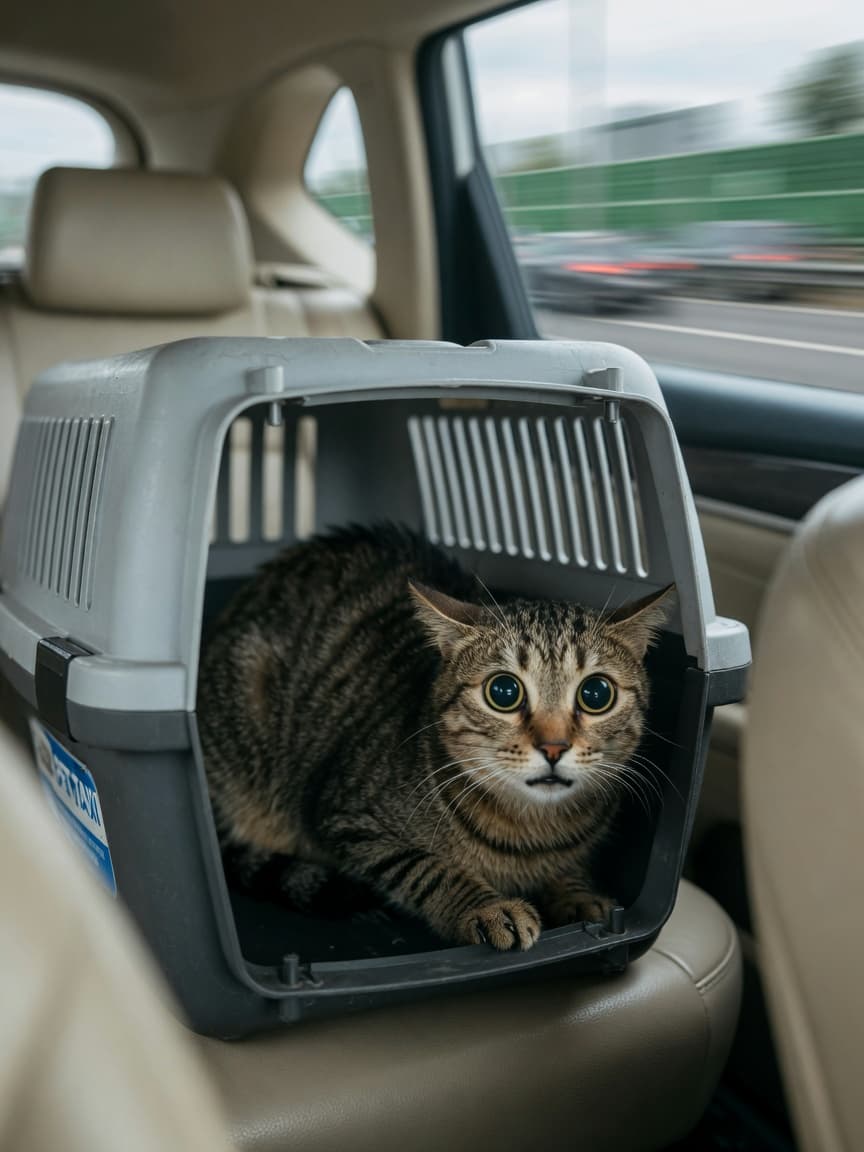
For travel anxiety, pair CBD with carrier habituation — leave the carrier open in your home days before travel so your cat associates it with neutral experiences. Administer CBD 45 minutes before placing your cat in the carrier.
For fireworks or thunderstorms, give the dose as early as possible once you know the event is approaching. CBD works best when given before the stress response peaks — it is less effective as a rescue remedy once a cat is already highly aroused.
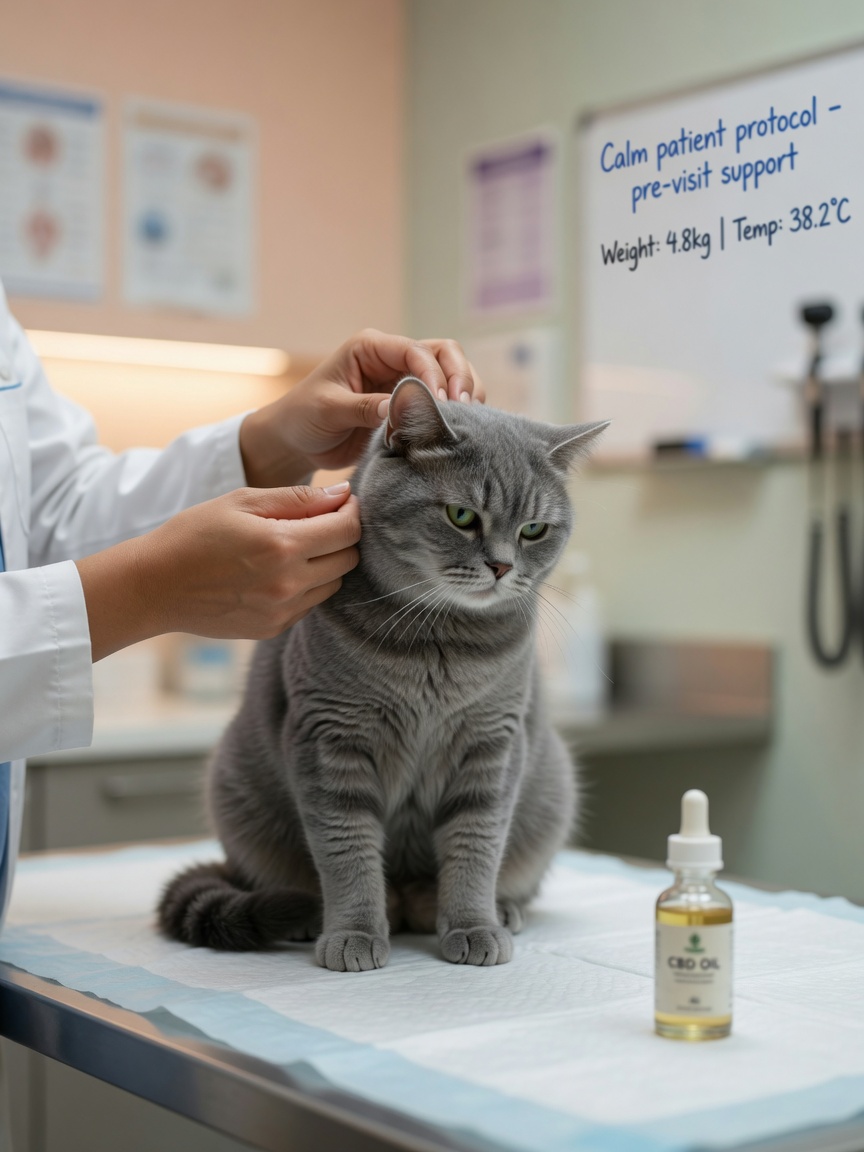
For vet visits, administer at home before departure rather than at the clinic. Handling a stressed cat at the clinic after a stressful journey compounds anxiety; early dosing addresses the anticipatory component that begins the moment the carrier appears.
What to Look for in a Feline CBD Product
Not all CBD products are suitable for cats. Key criteria include: no THC (cats may be more sensitive to THC than dogs — broad-spectrum or isolate products are preferable), no artificial flavors that mask toxic additives, clear mg-per-ml labeling, and a third-party Certificate of Analysis confirming cannabinoid content and the absence of contaminants. The American Kennel Club standards for canine CBD quality apply equally to feline products.
Signs CBD Is Helping — and When to Stop
Positive responses in anxious cats include reduced hiding, more relaxed body posture (soft eyes, loose tail, no piloerection), willingness to eat, and calmer vocalization during travel. If your cat becomes excessively sedated, drools, or shows signs of ataxia (wobbling), the dose is too high — halve it and consult your vet. These signs are rare at conservative doses but are more likely in cats given dog-formulated products with much higher concentrations.
Key Takeaways
- Cats have a unique metabolism — start at 0.1–0.5 mg CBD per kg body weight, once daily.
- For situational anxiety, give CBD 30–60 minutes before the stressful event.
- Avoid products with THC, xylitol, essential oils, or unclear ingredient lists.
- CBD interacts with feline serotonin receptors, supporting its anxiolytic potential.
- Always pair CBD with behavioral strategies (carrier training, desensitization).
- Consult a veterinarian, especially if your cat takes other medications.
Article by Julia Wrenfield, Pet Wellness Researcher. For educational purposes only — not a substitute for professional veterinary advice.
CBD has been studied for stress and anxiety reduction in multiple clinical trials. Key findings:
- A systematic review of 927 adults found CBD effective for anxiety-related conditions (PMID 32231748)
- A 2024 systematic review of RCTs confirmed anxiolytic effects across multiple contexts (PMID 39598172)
- An RCT in dogs showed reduced stress measures during noise events (PMC7537661)
- A 2024 RCT confirmed tolerability of 2–4 mg/kg CBD every 12h in dogs (PMID 38997975)
Julia's Pick for Europe: Candid Tails Calm+
Among EU-available CBD pet supplements, Candid Tails stands out for its regulatory transparency and formulation quality:
- Every batch independently lab-tested — THC <0.3% guaranteed on each Certificate of Analysis
- Formulated under EU complementary feedstuff regulations — not a grey-area supplement
- Petibidiol® proprietary extract with added Omega-3 & 6 and vitamins for synergistic support
- Veterinary-approved formulation, science-backed ingredient selection
- 4.9/5 Google Reviews | 30-day money-back guarantee
- According to the brand: present in 10+ countries and used in over 3,000 veterinary clinics
Many CBD pet products lack public Certificates of Analysis, have no vet oversight, and are not registered under EU animal nutrition law. Always verify before buying.