
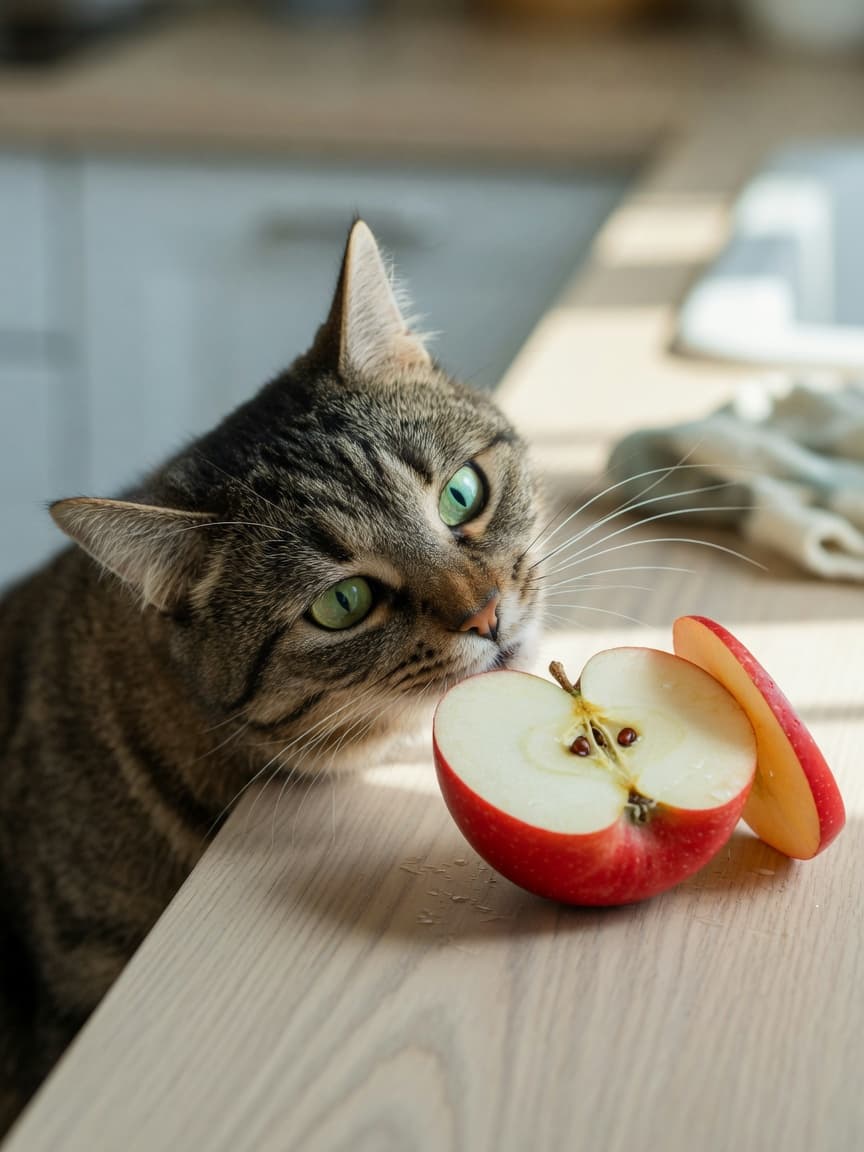
Can Cats Eat Apples? Seeds, Stems, and Safety Explained
Is Apple Flesh Safe for Cats?
The flesh of an apple — the soft, edible part — is not toxic to cats. If your cat happens to sniff and nibble a small slice of apple, there is no cause for immediate alarm. Apple flesh contains water, natural sugars (fructose), dietary fiber, and vitamins such as vitamin C and vitamin A. In humans, these are valued nutrients. In cats, however, the picture is quite different.
Cats synthesize their own vitamin C internally and do not require it from food. Their digestive systems are designed to process animal protein and fat efficiently, while carbohydrates — including the natural sugars in fruit — are processed poorly. Offering apple flesh to a cat is, nutritionally speaking, an empty gesture. It will not harm them in small amounts, but it will not help them either.
If you do offer apple to your cat, keep the piece very small — about the size of a fingernail — and remove all skin if possible, as some cats may find the texture difficult to digest. Never make it a regular treat or a significant part of the diet.
The Danger of Apple Seeds: Cyanide Risk
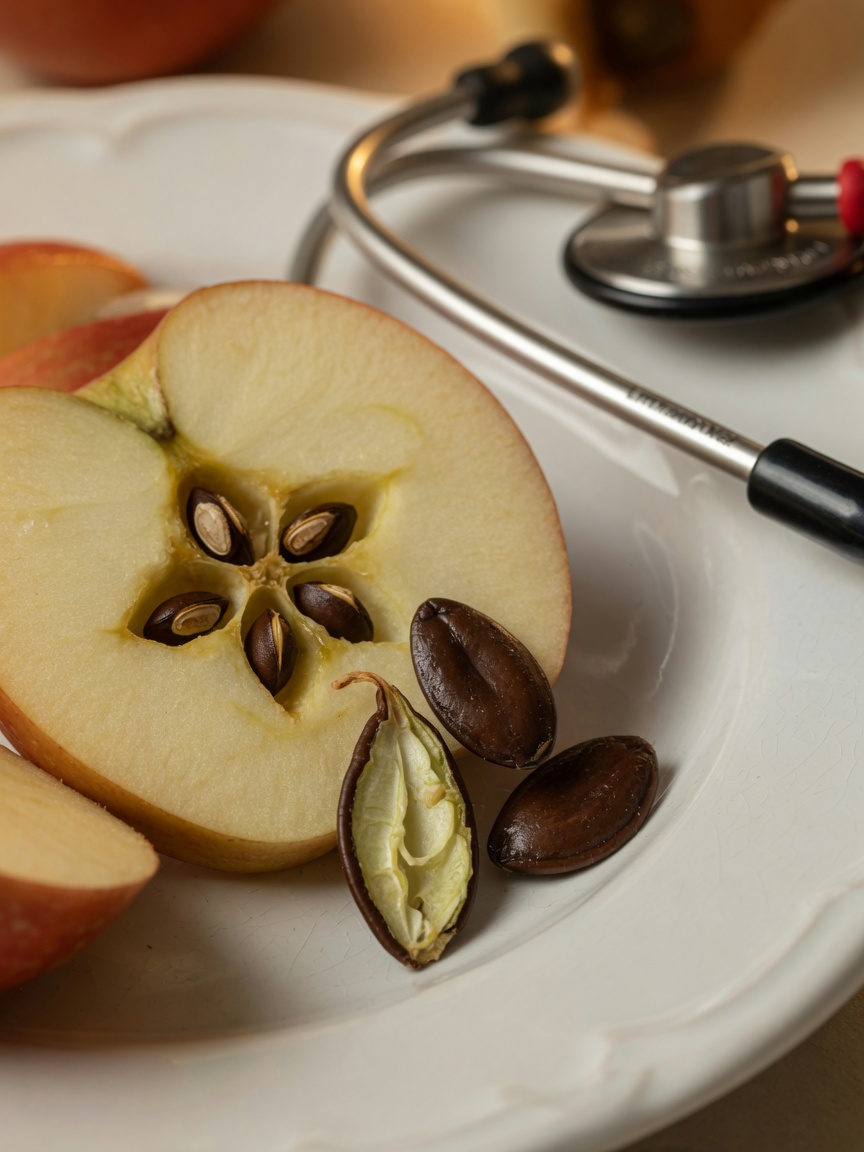
This is the critical safety point every cat owner must understand. Apple seeds — along with the stems, leaves, and core — contain a compound called amygdalin. When amygdalin is chewed or broken down during digestion, it releases hydrogen cyanide, a potent toxin that interferes with cellular oxygen use.
Cats are small animals, and their tolerance for cyanogenic compounds is lower than that of humans. While a human would need to consume a large quantity of apple seeds to experience toxicity, the threshold for a cat is much lower. A single seed is unlikely to cause acute poisoning, but the risk is real and entirely unnecessary to take.
Signs of cyanide toxicity in cats include:
- Dilated pupils
- Difficulty breathing or rapid breathing
- Bright red gums (due to cells being unable to use oxygen)
- Convulsions or seizures
- Sudden collapse
If you suspect your cat has ingested apple seeds or any part of the apple core, contact your veterinarian or an animal poison control hotline immediately. Cyanide toxicity is a medical emergency.
Can Cats Taste the Sweetness in Apples?
An interesting aspect of feline biology is that cats lack functional sweet taste receptors. Unlike humans and many other mammals, cats have a non-functional version of the Tas1r2 gene, one of the two genes required to detect sweetness. This means cats are essentially unable to taste sugar — they cannot experience the pleasant sweetness that makes fruit appealing to us.
If your cat shows interest in an apple, it is almost certainly driven by curiosity about the smell, texture, or the fact that you are handling it — not by any attraction to its flavor. Cats are highly attuned to their owners' behaviors, and anything you eat or prepare can become an object of curiosity for them.
Apple Skin: Worth Removing?
Apple skin is not toxic, but it can be difficult for some cats to chew and digest, particularly older cats or those with dental issues. The skin may also carry pesticide residues if the apple has not been thoroughly washed. If you offer apple to your cat, peeling it first is a sensible precaution.
Apple sauce and apple juice are not appropriate alternatives. Commercial apple sauce often contains added sugars and preservatives, and apple juice is essentially concentrated sugar water with none of the fiber that at least slows down sugar absorption in the flesh. Neither product is suitable for cats.
Cats Are Obligate Carnivores: Fruit Is Never Necessary
Cats evolved as strict meat-eaters. Their entire metabolic machinery is oriented around processing protein and fat from animal sources. Unlike omnivores such as dogs or bears — or humans — cats cannot effectively use plant-based carbohydrates as an energy source. They have limited ability to upregulate the enzymes needed to digest starch and sugars efficiently.
Research into the natural dietary composition of feral cats shows that their diet consists of roughly 50–60% protein, 30–40% fat, and very little carbohydrate — all sourced from prey animals. Fruit does not appear in the natural feline diet in any meaningful quantity. Occasionally a wild cat might incidentally ingest small plant matter from a prey animal's stomach contents, but deliberate fruit consumption is not a natural feline behavior.
This means that any fruit, including apples, is essentially a non-food for cats from a nutritional standpoint. Feeding it regularly — even in non-toxic amounts — displaces calories that should come from high-quality animal protein and can contribute to nutritional imbalance over time.
Ver alimentos para gatos en Zooplus →How to Safely Offer Apple to Your Cat (If You Wish)
If your cat is curious about apples and you want to let them explore, follow these steps:
- Wash the apple thoroughly under running water.
- Peel the skin to reduce pesticide exposure and ease digestion.
- Remove all seeds, the core, and any stem or leaf material completely.
- Cut a very small piece of flesh — no larger than 1 cm square.
- Offer it to your cat and observe their reaction. Most cats will sniff and walk away.
- Do not offer apple more than once or twice a week, and only as an occasional curiosity treat.
- Apple flesh is not toxic to cats and is safe in very small pieces, occasionally.
- Apple seeds, stems, core, and leaves contain amygdalin, which releases cyanide — always remove them completely.
- Cats cannot taste sweetness, so they have no appetite-driven reason to want fruit.
- Apples provide no nutritional benefit to obligate carnivores and should never be a dietary staple.
- If your cat ingests apple seeds, contact a vet immediately.
References
- Plantinga EA, Bosch G, Hendriks WH. "Estimation of the dietary nutrient profile of free-roaming feral cats: possible implications for nutrition of domestic cats." Br J Nutr. 2011;106 Suppl 1:S35-48. PMID: 22005436
- Li X, Li W, Wang H, et al. "Pseudogenization of a sweet-receptor gene accounts for cats' indifference toward sugar." PLoS Genet. 2005;1(1):27-35. PMID: 16103917
- Verbrugghe A, Bakovic M. "Peculiarities of one-carbon metabolism in the strict carnivore, the domestic cat (Felis catus)." Nutrients. 2013;5(7):2811-35. PMID: 23873295