

Best Joint Supplements for Cats: Cosequin vs Dasuquin vs Antinol
Quick Summary
Joint supplements can meaningfully support mobility and comfort in cats with arthritis or age-related joint changes. The most studied options are glucosamine-based products (Cosequin for Cats, Dasuquin for Cats) and the lipid-extract newcomer Antinol for Cats.
Evidence level: Moderate for glucosamine/chondroitin in cats; promising but early for PCSO-524 (Antinol). Omega-3 fatty acids (EPA/DHA) have solid anti-inflammatory support across species.
⚠ CRITICAL SAFETY WARNING — READ THIS FIRST: Never give your cat a supplement formulated for dogs. This is not a minor precaution — it is a genuine toxicity risk. Cats lack the liver enzymes that dogs use to process many common compounds. Ingredients that are entirely safe for dogs, including certain preservatives, herbal additives, and even some forms of omega-3 blends, can be toxic or fatal to cats. Only ever purchase products explicitly labelled for cats. If the label does not say "for cats," do not use it. I will repeat this warning throughout this article because it is that important.
Why Cats Are Not Small Dogs: A Metabolism Lesson That Could Save Your Cat’s Life
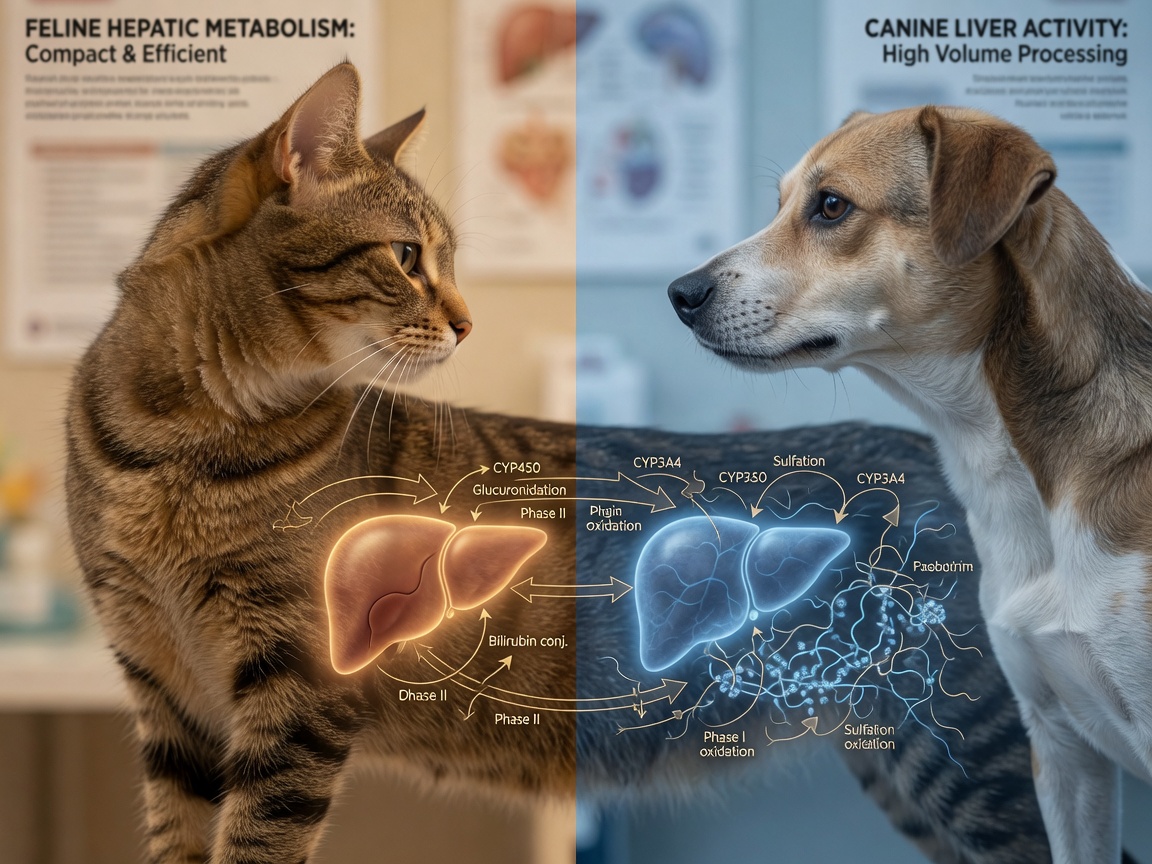
Cats are obligate carnivores whose liver biochemistry evolved along a very different path from that of dogs and humans. The single most important difference, from a supplement-safety standpoint, is that cats have severely limited or absent activity of certain glucuronidation enzymes — specifically UGT1A6 and UGT1A9, two members of the UDP-glucuronosyltransferase family responsible for conjugating and clearing a wide range of compounds from the body.
In practical terms, this means cats cannot safely metabolise many substances that dogs handle with ease. The classic example is paracetamol (acetaminophen), which is acutely fatal to cats at doses that a human or dog tolerates. But the issue extends far beyond obvious human medicines. Some preservatives commonly used in dog supplements, certain herbal extracts marketed for joint health, and even specific formulations of essential fatty acid blends can accumulate to toxic levels in a cat because the feline liver simply does not have the enzymatic toolkit to break them down and excrete them.
This is not a theoretical concern. Veterinary toxicology case files contain reports of cats harmed by owners who, with entirely good intentions, gave them a supplement from the dog section because the dosage seemed easy to halve. Please do not do this. The risk is real, and "half a dog dose" does not automatically become a safe cat dose when the underlying chemistry is wrong.
Rule, stated plainly: if the product does not explicitly say it is formulated for cats, it does not go near your cat.
Comparison at a Glance
| Product | Glucosamine | Omega-3 | PCSO-524 | Cat-Safe | Price/day | Verdict |
|---|---|---|---|---|---|---|
| Cosequin for Cats | ✓ Yes (HCl form) | ✗ No | ✗ No | ✓ Yes — cat-specific | ∼€0.35 | Reliable baseline. Well-tolerated, widely available, solid safety record in cats. |
| Dasuquin for Cats | ✓ Yes + ASU | ✗ No | ✗ No | ✓ Yes — cat-specific | ∼€0.50 | Adds avocado-soybean unsaponifiables (ASU); slightly stronger evidence than glucosamine alone. |
| Antinol for Cats | ✗ No | ✓ EPA/DHA (via PCSO-524) | ✓ Yes | ✓ Yes — cat-specific | ∼€0.60–0.80 | Most novel option. Genuine interest from vet researchers. Limited but promising early data. |
| Zesty Paws Cat Mobility | ✓ Yes | ✓ Some | ✗ No | ✓ Yes — cat line only | ∼€0.40 | Palatable chew format; useful for supplement-resistant cats. Ingredient profile is adequate. |
| Generic fish oil (cat-appropriate dosing) | ✗ No | ✓ EPA/DHA only | ✗ No | ⚠ Check source & dose carefully | ∼€0.10–0.20 | Lowest cost EPA/DHA option. Quality and purity vary widely. Requires careful dosing. |
Antinol for Cats: What Is PCSO-524 and Why Does It Matter?
Antinol occupies genuinely interesting scientific territory. Its active ingredient, PCSO-524, is a proprietary lipid extract derived from the New Zealand green-lipped mussel (Perna canaliculus), concentrated using a cold-extraction process that preserves a complex mixture of polyunsaturated fatty acids, sterols, and polar lipids not found in standard fish oil.
The relevance for joint health lies in the extract’s apparent ability to modulate the leukotriene pathway — a key mediator of inflammation that is distinct from the prostaglandin pathway targeted by NSAIDs. Early in-vitro and rodent studies suggested PCSO-524 could reduce inflammatory markers through this route, and there is now a small but growing body of work in companion animals, including cats specifically.
A 2021 study published in the Journal of Veterinary Internal Medicine examined Antinol in cats with naturally occurring degenerative joint disease. Owners reported measurable improvements in mobility scores, and the cats tolerated the supplement without adverse effects over the study period. That is encouraging. It is also a single study with a relatively small cohort.
My honest assessment: PCSO-524 is not yet at the level of evidence where I would call it definitively proven for cats. But it is genuinely novel, it appears well-tolerated, it is formulated specifically for cats, and the mechanism of action is scientifically plausible in a way that some supplement marketing is not. For a cat who has not responded well to traditional glucosamine products, or an owner who wants to try an anti-inflammatory approach rather than a structural support approach, Antinol is a reasonable and interesting choice. Just go in with appropriate expectations about the strength of the evidence base.
Omega-3 Fatty Acids for Cats: What You Must Get Right
Omega-3 fatty acids, specifically EPA (eicosapentaenoic acid) and DHA (docosahexaenoic acid), have genuine anti-inflammatory properties and meaningful supporting evidence for joint and general inflammatory conditions across species. For cats, however, there is a critical biochemistry point that many owners and even some product labels get wrong.
Cats cannot meaningfully convert ALA (alpha-linolenic acid) — the omega-3 found in flaxseed oil, chia seeds, and most plant-based omega-3 supplements — into EPA and DHA. Humans do this conversion poorly; cats do it negligibly. Plant-based omega-3 supplements are therefore essentially useless for cats as an anti-inflammatory intervention. The only effective forms are pre-formed EPA and DHA from marine sources: fish oil or, as in Antinol, green-lipped mussel extract.
If you choose to use a generic fish oil for your cat, dosing matters enormously. A general starting point cited in veterinary nutrition literature is approximately 50–75 mg of combined EPA+DHA per kilogram of body weight daily for anti-inflammatory support, but this should be confirmed with your vet, particularly if your cat has kidney disease or is on any other medication. Too much fish oil can affect platelet function and, in poor-quality products, introduce contaminants. Always choose a fish oil that has been third-party tested for heavy metals and oxidation, and store it correctly — oxidised fish oil is at best useless and at worst harmful.
One more note: some fish oil capsules formulated for humans contain additives or preservatives that have not been assessed for feline safety. Plain, pure fish oil with no additives is what you want. And once again — never use a dog-specific omega-3 blend with your cat. Check the label. Every time.
Julia’s Verdict
After reviewing the available evidence and formulation safety, here is where I land:
Antinol for Cats is my most genuinely interesting recommendation. The PCSO-524 complex represents a different mechanism from glucosamine and has cat-specific research behind it. The evidence is early, and I say that clearly, but the scientific rationale is solid and the cat-specific formulation removes the toxicity risk that shadows anything designed for dogs. If your cat has not responded to glucosamine or you want to try an anti-inflammatory approach, this is worth discussing with your vet.
Cosequin for Cats remains the reliable baseline. It has the longest safety record in feline use, it is widely available, and glucosamine hydrochloride is generally well-tolerated by cats. If you want a conservative, evidence-informed starting point, this is it.
The one thing I will not compromise on is cat-specific formulation. I would rather recommend no supplement at all than one designed for dogs. The feline liver is not the canine liver, and the consequences of getting this wrong can be severe and irreversible. Please, always buy from the cat section.
Key Takeaways
- ⚠ Never use dog joint supplements in cats. Cats lack the liver enzymes (glucuronidation pathway) that dogs use to process many common supplement ingredients. This is a toxicity risk, not a minor caution.
- Always choose products explicitly labelled for cats — "cat-specific" or "for cats" must appear on the packaging.
- Glucosamine-based products (Cosequin for Cats, Dasuquin for Cats) have the longest safety record in feline use and are a reasonable starting point.
- Antinol for Cats (PCSO-524 green-lipped mussel extract) is the most scientifically novel option and has genuine early cat-specific research, though evidence is still limited.
- Cats cannot convert plant-based ALA omega-3 into useful EPA/DHA. Only marine-source EPA/DHA (fish oil, green-lipped mussel) works for cats.
- Fish oil dosing requires care. Use third-party tested products with no additives, dose by body weight, and confirm with your vet.
- The evidence base for joint supplements in cats generally lags behind that for dogs. Realistic expectations matter — these are supportive measures, not cures.
- Always consult your veterinarian before starting any supplement, especially if your cat has kidney disease, liver conditions, or is on NSAIDs or other medications.