
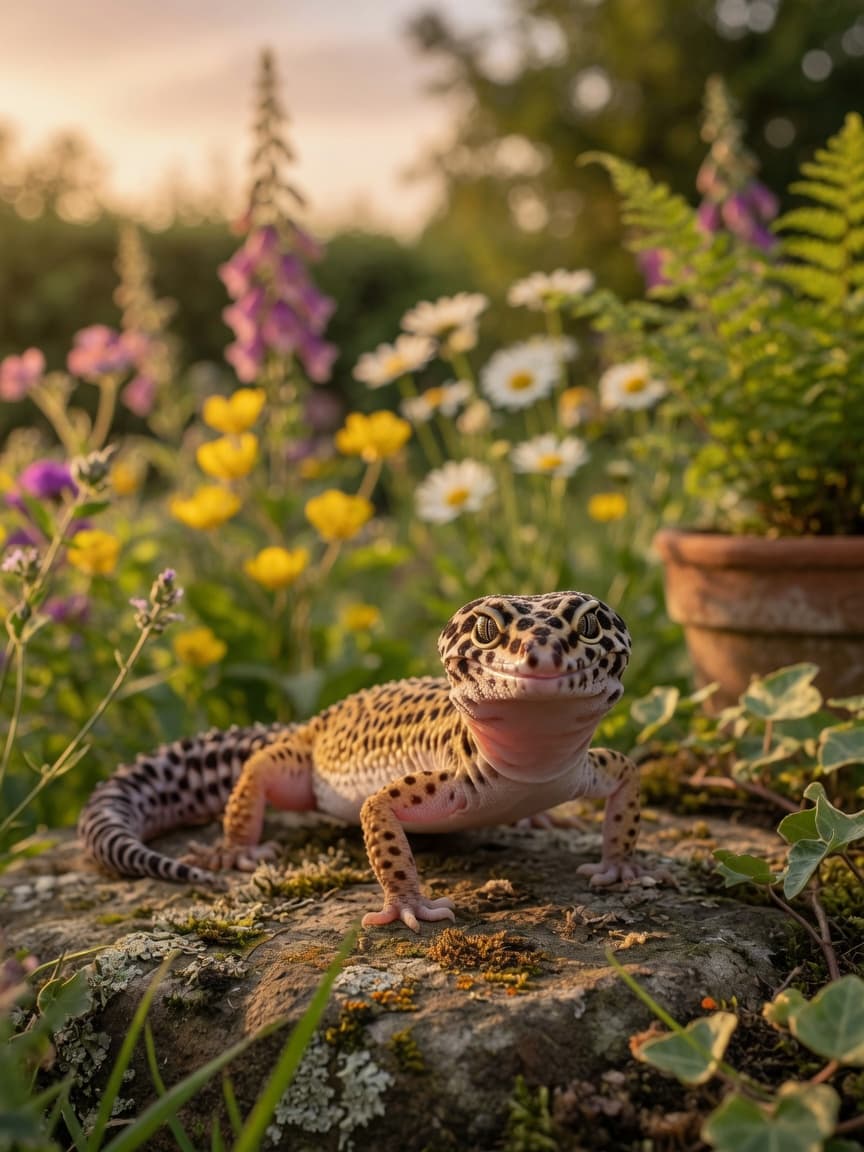
Guide d'entretien du gecko léopard pour les éleveurs européens
Les geckos léopards (Eublepharis macularius) figurent régulièrement parmi les reptiles de compagnie les plus populaires en Europe, et on comprend aisément pourquoi. Ils sont de taille maniable, naturellement dociles après une socialisation en douceur, visuellement remarquables dans leurs nombreuses morphes de couleur obtenues en captivité, et relativement simples à maintenir comparés à beaucoup d'autres espèces de reptiles. Avec une espérance de vie de 15 à 20 ans dans de bonnes conditions, un gecko léopard représente un engagement sérieux sur le long terme — mais gratifiant. Ce guide couvre tout ce qu'un éleveur européen doit savoir sur le statut légal, l'aménagement du vivarium, le chauffage, l'alimentation, la complémentation et la santé.
Statut légal dans l'UE
Eublepharis macularius n'est inscrit à aucune annexe de la CITES, et aucun permis ni document n'est requis pour détenir, acheter ou vendre des geckos léopards nés en captivité au sein des États membres de l'UE. Ils sont légaux dans toute l'Union européenne. Les geckos léopards nés en captivité sont produits en grand nombre par des éleveurs en Allemagne, aux Pays-Bas, en France, en République tchèque et ailleurs, ce qui signifie qu'il n'est nullement nécessaire de rechercher des spécimens importés capturés dans la nature. Achetez toujours auprès d'un éleveur réputé ou d'une animalerie spécialisée établie en reptiles — demandez à voir l'animal se nourrir avant l'achat et réclamez si possible un carnet d'alimentation.
Taille et aménagement du vivarium
Les geckos léopards sont terrestres et nocturnes. Contrairement aux espèces arboricoles, ils privilégient la surface au sol plutôt que la hauteur. La taille minimale du vivarium pour un gecko léopard adulte seul est de 60 x 40 x 40 cm, mais plus grand est toujours préférable. Un enclos de 80 x 40 x 40 cm offre au gecko davantage d'espace pour thermoréguler, explorer et exprimer des comportements naturels. Les terrariums en verre à ouverture frontale sont idéaux — ils permettent un accès et une visibilité aisés tout en conservant la chaleur plus efficacement que les vivariums en bois à couvercle grillagé.
Ne logez jamais deux geckos léopards mâles ensemble. Les mâles sont territoriaux et se battront, provoquant des blessures graves. Un mâle seul peut être logé avec une ou deux femelles, à condition que les femelles soient surveillées pour détecter tout signe de stress et qu'il y ait suffisamment de cachettes pour que chaque animal puisse se retirer indépendamment.
Chauffage et gradient de température
Les geckos léopards sont ectothermes et nécessitent un gradient thermique pour réguler leur température corporelle. Le chauffage est idéalement assuré par un tapis chauffant placé sous le terrarium et couvrant environ un tiers de la surface au sol du vivarium, relié à un thermostat fiable. Les températures cibles sont :
- Température de surface du côté chaud : 28–32 °C
- Température ambiante du côté frais : 22–25 °C
- Baisse nocturne : les températures peuvent descendre à 18–20 °C la nuit, imitant les conditions naturelles
Un thermostat est absolument indispensable — n'utilisez jamais un tapis chauffant sans thermostat. Les tapis chauffants non régulés peuvent atteindre des températures provoquant des brûlures thermiques mortelles, qui figurent parmi les blessures les plus courantes observées chez les geckos léopards mal entretenus. Utilisez un thermomètre numérique dont la sonde est placée sur la surface du sol côté chaud afin de vérifier les températures avec précision. Les thermomètres infrarouges à visée laser sont également utiles pour des contrôles ponctuels rapides. Zooplus propose une gamme complète de thermostats pour reptiles, incluant des modèles tout-ou-rien et à impulsions proportionnelles adaptés au chauffage par le sol.
Éclairage UV : facultatif mais bénéfique
Les geckos léopards sont crépusculaires à nocturnes et ont historiquement été maintenus sans éclairage UV avec un succès raisonnable. Toutefois, les connaissances herpétologiques actuelles ont évolué : les recherches indiquent que les geckos léopards recherchent bel et bien de faibles niveaux d'UV dans la nature, et qu'un accès à un éclairage UV-B, même de faible intensité (IUV 0,5–1,5), favorise la synthèse de la vitamine D3, le métabolisme calcique et le bien-être général. Un tube UV-B de faible puissance tel qu'un Arcadia 6 % ou un Zoo Med Reptisun 5.0, fourni 10 à 12 heures par jour, est aujourd'hui recommandé par de nombreux éleveurs expérimentés et vétérinaires spécialisés en NAC. Cela ne remplace pas la complémentation en calcium et en D3 — cela la complète.
Choix du substrat
Le choix du substrat pour les geckos léopards fait l'objet d'un véritable débat, mais un principe fait largement consensus : évitez les substrats particulaires meubles pour les juvéniles et pour les adultes présentant le moindre problème de santé. Le sable meuble, le sable calcique et les coques de noix concassées comportent tous un risque d'occlusion intestinale en cas d'ingestion pendant le nourrissage. Les substrats adaptés comprennent :
- Carreaux d'ardoise ou de céramique : faciles à nettoyer, ils retiennent bien la chaleur et permettent une usure naturelle des griffes
- Papier essuie-tout : hygiénique et idéal pour les juvéniles, les installations de quarantaine ou les animaux malades
- Tapis pour reptiles : pratique et facile à remplacer, mais surveillez les fils qui se détachent
- Mélanges de terre bioactifs avec une couche supérieure de sable : réservés aux éleveurs expérimentés, ils apportent un enrichissement naturel tout en maîtrisant le risque d'occlusion grâce à une profondeur et une composition correctes
Cachettes et enrichissement
Les geckos léopards ont besoin d'un minimum de trois cachettes : une du côté chaud, une du côté frais et une cachette humide pour la mue. Les cachettes doivent être bien ajustées au gecko — un espace exigu procure un sentiment de sécurité qu'une grande grotte ouverte n'offre pas. La cachette humide est particulièrement importante pendant l'ecdysis (la mue) : remplissez-la de sphaigne humidifiée ou de papier essuie-tout et assurez-vous que votre gecko puisse y accéder librement dans les jours précédant une mue. Un enrichissement supplémentaire tel que de l'écorce de liège, des plantes artificielles basses et des corniches en ardoise ajoute de la complexité comportementale et réduit le stress.
Alimentation et complémentation
Les geckos léopards sont insectivores. Leur alimentation doit reposer sur une variété d'insectes vivants afin d'assurer une complétude nutritionnelle et une stimulation mentale par le comportement de chasse. Les proies adaptées comprennent :
- Grillons (Acheta domesticus) : un aliment de base nutritif qui encourage la chasse naturelle
- Blattes Dubia : plus riches en protéines que les grillons, moins riches en chitine ; excellent aliment de base
- Vers de farine (larves de Tenebrio molitor) : volontiers acceptés mais riches en graisses ; à utiliser en complément et non comme aliment de base
- Vers de cire (larves de Galleria mellonella) : très riches en graisses ; à réserver comme friandise occasionnelle ou pour stimuler l'appétit d'un gecko en sous-poids
Nourrissez les insectes (gut-loading) avec des aliments nutritifs (légumes, mélange commercial de gut-load) pendant au moins 24 heures avant de les proposer à votre gecko. Saupoudrez chaque insecte de poudre de calcium et de vitamine D3 pour les juvéniles nourris quotidiennement, et un repas sur deux pour les adultes. Du calcium pur (sans D3) peut être proposé dans une petite coupelle afin que le gecko s'autorégule. Sans apport suffisant en calcium et en D3, les geckos léopards développent une maladie osseuse métabolique — l'une des affections les plus fréquentes et totalement évitables observées en captivité. Zooplus propose une sélection de compléments pour reptiles, dont les produits Repashy et Exo Terra adaptés aux geckos léopards.
Eau
Fournissez toujours une coupelle d'eau peu profonde, suffisamment grande pour que votre gecko puisse y boire mais assez peu profonde pour éviter toute noyade. Renouvelez l'eau quotidiennement et nettoyez la coupelle chaque semaine. Les geckos léopards tirent la majeure partie de leur hydratation de leurs proies, mais ils boivent bel et bien, en particulier durant la période entourant une mue.
Problèmes de santé courants
- Maladie osseuse métabolique (MBD) : causée par une carence en calcium ou en D3. Les signes comprennent des membres caoutchouteux ou déformés, des tremblements, des difficultés à marcher et une déformation de la mâchoire. Entièrement évitable grâce à une complémentation correcte. Nécessite une intervention vétérinaire urgente si elle est présente.
- Cryptosporidiose : une infection intestinale à protozoaires causée par Cryptosporidium varanii. Elle se manifeste par une perte de poids progressive malgré un appétit conservé — connue sous le nom de « maladie de la queue en bâtonnet » (stick tail disease) à un stade avancé. Il n'existe aucun traitement curatif homologué ; la prise en charge repose sur des soins de soutien. Les animaux infectés doivent être strictement isolés afin d'empêcher la transmission.
- Mue retenue (dysecdysis) : mue incomplète, souvent avec de la peau retenue autour des doigts ou du bout de la queue. La peau retenue sur les doigts comprime la circulation et peut entraîner la perte d'un doigt si elle n'est pas retirée. Faites tremper la zone concernée dans un peu d'eau tiède et aidez délicatement au retrait. Augmentez l'humidité et vérifiez la présence d'une cachette humide.
- Infection respiratoire : mucus, respiration sifflante et respiration bouche ouverte. Généralement liée à des températures trop basses ou à des courants d'air. Nécessite un traitement antibiotique vétérinaire.
Les geckos léopards nécessitent rarement des soins vétérinaires d'urgence lorsque les conditions d'élevage sont correctes, mais des contrôles réguliers chez un vétérinaire expérimenté en reptiles sont utiles, notamment pour dépister les parasites internes. Recherchez un vétérinaire titulaire d'une qualification ECZM (European College of Zoological Medicine) en herpétologie ou disposant d'une expérience avérée des animaux exotiques — les praticiens généralistes sont rarement équipés pour évaluer la santé des reptiles. De nombreux pays européens disposent de cliniques dédiées aux animaux exotiques, en particulier dans les villes possédant des facultés vétérinaires.
Où se procurer des geckos léopards et du matériel dans l'UE
Les geckos léopards sont élevés par une communauté de passionnés européens vaste et active, en particulier en Allemagne, aux Pays-Bas et en République tchèque. Les sociétés herpétologiques nationales et les forums en ligne consacrés aux reptiles constituent d'excellents points de départ pour trouver des éleveurs réputés capables de fournir des carnets de santé et d'alimentation. Évitez d'acheter des geckos léopards dans les animaleries généralistes, sauf si vous pouvez vérifier qu'ils sont nés en captivité et qu'ils se nourrissent bien. Le matériel de vivarium — thermostats, tapis chauffants, cachettes, compléments et éclairage UV — peut être commodément acheté chez Zooplus ou auprès de détaillants européens spécialisés en reptiles. Avec une installation adaptée et un engagement en faveur de conditions d'élevage constantes, un gecko léopard sera un compagnon sain et attachant pendant deux décennies.