
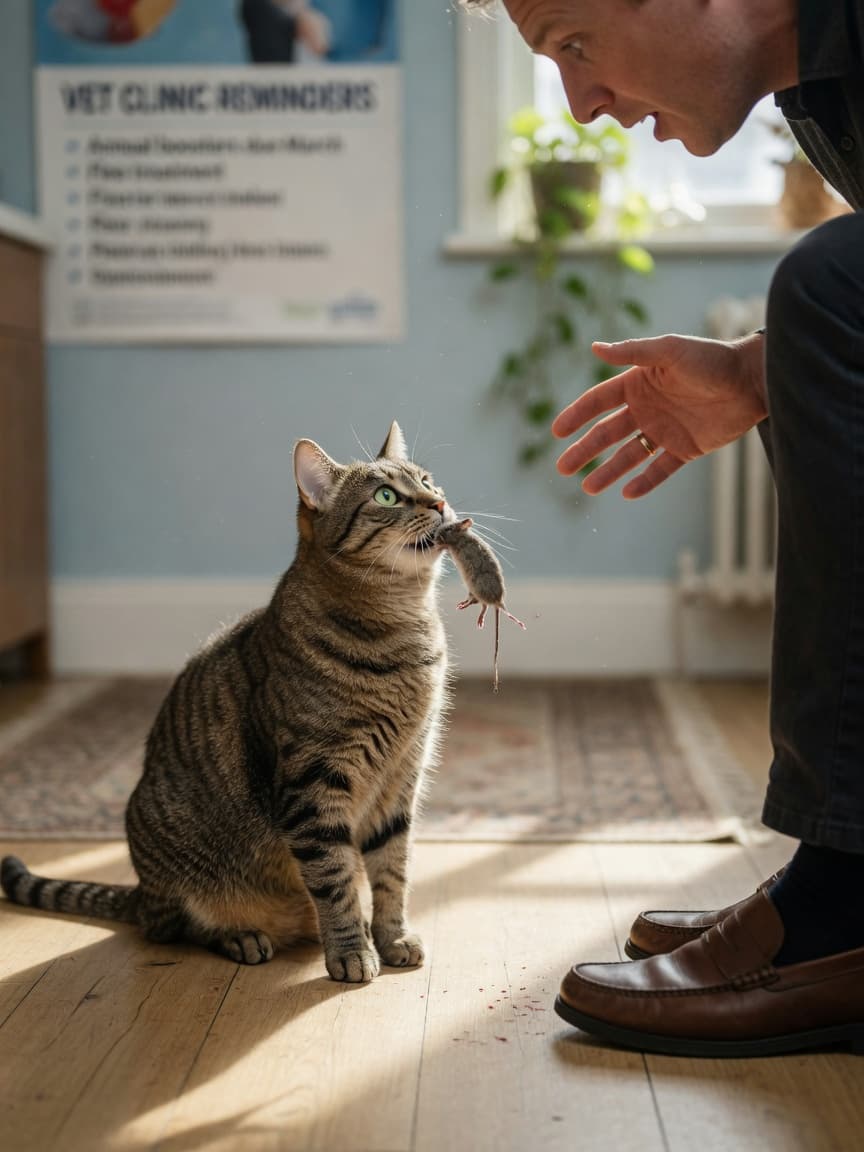
Why Does My Cat Bring Me Dead Animals? The Gift Explained
By Julia Wrenfield, Pet Wellness Researcher
The Hunting Instinct Is Hardwired — Not Optional
One of the most persistent myths about domestic cats is that a well-fed cat will not hunt. The truth is that hunger and hunting are controlled by entirely separate neurological systems in the feline brain. A cat that has just eaten a full meal will still chase, stalk, and catch prey with complete enthusiasm. Satiation turns off appetite; it does not turn off the predatory drive.
This separation makes evolutionary sense. In the wild, cats that only hunted when desperately hungry would not survive — prey does not appear on a convenient schedule. The instinct to hunt whenever the opportunity arises is deeply embedded and does not disappear after a few generations of living on kibble.
Your Cat Sees You as Family
When your cat drops a dead mouse or mangled bird at your feet, the most widely accepted explanation is rooted in social bonding. Cats are not the strictly solitary animals they are sometimes portrayed to be. Feral and semi-feral cats live in colonies, and within those colonies, there is a degree of resource sharing — particularly among females raising kittens together.
Adult cats, especially females, bring prey back to the colony's shared territory rather than consuming it at the kill site. By doing this repeatedly with you, your cat is essentially treating you as a colony member — someone worth feeding and caring for. The dead bird is not meant to be grotesque. It is, from your cat's perspective, an act of generosity and social inclusion.
The Teaching Behavior: Your Cat Thinks You Need Help
A second layer of explanation involves the teaching behavior observed in mother cats. When kittens are young, a mother cat brings back dead prey for them to eat. As the kittens develop, she begins bringing back stunned or live prey so they can practice killing. This graduated curriculum of hunting instruction is called "prey carrying."
Some behavioral researchers believe that cats occasionally treat their owners the way a mother cat treats an unskilled kitten — as someone who clearly cannot hunt and needs to be educated. If your cat drops live prey at your feet and watches expectantly, it may genuinely be trying to teach you. If you fail to pounce, it is probably confused about your survival prospects.
Bringing Prey to Safe Territory
Cats are also prey animals themselves and are instinctively aware of their own vulnerability when stationary and eating. Consuming a kill in the open is risky. In the wild, cats will often drag prey to sheltered locations — dense brush, a burrow entrance, a rocky overhang — before settling in to eat.
Your home is the safest territory your cat knows. Bringing prey home may simply reflect an instinct to eat in a protected location, combined with the social behaviors described above. The fact that you happen to be there when the delivery arrives places you in the role of recipient by proximity and association.
Pride and Social Display
There is also evidence that presenting prey to others functions as a form of social signaling. In group-living animals, demonstrations of competence strengthen social bonds and establish status. Your cat may be showing off — displaying its skills to a member of its social group in a way that communicates: "I am a successful hunter. I contribute to this household."
The way a cat presents prey — placing it deliberately, vocalizing with the characteristic "mrrrow" sound made while carrying something in the mouth, and watching for your reaction — supports the idea that this is not accidental but intentional communication.
Spayed and Neutered Cats Still Hunt
Many owners are surprised to discover that spaying or neutering does not significantly reduce hunting behavior. Unlike some sexual or territorial behaviors that are hormonally driven and do respond to sterilization, hunting is a deeply embedded instinct that exists in both males and females and persists regardless of reproductive status. If your cat hunts, neutering alone is unlikely to stop it.
The Environmental Impact of Cat Predation
Loss et al. (2013), published in Nature Communications, estimated that free-ranging cats kill 1.3–4 billion birds and 6.3–22.3 billion mammals annually in the contiguous United States alone, making cats one of the single greatest human-linked threats to wildlife. The majority of this killing is done by un-owned or feral cats, but owned cats that spend time outdoors contribute meaningfully to these figures. This is not a reason to feel guilty about your cat — but it is a strong argument for considering measures that reduce outdoor hunting.
How to Reduce Hunting Without Punishing Your Cat
There are several evidence-backed strategies for reducing the number of animals your cat catches:
- Bell collars: Studies have found that fitting a bell to a cat's collar can reduce bird kills by approximately 40–50% and mammal kills by around 30%. The sound gives prey an early warning. Brightly colored "Birdsbesafe" collar covers have shown even stronger results in some studies — up to 87% reduction in bird captures specifically.
- Keeping cats indoors: The most effective intervention. An indoor-only cat cannot bring home wildlife, and indoor cats are also statistically healthier and longer-lived.
- Puzzle feeders and structured play: Providing regular hunting simulation — interactive wand toys, puzzle feeders, treat balls — satiates the predatory drive in a wildlife-neutral way. Research suggests that 5–10 minutes of wand play per day measurably reduces outdoor predation in cats allowed outside afterward.
- CatBib: A small bib worn on the collar that disrupts a cat's front-paw grabbing motion has been shown to reduce bird and small mammal catches.
How to Respond When Your Cat Brings a Gift
The most important rule: do not punish your cat. Scolding, shooing, or reacting with loud disgust after your cat brings prey will not teach it to stop hunting — it will only confuse or distress an animal that was trying to do something kind. Your cat does not understand that you find the gift upsetting.
The appropriate response is calm, neutral acknowledgment. You can quietly remove the prey while your cat is distracted, clean the area, and reward your cat with play or affection — reinforcing the bond without encouraging the gifting behavior specifically. If the prey is still alive, contact a local wildlife rehabilitator for guidance before intervening.
Key Takeaways
- Hunting is hardwired and operates independently of hunger — a full cat still hunts.
- Bringing you prey is a social act: your cat views you as a colony member worth feeding or teaching.
- Spaying or neutering does not significantly reduce hunting drive.
- Domestic cats cause significant wildlife loss — bell collars and indoor living are the most effective mitigations.
- Never punish your cat for bringing gifts — calmly and neutrally remove the prey instead.
- Structured daily play with wand toys can reduce outdoor predatory behavior meaningfully.
References
- Loss SR, Will T, Marra PP. The impact of free-ranging domestic cats on wildlife of the United States. Nature Communications. 2013;4:1396. PMID: 23360987.
- Loyd KAT, Hernandez SM, Carroll JP, Abernathy KJ, Marshall GJ. Quantifying free-roaming domestic cat predation using animal-borne video. Biological Conservation. 2013;160:183-189. doi:10.1016/j.biocon.2013.01.008.