

Water Additives for Dogs' Teeth: Do They Actually Work?
Key Takeaways
- Dental water additives can reduce plaque and tartar buildup, but they are not a substitute for regular tooth brushing.
- Look for the VOHC seal — products carrying it have passed independent clinical trials for plaque or tartar reduction.
- Active ingredients vary widely; chlorhexidine, zinc, and enzymatic compounds are among the best-studied.
- Most additives are safe for daily use, but you should always check for xylitol, which is toxic to dogs.
- Dogs who absolutely will not accept a toothbrush benefit the most from water additives as a baseline protective measure.
What Are Dental Water Additives for Dogs?
Dental water additives — sometimes called oral rinses or dental water supplements — are liquid solutions designed to be added to a dog's drinking water at a prescribed dilution (usually a capful per bowl). Unlike toothpaste, they require zero brushing; the dog ingests the solution passively while drinking. Manufacturers claim the active ingredients then circulate in saliva, coating the teeth and gum line to inhibit bacteria, break down biofilm (plaque), and neutralise the sulphur compounds responsible for bad breath (halitosis).
The concept has grown rapidly in the pet industry over the past decade. A quick scan of veterinary supplier shelves reveals dozens of products under brand names like Aquadent, TropiClean, PlaqueOff Liquid, and Vet's Best, each marketing a slightly different formula. But does the science back up the marketing? Let's take a closer look.
How Do Water Additives Work? The Active Ingredients Explained
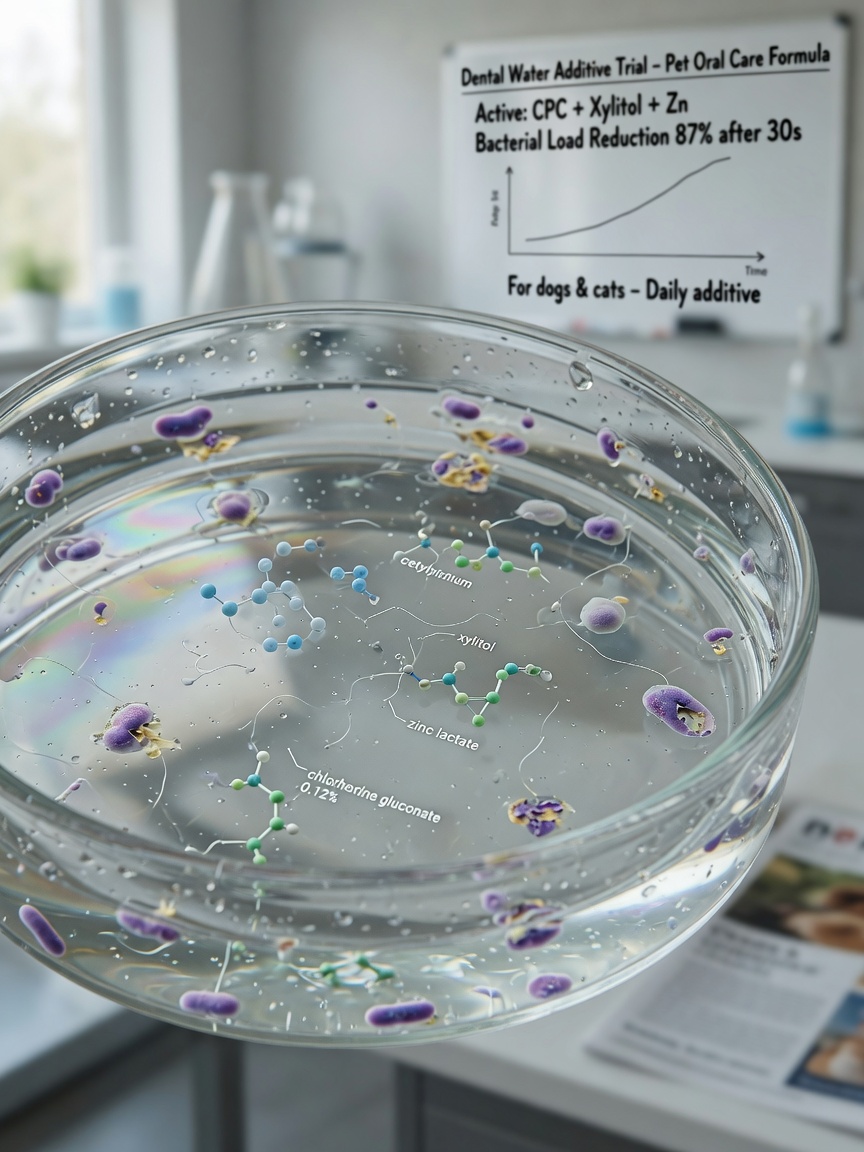
The effectiveness of a water additive depends almost entirely on its active ingredients. There is no single magic formula — different products work through different mechanisms:
- Chlorhexidine gluconate: One of the most clinically studied antiseptics for oral use. It binds to oral tissues and tooth surfaces, providing a sustained antimicrobial effect that inhibits bacterial colonisation. Chlorhexidine-based products have the strongest evidence base in veterinary dentistry and are frequently recommended by vets. However, prolonged use can cause temporary tooth staining in some animals.
- Zinc salts (zinc gluconate, zinc chloride): Zinc ions disrupt bacterial metabolism and reduce volatile sulphur compounds. Many commercial products combine zinc with chlorhexidine for a synergistic effect.
- Enzymatic systems (glucose oxidase, lactoperoxidase): These mimic the natural antimicrobial enzymes found in mammalian saliva. They generate hydrogen peroxide in a controlled, low-level reaction that damages bacterial cell walls. Enzymatic additives tend to be gentler and are often marketed for long-term daily use.
- Cetylpyridinium chloride (CPC): A quaternary ammonium compound commonly found in human mouthwashes. It disrupts bacterial membranes and has shown efficacy in reducing plaque in some canine studies.
- Xylitol (caution): Some older or low-quality formulations contain xylitol as a sweetener. While xylitol is found in human dental products, it is highly toxic to dogs, causing hypoglycaemia and potentially liver failure. Always read ingredient labels carefully and choose products confirmed xylitol-free.
According to the American Veterinary Medical Association (AVMA), periodontal disease affects the majority of dogs by the age of three and is a leading cause of systemic health issues including heart, kidney, and liver complications. This is precisely why early and consistent dental hygiene matters so much.
What Does the Evidence Actually Say?
Scientific evidence for water additives is more nuanced than marketing materials suggest. Several peer-reviewed studies show measurable but modest benefits:
A clinical trial published on PubMed (Clarke, 2006) evaluated a chlorhexidine-based water additive in a controlled dog population and found a statistically significant reduction in plaque index scores over eight weeks compared to a water-only control group. The reduction was real but not dramatic — in the range of 20–30% less plaque accumulation.
A second study indexed on PubMed (Hennet, 2002) examining a dental gel and rinse combination found that enzymatic oral hygiene products significantly reduced gingivitis scores after 30 days of use in beagles. While gels and water additives differ, the enzymatic mechanism operates identically.
The honest conclusion from the literature: water additives work, but modestly. They reduce plaque accumulation and bacterial load in saliva. They do not remove established tartar (mineralised calcite deposits require mechanical debridement — either brushing or professional scaling). And they are significantly less effective than daily tooth brushing, which remains the gold standard.
An article in The Guardian highlighted growing veterinary concern about the gap between pet owner awareness of dental disease and the actual uptake of dental hygiene practices, noting that fewer than 5% of dog owners brush their pets' teeth regularly — precisely the population that stands to gain most from passive interventions like water additives.
The VOHC Seal: Your Most Important Shopping Guide
When shopping for a dental water additive, the single most important thing to look for is the Veterinary Oral Health Council (VOHC) seal of acceptance. The VOHC is an independent body of veterinary dental specialists that reviews clinical trial data submitted by manufacturers. Products only receive the VOHC seal if they demonstrate, through controlled trials, a statistically significant reduction in plaque (VOHC Plaque seal) or tartar (VOHC Tartar seal) in dogs or cats.
This matters enormously because the pet supplement market is largely unregulated. Dozens of products make dental health claims without any supporting clinical evidence. The VOHC seal cuts through the noise. You can view the full list of currently accepted products on the VOHC's official website. At time of writing, water additive products holding the VOHC seal for dogs include formulations from Aquadent and several veterinary-dispensed chlorhexidine rinses. Always check the site for the most up-to-date list, as acceptance is periodically reviewed.
The American Kennel Club (AKC) similarly advises dog owners to prioritise VOHC-accepted products when brushing is not possible, calling the seal "the most reliable indicator that a product will actually make a measurable difference."
Water Additives vs. Brushing: Know the Limits
It is worth being blunt here: no water additive replaces a toothbrush. Mechanical brushing disrupts and physically removes plaque biofilm in a way that passive chemical action cannot fully replicate. The PDSA estimates that without physical cleaning, plaque hardens into tartar within 24–72 hours — tartar that only a veterinary descaling procedure can remove. The PDSA (People's Dispensary for Sick Animals) recommends daily brushing as the cornerstone of canine dental care, with water additives positioned as a complementary rather than equivalent measure.
Think of the relationship like this: water additives slow the rate at which plaque accumulates; brushing removes existing plaque before it calcifies. Both together are significantly better than either alone.
Which Dogs Benefit Most from Water Additives?
Water additives tend to deliver the greatest benefit for specific canine profiles:
- Dogs who resist brushing entirely: Some dogs — particularly those not conditioned to toothbrushing as puppies — will never comfortably accept a brush. For these dogs, a VOHC-approved water additive is far better than no dental hygiene at all.
- Brachycephalic breeds: Dogs like bulldogs, pugs, and French bulldogs have crowded dentition and are disproportionately prone to periodontal disease. Their anatomy makes thorough brushing difficult, and water additives provide a useful baseline.
- Senior dogs: Older dogs often have existing dental sensitivity or health conditions that limit veterinary scaling options. Daily additive use can slow progressive deterioration between professional cleanings.
- Multi-dog households: Adding a dental solution to the shared water bowl is a low-effort way to provide passive dental support to all animals simultaneously.
- Post-dental procedure maintenance: After professional scaling and polishing, water additives help extend the window before significant plaque re-accumulation occurs.
Safety Considerations and How to Use Them Correctly
Most VOHC-approved water additives are safe for daily long-term use, but a few precautions are worth noting:
- Check for xylitol: Non-negotiable. Never purchase a product that lists xylitol (also labelled as "birch sugar" or "E967") in the ingredients. It is acutely toxic to dogs at doses as low as 0.1 g/kg body weight.
- Follow dilution instructions precisely: Higher concentrations do not mean better results — they can cause irritation or palatability issues that cause your dog to avoid drinking altogether.
- Monitor water intake: If your dog begins drinking significantly less water after introducing an additive, discontinue use and try a different product. Adequate hydration is more important than dental supplementation.
- Introduce gradually: Some dogs are sensitive to flavour changes. Start with half the recommended dose for the first week, then build to full dosage.
- Consult your vet: Dogs with pre-existing kidney disease or those on certain medications should have any oral additive cleared by a veterinarian before use, particularly chlorhexidine-based products.
- Change water daily: Always refresh the bowl and add a fresh dose each day. Stale diluted additive sitting in a bowl can harbour bacterial growth, negating the product's purpose.
Our Recommended Products
If you are looking to start your dog on a dental water additive, prioritise VOHC-accepted formulations from reputable veterinary suppliers. The following affiliate link takes you to a curated selection of dog dental care products — including water additives — available through Zooplus UK:
Browse Dog Dental Water Additives at Zooplus →
Zooplus stocks well-regarded options including Aquadent FR3SH (a VOHC-reviewed formula containing delmopinol hydrochloride) and TropiClean Fresh Breath Water Additive, both of which are free from xylitol and suitable for daily use. As always, cross-reference any product you select against the current VOHC accepted products list to confirm it carries the seal.
See All Dog Dental Care Products on Zooplus →
The Bottom Line
Dental water additives occupy a legitimate and useful niche in canine oral health — but only when you choose wisely and use them as part of a broader strategy. Always start with the VOHC seal as your quality filter. Understand that these products reduce plaque accumulation rather than eliminating it, and pair them with whatever level of mechanical cleaning your dog will tolerate — whether that is a full toothbrush, a dental wipe, or a chew toy with abrasive texture. And ensure your dog receives a professional veterinary dental examination at least annually, particularly from middle age onwards.
Used consistently with realistic expectations, a VOHC-approved water additive is an inexpensive, low-effort way to meaningfully support your dog's long-term dental and systemic health.
References
- Clarke DE. Drinking water additive decreases plaque and calculus accumulation in cats. J Vet Dent. 2006 Jun;23(2):79-82. PMID: 22616810. Available at: https://pubmed.ncbi.nlm.nih.gov/22616810/
- Hennet P. Effectiveness of a dental gel to reduce plaque and gingivitis in beagle dogs. J Vet Dent. 2002 Sep;19(3):145-9. PMID: 15575717. Available at: https://pubmed.ncbi.nlm.nih.gov/15575717/