
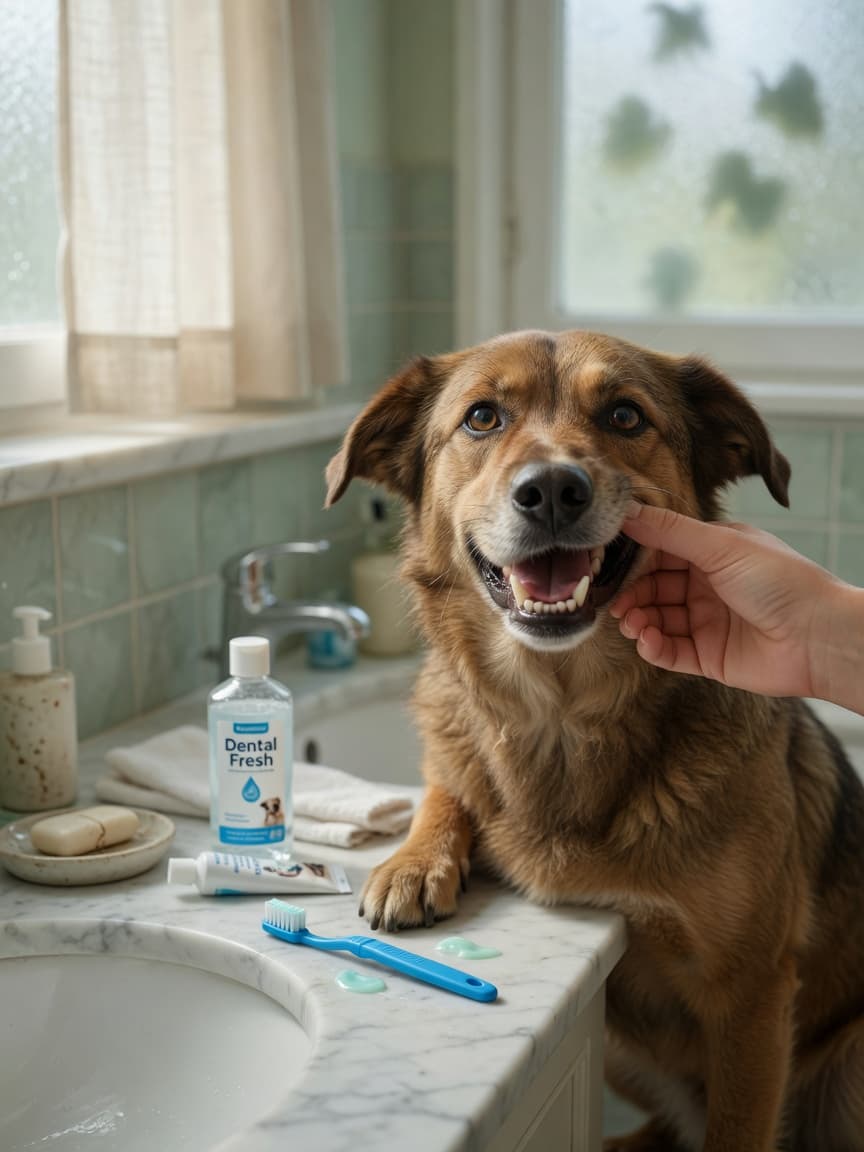
Dental Water Additives for Dogs: Do They Work?
Dental water additives are a useful supplement to daily brushing — but they are not a replacement. Used consistently, they can meaningfully reduce oral bacteria and slow plaque formation.
What Are Dental Water Additives?
Dental water additives are liquid solutions designed to be mixed directly into your dog's drinking water. Each time your dog drinks, they ingest a diluted antimicrobial rinse that coats the teeth, gums, and oral mucosa. Because dogs drink multiple times throughout the day, the active ingredients have repeated opportunities to act on the bacterial communities that form plaque. Most products are colorless and odorless by design, making daily administration straightforward — you simply pour the recommended amount into the water bowl when you refill it. There is no chasing, no restraining, and no special equipment required, which is a significant practical advantage over brushing for many owners.
How They Work: The Science Explained
The mouth is a dense ecosystem of bacteria organized into structured communities called biofilms. Dental plaque is the visible result of these biofilms adhering to the tooth surface and mineralizing over time into tartar. Dental water additives target this process at the biofilm stage, before mineralization occurs. The most common active ingredients work through distinct mechanisms. Chlorhexidine gluconate is a broad-spectrum antiseptic that disrupts bacterial cell membranes and has been used in human dentistry for decades; in canine formulas it appears in lower concentrations to balance efficacy against palatability. Zinc compounds interfere with sulfur-compound production — the same compounds responsible for bad breath — while also inhibiting the enzymes bacteria use to build biofilm scaffolding. Cetylpyridinium chloride (CPC) is a quaternary ammonium compound that destabilizes bacterial cell walls and reduces overall bacterial load. It is worth noting that xylitol, a sweetener found in some human oral care products, is highly toxic to dogs and must never appear in any canine dental product; reputable manufacturers formulate entirely without it, and checking the ingredient list before purchase is essential.
VOHC-Approved vs. Non-Approved: Why It Matters
The Veterinary Oral Health Council (VOHC) is an independent body that evaluates dental products for pets against a defined scientific standard. To earn the VOHC Seal of Acceptance, a product must demonstrate in at least two well-designed clinical trials that it reduces plaque accumulation, tartar accumulation, or both, by a statistically significant margin. The process is rigorous: studies must include appropriate control groups, sufficient sample sizes, and standardized measurement techniques. Products that carry the VOHC seal have genuinely earned it through evidence — not marketing. The vast majority of dental water additives on the market make claims that have never been independently verified. Some may still be useful, but without peer-reviewed trial data you are essentially guessing. For owners who want evidence-based choices, seeking out VOHC-approved products is the single most important filtering criterion. In Europe, VOHC-approved or clinically substantiated options include brands such as Vet's Best, TropiClean Fresh Breath, and Oxyfresh, which are available through major pet retailers including Zooplus. Always verify current approval status on the VOHC website, as the approved list is updated periodically.
What the Research Actually Shows
The honest answer is that dental water additives produce modest but real benefits. Studies examining water-soluble chlorhexidine and CPC-based products in dogs and cats have generally found plaque and calculus reductions in the range of 10 to 20 percent compared to untreated control groups. This is not a dramatic figure, and it would be misleading to present water additives as a comprehensive dental care solution. What the research does support is their role as a preventive adjunct — a tool that consistently applied slows the rate at which plaque accumulates, which over weeks and months translates into a measurable reduction in dental disease burden. Critically, no study has demonstrated that water additives can reverse existing tartar that has already mineralized onto the tooth surface. Once calculus has formed, only mechanical removal — either by a veterinary professional or through the abrasive action of brushing — can eliminate it. The clinical utility of water additives lies in prevention and maintenance, not remediation.
How to Use Water Additives Correctly
Correct and consistent use is essential to achieving any benefit. The product instructions specify a dilution ratio — typically a small measured amount per standard bowl volume — and this ratio should be followed precisely. Using more additive than recommended does not improve results and may make the water unpalatable, causing your dog to drink less. Fresh water with additive should be provided daily; stale water left in the bowl loses efficacy as the active compounds degrade and allows bacterial regrowth. Never combine two different dental additives in the same bowl, as interactions between active ingredients are unpredictable. Monitor your dog's water intake when first introducing any additive. Some dogs are sensitive to flavor or smell changes in their water and may initially drink less. If intake drops significantly over the first week, try a different product or a further dilution. Puppies can generally begin using water additives as soon as they are weaned and drinking independently, though you should consult your veterinarian before starting any new product in very young animals.
Limitations You Should Know
No honest review of dental water additives should omit their real limitations. First, they are consistently less effective than mechanical tooth brushing. Brushing physically disrupts the biofilm and removes accumulated material; no liquid rinse replicates that action. Second, palatability is a genuine obstacle — dogs with sensitive palates may refuse flavored water entirely, and even odorless formulas alter the taste enough to affect intake in some individuals. Third, as emphasized above, water additives cannot reverse tartar that has already formed; a dog presenting with moderate-to-severe calculus accumulation needs a professional veterinary dental cleaning before any preventive regimen will be effective. Finally, the market is saturated with products making unsubstantiated claims. Without the VOHC seal or published trial data, there is no reliable way to know whether a given product delivers on its promises. Informed purchasing matters considerably in this category.
The Combination Approach for Best Results
The most effective canine dental care strategy combines multiple modalities, each contributing what the others cannot. Daily tooth brushing with an enzymatic toothpaste is the gold standard — no other intervention matches its mechanical plaque-removal efficacy. Dental water additives used daily add a chemical antimicrobial dimension that reaches surfaces and angles the brush may miss. VOHC-approved dental chews provide additional mechanical abrasion through the chewing action itself and are especially useful for dogs that resist brushing. Annual professional veterinary cleanings under anesthesia address the calculus accumulation that home care cannot reverse and allow for a thorough subgingival assessment. Together, these four elements create a layered defense: brushing handles the bulk of daily plaque, additives suppress bacterial regrowth between brushings, chews provide mechanical support, and professional cleanings reset the baseline annually. Dental water additives earn their place in this stack not as a miracle solution, but as a low-effort, evidence-supported component that meaningfully complements the rest of a complete oral health program.
Key Takeaways
- Dental water additives reduce oral bacteria and slow plaque formation but cannot replace daily brushing or reverse existing tartar buildup.
- Look for products carrying the VOHC Seal of Acceptance — it is the only independent verification that a product has proven efficacy in clinical trials.
- Active ingredients to look for include chlorhexidine, zinc compounds, and cetylpyridinium chloride (CPC); always confirm that any product is completely xylitol-free, as xylitol is toxic to dogs.
- Research supports modest plaque and tartar reductions of roughly 10–20% with consistent daily use — a meaningful benefit for prevention, not a dramatic cure.
- The best dental outcomes come from combining daily brushing, VOHC-approved water additives, dental chews, and annual professional veterinary cleanings.
Find VOHC-approved dental water additives for dogs at Zooplus — easy, daily dental support.
Shop Dental Water Additives at ZooplusReferences
- Clarke DE. Drinking water additive decreases plaque and calculus accumulation in cats. J Vet Dent. 2006;23(2):79-82. PMID: 16922400.
- Hennet P, Servet E, Soulard Y, Biourge V. Effect of pellet food size and polyphosphates in preventing calculus accumulation in dogs. J Vet Dent. 2007;24(4):236-239. PMID: 18318380.