
Turtle, Tortoise, or Terrapin: What Is the Difference?
These three terms describe chelonians — reptiles with shells — but they refer to animals with fundamentally different lifestyles and care needs. Getting the terminology right is the first step to responsible ownership.
Tortoises
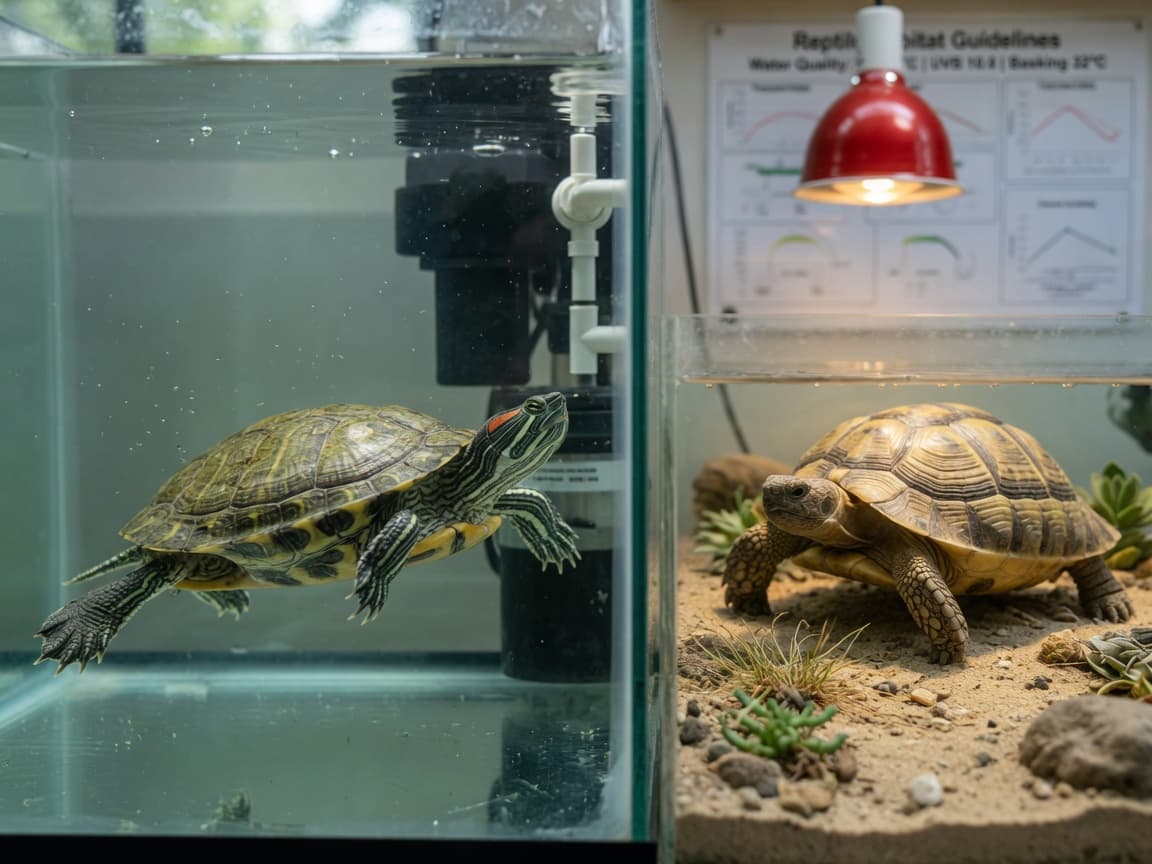
Tortoises are entirely terrestrial. They live on land, have high-domed shells for protection, and have elephant-like, columnar legs adapted for walking on solid ground. They cannot swim and will drown in deep water. Tortoises are found naturally in dry, warm environments across Africa, the Mediterranean, Asia, and the Americas. Popular pet species in the UK include the Hermann's tortoise and the horsefield (Russian) tortoise.
Turtles
Turtles are primarily aquatic. They have streamlined, flattened shells for hydrodynamic efficiency and webbed feet or flippers for swimming. They live in rivers, lakes, ponds, and oceans, coming onto land mainly to bask and lay eggs. The red-eared slider is by far the most commonly kept pet turtle in the world. Sea turtles are fully marine and entirely unsuitable as pets.
Terrapins
The term terrapin is primarily used in British English to describe semi-aquatic freshwater turtles. In practice, the word is often applied to the same species that Americans call turtles — particularly red-eared sliders and map turtles. In UK pet shops, "terrapin" and "turtle" are sometimes used interchangeably, which adds to the confusion.
The key point is this: a tortoise and a turtle require entirely different setups, diets, temperatures, and husbandry. Confusing the two is not a minor error — it is potentially fatal for the animal.
Common Mislabelling in Pet Shops
Mislabelling of chelonians in UK pet shops is a genuine and ongoing problem. The most frequent issues include:
- Tortoises and turtles sold under the same signage without species-specific care information
- "Tortoise" used as a catch-all term for any reptile with a shell
- Species that require CITES documentation sold without the seller verifying whether the buyer understands their legal obligations
- Wildly underestimated size projections — small hatchlings presented without information about adult size
- Incorrect care sheets provided at point of sale, particularly around diet and UVB requirements
If you are purchasing a chelonian from a pet shop and the staff cannot tell you the exact species name, the adult size, the dietary requirements, and the legal status of the animal, walk away. These are not optional questions — they are fundamental to responsible ownership.
The Red-Eared Slider: The World's Most Kept and Most Abandoned Turtle
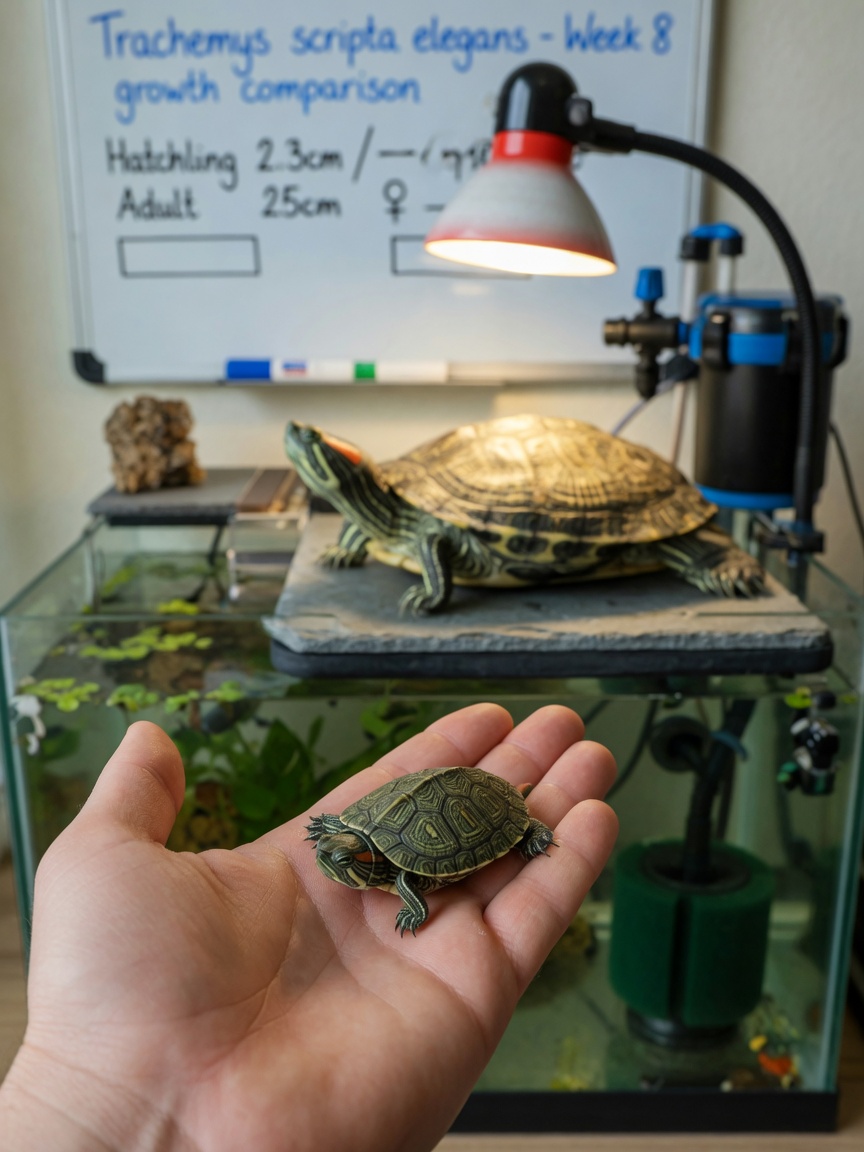
The red-eared slider (Trachemys scripta elegans) is the most commonly kept pet turtle in the world and, unfortunately, one of the most frequently abandoned. These aquatic turtles are sold as small, appealing hatchlings but grow to 20 to 30 centimetres in length and can live 20 to 40 years with proper care.
Adult red-eared sliders require a large aquatic setup:
- A tank or pond of at least 300 to 500 litres for a single adult
- A powerful external canister filter — these animals produce substantial waste
- A dry basking area that reaches 30 to 35 degrees Celsius under a heat lamp
- UVB lighting for at least 12 hours per day to enable calcium metabolism and prevent metabolic bone disease
- Water temperature maintained between 22 and 26 degrees Celsius
Red-eared sliders are omnivores that require a varied diet of aquatic turtle pellets, leafy greens, and occasional protein sources such as earthworms, shrimp, or feeder fish. They are intelligent, active animals that respond to their environment and their owners, but they are a serious long-term commitment.
Salmonella Risk: A Genuine Public Health Concern
All chelonians — tortoises and turtles alike — can carry Salmonella bacteria on their skin and shells without showing any signs of illness. This is not a sign of disease in the animal; it is a natural part of their microbiology. However, Salmonella is a serious human pathogen that causes gastroenteritis and, in vulnerable individuals, can lead to severe illness.
The risk is highest for children under five, pregnant women, elderly people, and anyone with a compromised immune system. In the United States, a federal law since 1975 prohibits the sale of turtles with shells smaller than 10 centimetres specifically because of Salmonella-related illness outbreaks in children.
To manage the risk:
- Always wash hands thoroughly with soap and warm water after handling any chelonian or anything in their enclosure
- Never allow children under five to handle turtles or tortoises unsupervised
- Never allow chelonians to roam freely in kitchens or areas where food is prepared
- Never clean turtle tanks in kitchen sinks — use a dedicated outdoor area or bathtub that is thoroughly disinfected afterwards
CITES Licensing: Legal Requirements for Chelonian Ownership
Many chelonian species are protected under CITES — the Convention on International Trade in Endangered Species of Wild Fauna and Flora. In the UK, this is implemented through domestic legislation, and certain species require Article 10 certificates (also called CITES certificates) before they can be legally bought, sold, or transferred.
Species commonly affected include:
- Hermann's tortoise (Testudo hermanni) — CITES Appendix II
- Horsefield tortoise (Agrionemys horsfieldii) — CITES Appendix II
- Many Mediterranean tortoise species
- Some aquatic turtle species
If you are buying a tortoise in the UK, the seller must provide documentation confirming the animal was captive-bred, not wild-caught. Without this documentation, you cannot legally resell, rehome, or transfer the animal. When buying from a reputable breeder, the paperwork should be provided automatically. If a seller claims a tortoise does not require paperwork, verify this independently with the Animal and Plant Health Agency (APHA) before purchasing.
Care Requirements: A Side-by-Side Overview
To illustrate just how different tortoise and turtle care is, consider these contrasting requirements:
- Tortoises need a dry, warm enclosure (tortoise table or outdoor pen in summer) with a cool end around 20 degrees and a warm basking spot of 30 to 35 degrees. Turtles need a large aquatic setup with both water and a dry basking area.
- Tortoises eat primarily leafy greens, weeds such as dandelion and plantain, and occasional fruit. Aquatic turtles eat a mixed diet of aquatic pellets, vegetation, and animal protein.
- Tortoises hibernate in winter (a process called brumation) and require specific management to do this safely. Most pet turtles in the UK are kept at stable temperatures year-round and do not hibernate in captivity.
- Both require UVB lighting for metabolic bone health when kept indoors.
Neither animal is a beginner pet in the true sense. Both require specialist knowledge, appropriate equipment, and a commitment measured in decades. Tortoises in particular are genuinely long-lived animals — Hermann's tortoises routinely live 50 to 80 years, and many outlive their owners. If you are considering either as a pet, research extensively, find a specialist reptile vet in your area before you purchase, and connect with reputable tortoise or turtle keeping communities for ongoing support.