
Navigating the Supplement Market for Older Dogs
Walk into any pet shop or browse online retailers and you will find hundreds of supplements marketed specifically at senior dogs. Joint support, cognitive function, immune health, coat condition, digestive support — the claims are wide-ranging and the packaging invariably features images of happy grey-muzzled dogs. The market for pet supplements is enormous and largely unregulated, which means that quality, dosing, and evidence base vary enormously from one product to the next.
This article takes a clear-eyed look at the supplements most commonly recommended for senior dogs, the research that does and does not support their use, and how to make sensible decisions about what to give an ageing dog.
The Regulatory Context
In the UK, pet supplements are not regulated to the same standard as licensed veterinary medicines. Manufacturers are not required to conduct clinical trials before making efficacy claims, and dosing recommendations are often based on tradition, manufacturer preference, or extrapolation from other species rather than rigorous research. Third-party quality testing — independent verification that a product contains what the label says, in the quantities stated, without contaminants — is voluntary and not universally practiced.
This context does not mean supplements are useless, but it does mean that critical evaluation is essential. The question for every supplement should be: what does the peer-reviewed evidence actually show?
Joint Supplements

Joint supplements are far and away the most popular category for senior dogs, and this is where the evidence base is most developed, if still imperfect.
Omega-3 Fatty Acids
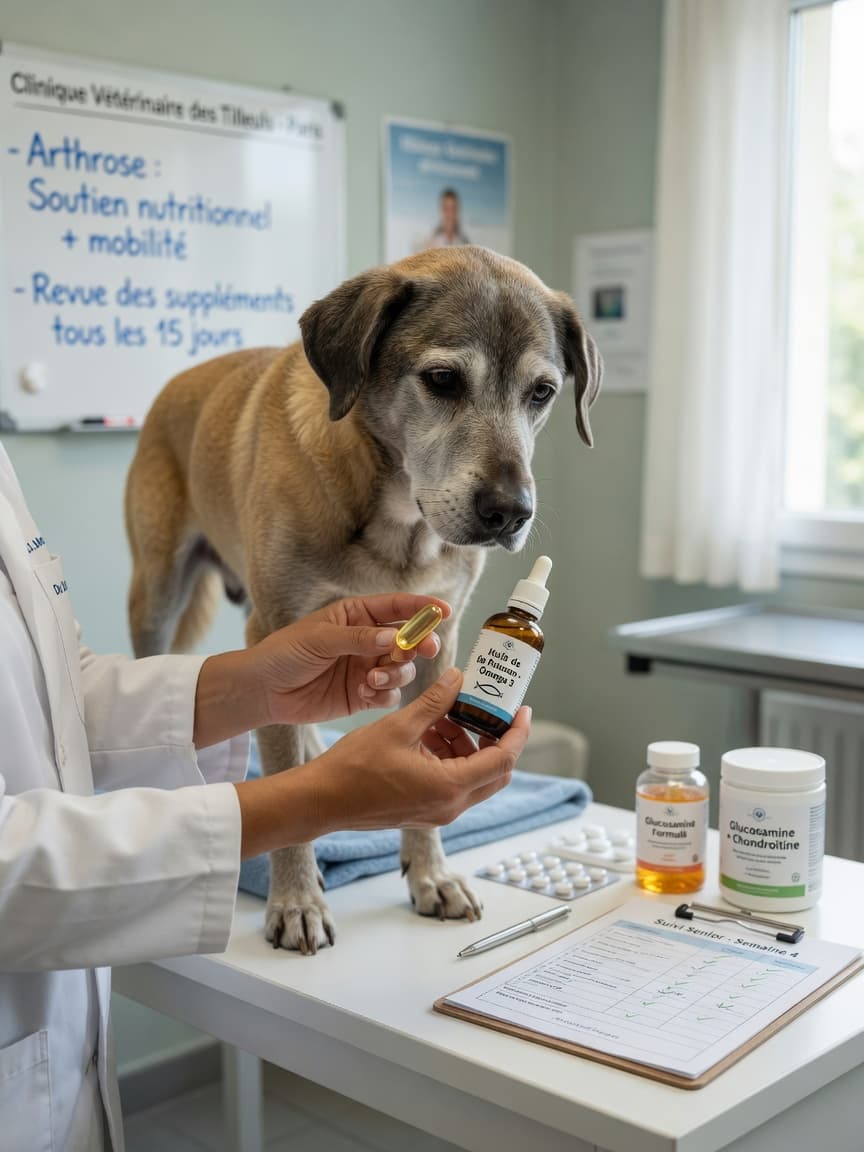
Marine-sourced omega-3 fatty acids, specifically EPA (eicosapentaenoic acid) and DHA (docosahexaenoic acid), are among the most evidence-backed supplements available for senior dogs. Multiple randomised controlled trials have demonstrated that omega-3 supplementation reduces joint inflammation, improves clinical signs of osteoarthritis, and allows some dogs to be managed on lower doses of pain medication. The anti-inflammatory effects are dose-dependent, meaning many over-the-counter products contain insufficient quantities to produce a therapeutic effect. Your vet can advise on appropriate therapeutic dosing for your dog's body weight.
Omega-3s also support cardiovascular health and have emerging evidence for cognitive benefits, making them particularly valuable as a multimodal supplement for senior dogs.
Glucosamine and Chondroitin
These two compounds are the ingredients found in the vast majority of joint supplements for dogs. Glucosamine is a precursor to glycosaminoglycans, structural components of joint cartilage. Chondroitin inhibits enzymes that break down cartilage. The theoretical rationale is sound.
The clinical evidence, however, is mixed. Studies in dogs have shown variable results, with some trials demonstrating modest improvements in mobility and pain scores, others showing no significant difference from placebo. A large-scale systematic review found that methodological limitations in most studies make definitive conclusions difficult. That said, both compounds have an excellent safety profile, and a meaningful subset of dog owners and vets report clear clinical benefit in individual animals. They are a reasonable choice to trial, with effectiveness assessed over eight to twelve weeks.
Green-Lipped Mussel
Green-lipped mussel (Perna canaliculus) contains omega-3 fatty acids, glycosaminoglycans, and a range of other bioactive compounds. Several small clinical trials in dogs have shown statistically significant improvements in joint pain and mobility, and one study found green-lipped mussel superior to fish oil supplementation for reducing arthritic signs, possibly because of the additional non-omega-3 components. It is one of the more promising joint supplements from an evidence standpoint, though study sizes remain relatively small.
Boswellia
Boswellia serrata, a plant-based anti-inflammatory used in Ayurvedic medicine, has two published clinical trials in dogs, both showing improvements in joint pain scores. It inhibits certain inflammatory enzymes through a different pathway than NSAIDs, which is interesting from a mechanism standpoint. The evidence base is limited but positive.
Cognitive Health Supplements

SAMe (S-Adenosylmethionine)
SAMe is a naturally occurring compound involved in multiple biochemical pathways in the brain. Two double-blind, placebo-controlled studies have shown that SAMe supplementation improves cognitive function and activity levels in dogs with Canine Cognitive Dysfunction Syndrome. It is one of the more robustly studied supplements in veterinary medicine and is frequently recommended by neurologists for dogs with early to moderate CDS.
Phosphatidylserine
Phosphatidylserine is a phospholipid that is a structural component of cell membranes, particularly abundant in brain tissue. Clinical studies in dogs have shown improvements in several CDS-related behaviours including social interaction, disorientation, and house training reliability. It is often found in combination cognitive health formulas alongside antioxidants and omega-3s.
Medium-Chain Triglycerides
MCTs, derived from coconut oil in commercial products, provide an alternative fuel source for the brain that does not rely on normal glucose metabolism. As brain cells lose efficiency in using glucose with age, MCTs can help maintain neuronal energy supply. Studies in dogs have shown improvements in cognitive test performance with MCT supplementation, and they are now included in some prescription senior diets.
Supplements with Less Robust Evidence
Turmeric and Curcumin
Curcumin, the active compound in turmeric, has demonstrated anti-inflammatory properties in laboratory studies. However, its oral bioavailability in dogs is very poor — most of it is not absorbed. Formulations designed to improve bioavailability exist but have limited clinical data in dogs specifically. The in-vitro promise has not yet been reliably replicated in canine clinical trials.
Collagen Supplements
The claim that supplemental collagen supports joint cartilage is biologically plausible, and there is emerging data in humans. In dogs, the evidence base is currently very limited. Products may have benefit, but this has not been adequately demonstrated in controlled trials.
Practical Guidance for Choosing Supplements
- Look for products from manufacturers who publish batch-specific certificates of analysis from independent laboratories, confirming purity and accurate labelling
- Choose products with a NASC (National Animal Supplement Council) quality seal or equivalent third-party verification where available
- Be realistic about timescales — most joint supplements require six to eight weeks of consistent use before any clinical benefit becomes apparent
- Always inform your vet of any supplements you are using, as some interact with medications
- Prioritise supplements with peer-reviewed clinical evidence over those with only testimonials or theoretical rationale
Supplements are not a replacement for veterinary care, pain management, or appropriate medical treatment. But used thoughtfully and in conjunction with professional guidance, the right supplements can make a genuine contribution to an older dog's quality of life. The key is choosing products where the evidence matches the claim.