
The Hutch Myth: Why Traditional Housing Fails Rabbits
For decades, the standard image of a pet rabbit was an animal in a small wooden hutch at the bottom of a garden. That image is now widely recognised as a welfare failure. The Rabbit Welfare Association and Fund (RWAF) has led a long-running campaign — "A Hutch Is Not Enough" — to change public understanding of what rabbits actually need, and the evidence backing their position is substantial.
Rabbits are not sedentary animals. In the wild, they cover significant distances each day, run at speed, leap, dig, and interact socially. A small hutch — however well maintained — provides none of this. Confined rabbits develop physical problems including muscle wastage and bone density loss, and psychological problems including stress, boredom, and stereotypic behaviours. In many European countries, minimum welfare standards for rabbit housing are now enshrined in law, though enforcement remains inconsistent.
RWAF Minimum Space Requirements
The RWAF's current minimum recommendation for rabbit housing is a space of at least 3 metres by 2 metres by 1 metre — and this space must be permanently available, 24 hours a day, seven days a week. This is a minimum, not an ideal. It must include both a sheltered sleeping area and an exercise area, and the two must be permanently connected so the rabbit can move freely between them at any time.
This is the critical distinction that many hutch-and-run setups fail to meet. A rabbit who has access to a run for a few hours a day is not meeting the RWAF standard. The space must be available at all times, including at night — which is when rabbits are naturally most active.
Housing Options That Meet Welfare Needs
Meeting the RWAF minimum standard rules out most standard hutches sold in pet shops across Europe. The following setups are among the most practical ways to provide adequate space:
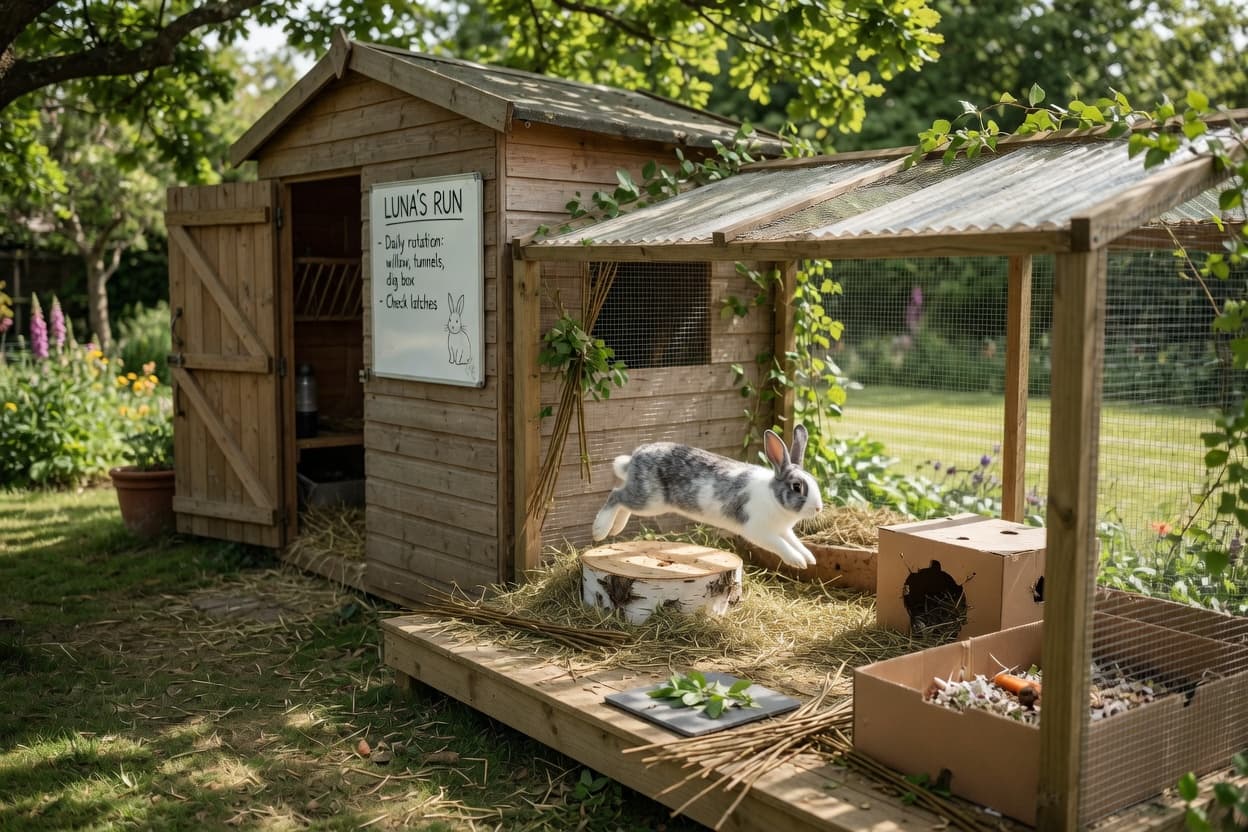
- A large wooden shed with a securely attached, permanent outdoor run — this is one of the most popular welfare-appropriate setups for outdoor rabbits
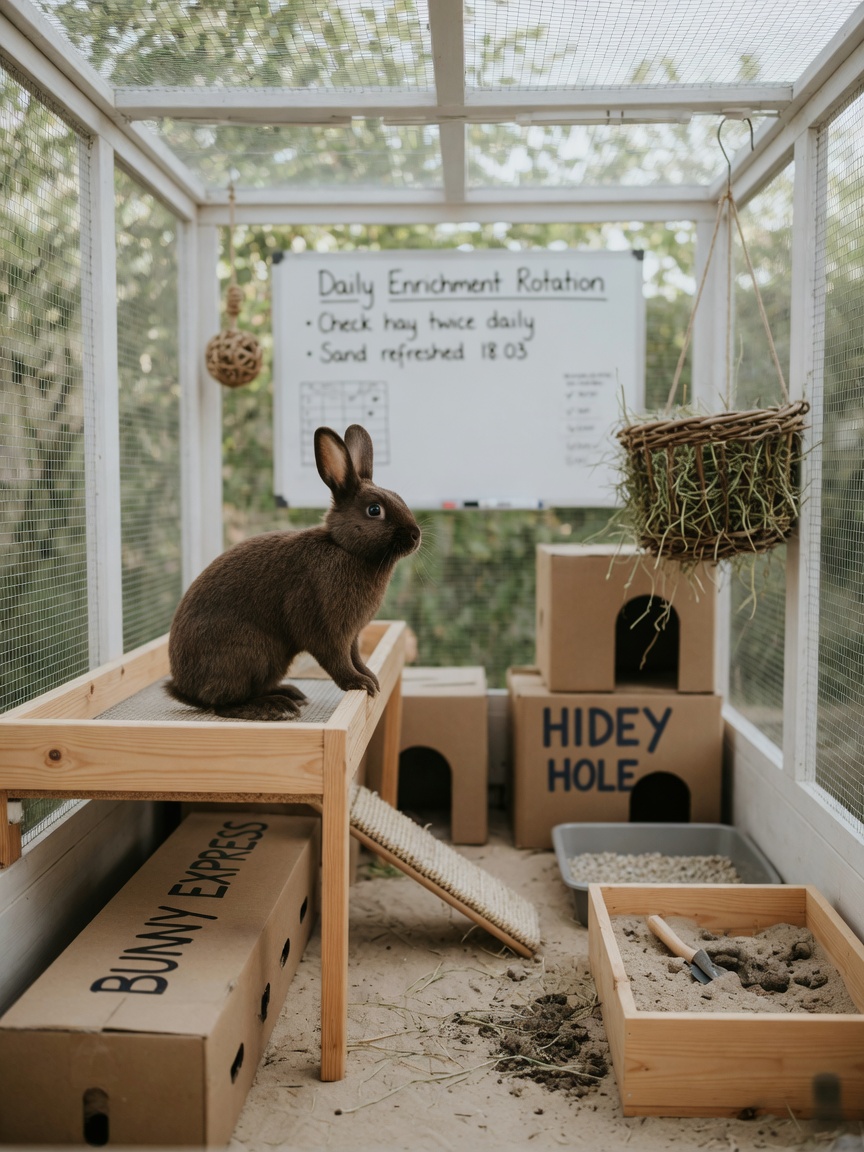
- A converted garden aviary or walk-in run, which provides excellent ventilation and light while allowing year-round access
- Indoor free-roaming, where the rabbit has access to at least one large room or a rabbit-proofed area of the home at all times
- Purpose-built modular housing systems specifically designed around the RWAF minimum, now available from several specialist rabbit suppliers in the UK and Europe
Indoors vs Outdoors: Both Are Possible
Rabbits can be kept successfully both indoors and outdoors, provided their specific needs are met in each environment.
Outdoor Rabbits
Outdoor rabbits need well-insulated housing to protect them from cold winters — rabbits can tolerate cold better than heat, but temperatures below freezing require additional bedding and ideally a heated element in the sleeping area. More critically, outdoor rabbits must be completely protected from predator stress. Foxes, cats, and even birds of prey can cause fatal fright responses in rabbits without ever making physical contact. The sight or smell of a predator through mesh can be enough to cause a rabbit to die from shock or to break their spine attempting to escape. Housing must be predator-proof and positioned to minimise predator exposure.
Heat is also a serious risk. Rabbits cannot tolerate temperatures above approximately 25-28°C and can die rapidly from heat stroke in summer. Housing must be positioned in shade, and frozen water bottles or cooling mats should be available during hot weather.
Indoor Rabbits
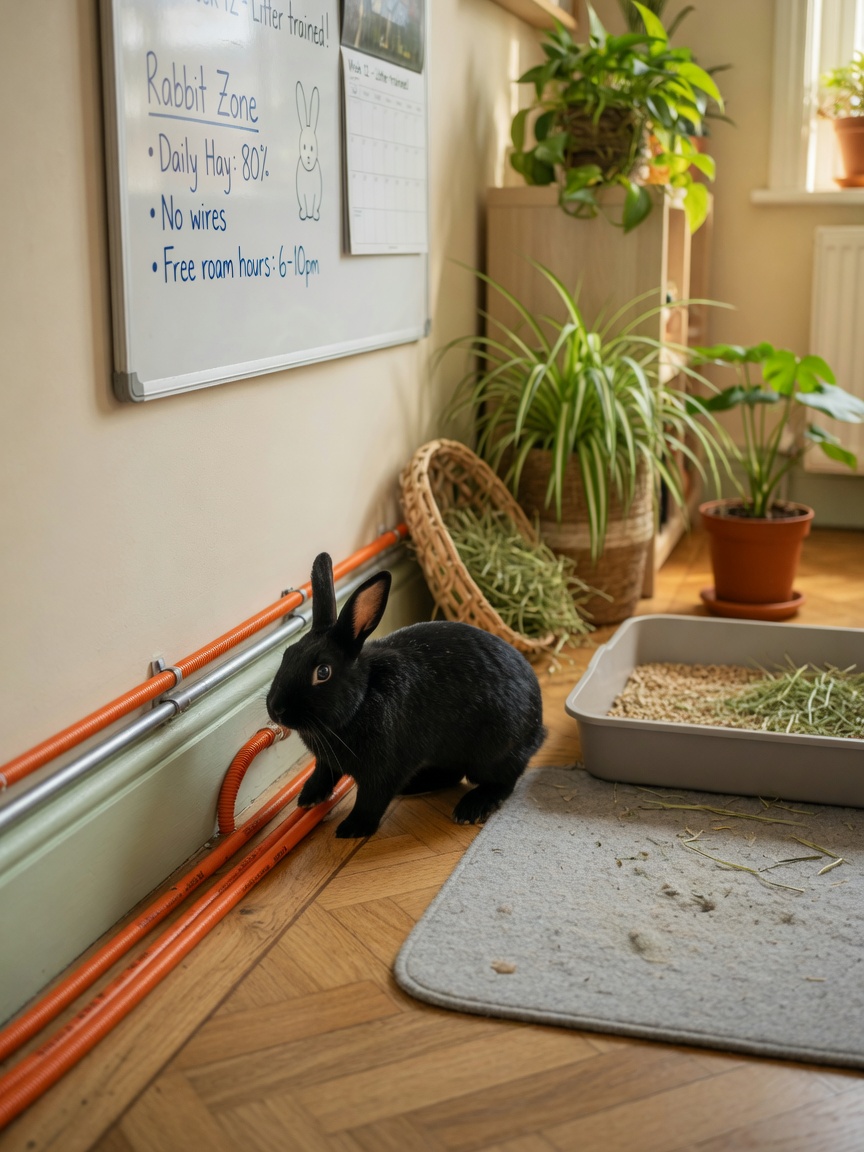
Indoor housing eliminates many predator and weather risks, but introduces others. Rabbits are highly curious and destructive, and a free-roaming house rabbit will investigate and chew anything they can reach. The most significant hazard is electrical cables — a rabbit chewing through a live cable can suffer electrocution. All cables in rabbit-accessible areas must be covered with protective conduit or raised entirely out of reach. Many common houseplants are toxic to rabbits; lilies, foxglove, and ivy are among the most dangerous. Flooring matters too — carpet fibres can be ingested in quantity, while slippery hard floors can cause injuries over time.
Bedding and Environment
Appropriate bedding includes dust-free hay (which doubles as a food source), cardboard, and safe wood pellets. Avoid cedar or pine shavings, which release aromatic oils that can damage the respiratory tract. Ensure good ventilation without direct draughts, which can cause respiratory illness.
Environmental enrichment is not a luxury — it is a welfare necessity. Tunnels, cardboard boxes to chew and rearrange, hay racks, raised platforms, digging boxes filled with earth or sand, and willow toys all contribute to physical and psychological wellbeing. Rabbits are intelligent animals who become bored and distressed without mental stimulation.
Litter Training
Contrary to what many owners assume, rabbits can be reliably litter trained. They naturally tend to toilet in one or two preferred spots, making training relatively straightforward. Use a large, low-sided tray filled with paper-based litter and a generous layer of hay on top — rabbits commonly eat and toilet simultaneously. Litter training significantly simplifies indoor rabbit keeping and reduces the cleaning burden for outdoor setups too.
The Case for Pair Housing
The RWAF strongly recommends that rabbits are kept in pairs or compatible groups rather than alone. Rabbits are highly social animals who form strong bonds and communicate almost constantly through subtle body language, scent, and physical contact. A solitary rabbit is a psychologically deprived rabbit, regardless of how much human interaction they receive — humans cannot fulfil the social role of another rabbit.
The bonding process requires careful introduction, typically over several days or weeks with gradual supervised contact in neutral territory. Neutering both rabbits before introduction dramatically reduces the risk of fighting and eliminates the risk of unwanted litters. Once bonded, pairs or groups are rewarding to observe and genuinely happier animals.
Vaccination and Housing Risk
Outdoor rabbits — and increasingly indoor rabbits — face serious infectious disease risks from Myxomatosis and Rabbit Haemorrhagic Disease (RHD), including the newer RHD2 strain. Both diseases are spread by insects and direct contact, meaning no rabbit is entirely safe without vaccination. In the UK and across much of Europe, annual vaccination covering both diseases is widely available and strongly recommended. Speak to your vet about the appropriate vaccination schedule for your rabbit's lifestyle and location.