
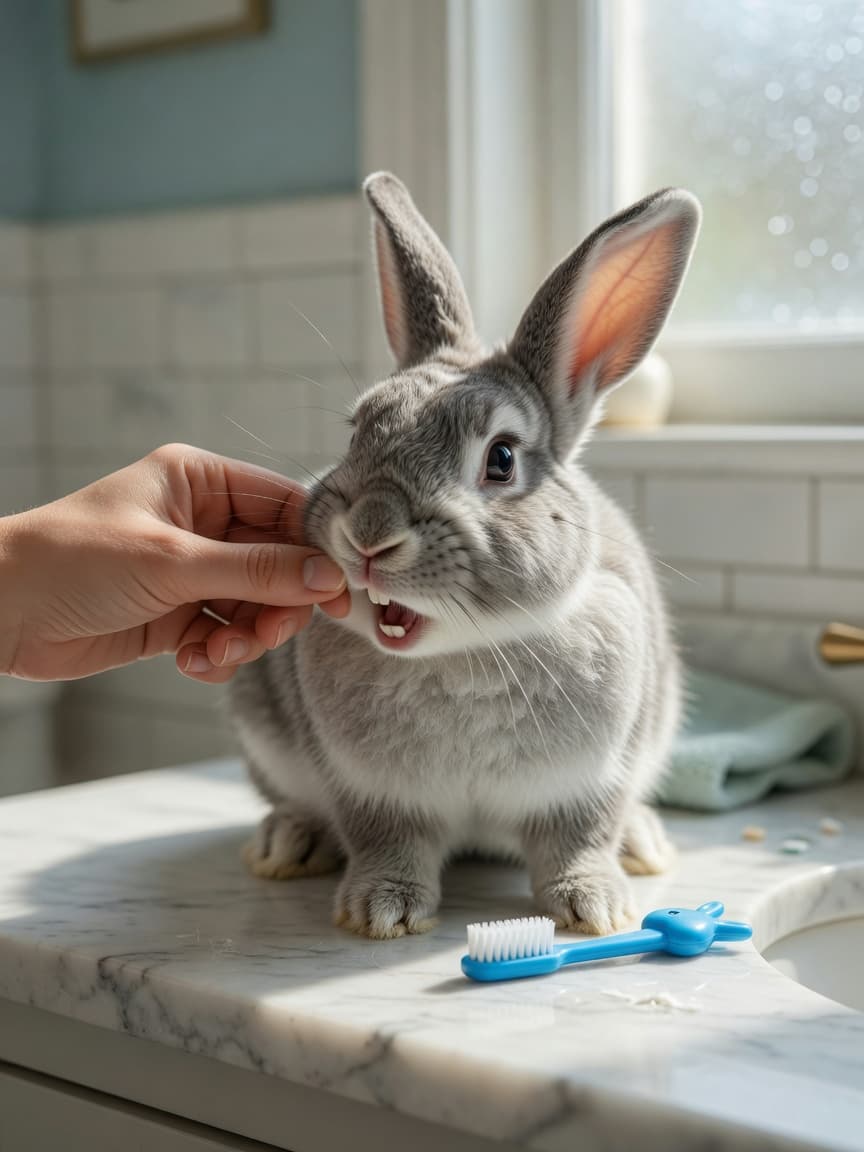
Rabbit Dental Problems: Signs, Causes & Treatment
By Julia Wrenfield, Pet Wellness Researcher
- Tooth growth rate: 2–3mm per week — continuous wear is essential
- Most common problem: Molar spurs and elongated roots
- Primary cause: Inadequate hay consumption
- Best prevention: Unlimited grass hay, always
- Diagnosis requires: Oral exam + dental X-rays (visual exam alone is insufficient)
Dental disease is one of the most common and most underdiagnosed health problems in domestic rabbits. Because rabbits instinctively hide pain and discomfort — a survival behavior inherited from prey animals — dental problems often progress significantly before owners notice anything is wrong. By the time classic signs appear, such as drooling, weight loss, or complete appetite loss, the underlying dental pathology may be severe.
Understanding how rabbit teeth work, what can go wrong, and how to catch problems early can save your rabbit from chronic pain and potentially life-threatening complications.
How Rabbit Teeth Work
Rabbits have a unique dental system called elodont dentition — meaning their teeth grow continuously throughout their lives. This is in contrast to most mammals, including humans, whose teeth grow to a fixed size and stop. A rabbit's incisors (front teeth) and molars (cheek teeth) never stop growing, at a rate of approximately 2–3mm per week for the incisors and a slightly slower rate for the molars.
This continuous growth requires continuous wear. In a healthy rabbit eating the right diet, the act of grinding grass hay keeps teeth in correct alignment and at appropriate length. The lateral (side-to-side) grinding motion of chewing long-stemmed hay is uniquely effective at wearing teeth evenly. Without sufficient hay consumption, this grinding does not occur adequately, and teeth begin to overgrow.
Rabbits have 28 teeth total: 4 incisors (including 2 small "peg teeth" behind the upper incisors), and 22 cheek teeth (premolars and molars). Dental problems can affect any of these teeth, but molar problems are both the most common and the most difficult to detect without proper examination equipment.
Common Dental Problems in Rabbits
Molar Spurs
As molars overgrow unevenly, the edges develop sharp points called spurs. These spurs cut into the cheeks and tongue with every jaw movement, causing significant pain that worsens with eating. A rabbit with molar spurs will often approach food, pick it up, then drop it — the pain of chewing makes it impossible to continue. This behavioral sign is one of the earliest observable indicators of molar problems.
Malocclusion
Malocclusion occurs when the upper and lower teeth do not meet correctly, preventing normal wear. In incisors, malocclusion is visible — the teeth curve outward dramatically, sometimes growing in spirals if untreated. In molars, malocclusion is invisible without specialist equipment. Malocclusion can be genetic (common in dwarf and lop breeds due to their skull shape) or acquired through injury, tooth loss, or progressive overgrowth.
Elongated Tooth Roots
Because rabbit teeth grow from the root end, abnormal tooth growth can cause the root to elongate downward (lower jaw teeth) or upward (upper jaw teeth). Elongated upper molar roots push toward the eye socket and can cause eye problems including epiphora (overflow of tears), eye discharge, and dacryocystitis (blocked tear duct). Elongated lower molar roots create painful bumps that can be felt on the underside of the jaw. Neither of these is visible on oral examination alone — dental X-rays are essential.
Tooth Abscesses
Rabbits are particularly prone to dental abscesses because their bone and abscess-wall tissue (unlike in humans and cats) does not allow good antibiotic penetration. Rabbit dental abscesses tend to develop thick, caseous (cheese-like) pus that does not drain easily. They often require surgical debridement and, in many cases, tooth extraction by a veterinary dental specialist.
Causes of Dental Disease
The causes of rabbit dental problems fall into two categories:
Dietary/environmental: The single most preventable cause is insufficient hay consumption. Without the constant abrasive grinding that hay provides, teeth overgrow. This is the dietary cause of most acquired dental problems in domestic rabbits — problems that would not occur in wild rabbits eating a natural diet of grasses and fibrous plants.
Genetic: Brachycephalic (short-faced) rabbit breeds — particularly Netherland Dwarf, Lionhead, and lop varieties — have compressed skull anatomy that causes teeth to be crowded and misaligned from birth. These breeds have an inherently higher risk of dental problems regardless of diet, making regular dental check-ups especially important.
Trauma — a fall, collision, or bite injury — can also damage teeth or jaw alignment and lead to subsequent dental disease.
Signs of Dental Problems
Because rabbits hide pain so effectively, owners must learn to recognize subtle behavioral and physical changes:
- Dropping food (quidding) — picking up food and then dropping it repeatedly
- Selective eating — avoiding hard foods (pellets, harder vegetables) but continuing to eat soft foods
- Reduced appetite progressing to anorexia
- Weight loss — often gradual and easy to miss
- Drooling or wet fur under the chin — saliva overflow from mouth pain
- Eye discharge or overflow of tears — from elongated upper molar roots
- Nasal discharge — roots can interfere with nasal passages
- Visible lumps on the jawline — elongated roots or abscess
- Overgrown or visibly misaligned incisors — visible from outside without equipment
- Head tilt — can indicate ear involvement secondary to dental infection
Diagnosis: Why X-Rays Are Essential
Many veterinarians and even owners believe that a visual oral examination with an otoscope or small flashlight is sufficient to assess rabbit dental health. It is not. The cheek teeth of a rabbit are deep in the jaw and difficult to visualize properly without specialized equipment — and the roots, which are the source of many serious problems, are entirely invisible without radiography.
Proper rabbit dental diagnosis requires general anesthesia (to allow full mouth opening and examination) and dental X-rays of both jaws. In specialist exotic animal practices, CT scanning is increasingly used for complex dental cases, providing three-dimensional imaging of root lengths and bone involvement.
Treatment Options
Treatment depends on the specific problem identified:
- Dental filing (burring) — the most common procedure, performed under general anesthesia by a veterinary dental specialist. Sharp molar spurs are filed down, and overgrown surfaces are leveled. This typically requires repeat procedures every 2–6 months in affected rabbits.
- Incisor trimming — can be done awake in some cases with a specialized dental burr (never with clippers, which cause tooth fracture).
- Tooth extraction — sometimes necessary for abscessed or severely maloccluded teeth. Root extraction in rabbits is technically demanding and requires a specialist.
- Abscess management — may require surgical debridement, long-term antibiotics, and in some cases, marsupializion (leaving the abscess open to drain over weeks).
Prevention: Hay as the Primary Tool
For acquired dental disease, prevention is straightforward: feed unlimited grass hay. No single dietary change is more impactful for rabbit dental health than ensuring hay constitutes 80%+ of the diet and is available at all times. The physical grinding action is irreplaceable.
Supplemental chewing objects — untreated wooden blocks, hay-based chew toys — can contribute additional wear for incisors but do not replicate the molar-grinding action of hay. Annual veterinary dental examinations are recommended for all adult rabbits, and twice-yearly exams for brachycephalic breeds or any rabbit with a history of dental problems.
Shop Quality Rabbit Hay at Zooplus
Key Takeaways
- Rabbit teeth grow 2–3mm per week and must be continuously worn down through hay grinding.
- Common problems include molar spurs, malocclusion, elongated roots, and abscesses.
- Key causes are insufficient hay intake (acquired) and genetics (especially in dwarf and lop breeds).
- Early signs include dropping food, selective eating, drooling, and eye discharge — often subtle.
- Proper diagnosis requires general anesthesia and dental X-rays; visual exam alone is insufficient.
- Prevention: unlimited grass hay at all times, plus annual dental exams (twice-yearly for at-risk breeds).
References
- Harcourt-Brown FM. Diagnosis of dental disease in rabbits by routine intraoral examination. Vet Rec. 2007;160(8):270–271. PubMed
- Böhmer E, Crossley D. Objective interpretation of dental disease in rabbits, guinea pigs and chinchillas. Tierarztl Prax Ausg K Kleintiere Heimtiere. 2009;37(4):250–260. PubMed