
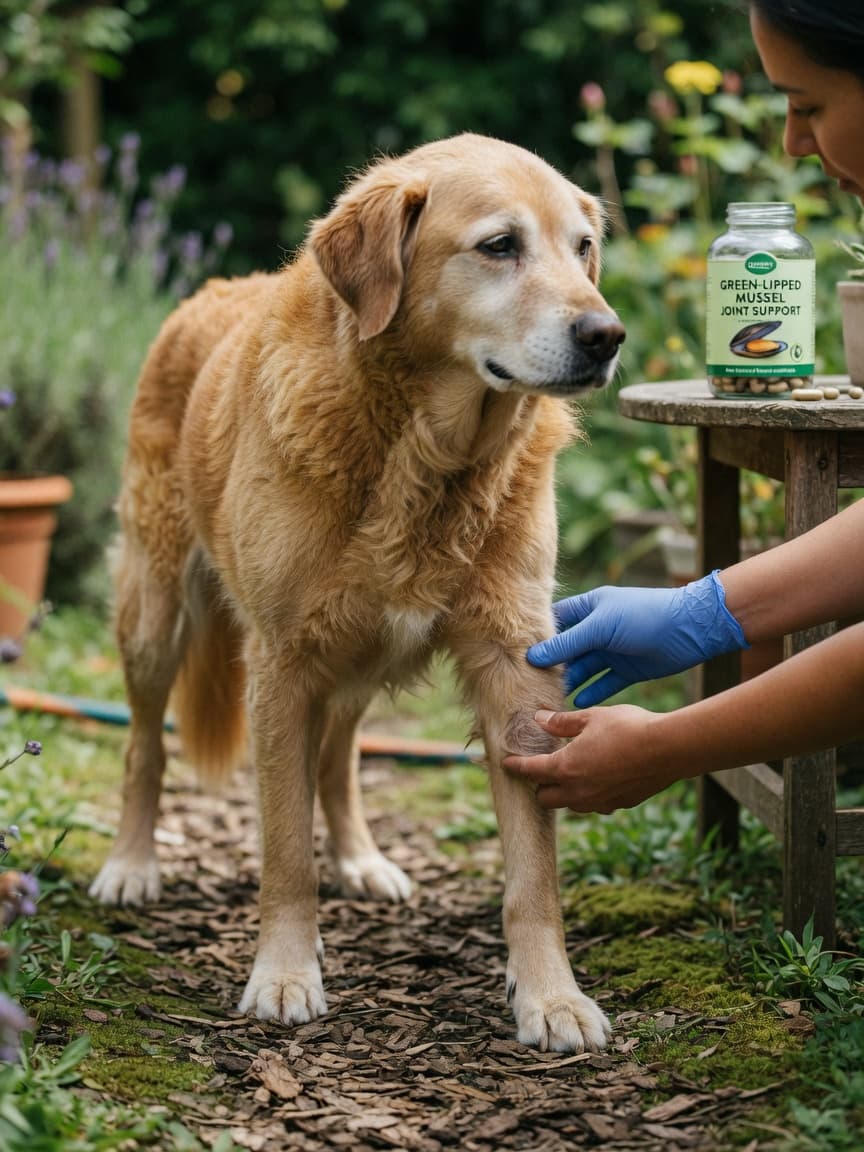
Green-Lipped Mussel for Dogs: Joint Health Evidence & Dosage
What Is Green-Lipped Mussel?
Perna canaliculus, commonly known as the green-lipped mussel, is a bivalve shellfish native to New Zealand. It has been used in traditional Māori medicine for centuries, and since the 1970s has attracted scientific interest for its anti-inflammatory properties. Today it is one of the most widely recommended natural joint supplements for dogs, found in powdered, freeze-dried, and oil extract forms.
What makes GLM stand out from generic omega-3 supplements is its unusually complex lipid profile. Beyond EPA and DHA — the omega-3 fatty acids also found in fish oil — GLM contains a unique group of lipids called furan fatty acids and eicosatetraenoic acid (ETA), which appear to inhibit both the cyclooxygenase (COX) and 5-lipoxygenase (5-LOX) pathways of inflammation. Most NSAIDs only block COX enzymes. This dual-pathway inhibition may explain why some studies report meaningful improvements in dogs that do not respond well to conventional anti-inflammatories.
Clinical Evidence in Dogs

The evidence base for GLM in canine osteoarthritis is modest but more robust than for many competing supplements. Several placebo-controlled trials have examined its efficacy.
A 2013 randomised controlled trial published in the Journal of Veterinary Science found that dogs with osteoarthritis treated with freeze-dried GLM powder showed significantly reduced pain scores and improved mobility compared to placebo after 8 weeks. The magnitude of improvement was clinically meaningful, though the sample size was small (n=45). A notable limitation was reliance on owner-reported outcomes — widely used in veterinary pain research but inherently subjective.
An earlier study by Bierer & Bui (2002), frequently cited in the GLM literature, examined a lipid extract of GLM in dogs with degenerative joint disease. Dogs receiving GLM showed a 30% greater reduction in pain scores versus controls, with improvements visible by week 4. Crucially, the study used both owner assessment and veterinary gait analysis, lending more credibility to its findings.
A 2019 systematic review of nutraceuticals for canine osteoarthritis, published in Veterinary Evidence, concluded that GLM was among the few supplements with "fair" evidence of efficacy — meaning multiple studies with positive results, though methodological limitations prevent a stronger rating. Fish oil was the only supplement rated higher.
It is worth noting that research into GLM oil extract specifically (as opposed to whole freeze-dried powder) is more limited in dogs. Most high-quality studies used the dried whole mussel or a standardised lipid fraction. Extrapolating results from one form to another should be done cautiously.
How It Compares to Fish Oil
Fish oil is often the first supplement veterinarians recommend for joint support because its anti-inflammatory mechanism — increasing the ratio of omega-3 to omega-6 fatty acids in cell membranes — is well characterised and dose-dependent. GLM offers a complementary approach rather than a competing one. Some practitioners use both simultaneously, though direct head-to-head trials in dogs are lacking.
One theoretical advantage of GLM over fish oil is its stability. Omega-3 fatty acids are prone to oxidation, which reduces their efficacy and may introduce harmful byproducts. High-quality freeze-dried GLM is more shelf-stable than many fish oil products, particularly those in low-grade capsule form.
Safety Profile
GLM has a favourable safety profile in both human and veterinary populations. There are no reports of organ toxicity at therapeutic doses. The main concerns are:
- Shellfish allergy: Dogs with documented shellfish hypersensitivity should not receive GLM. This is uncommon but real.
- GI upset: Some dogs experience mild loose stools or flatulence when first introduced. Starting at a lower dose and increasing gradually mitigates this.
- Anticoagulant effects: GLM inhibits platelet aggregation, as do fish oil and many omega-3 sources. Dogs on anticoagulant therapy or scheduled for surgery should be assessed by a veterinarian before starting supplementation.
GLM should not be confused with the isolated drug Lyprinol, which is a pharmaceutical-grade extract not equivalent to retail supplements, though it shares the same source material.
Dosage Guidelines
Dosing recommendations vary by product and form. The following are general guidance based on published studies and veterinary clinical practice:
- Freeze-dried powder: 15–20 mg per kg body weight per day is the most commonly cited therapeutic dose. Some products recommend higher doses for the first 4–6 weeks (loading phase).
- Lipid extract (oil): Typically dosed at 10–15 mg/kg/day, though bioavailability studies comparing extract to whole powder are limited in dogs.
- Response timeline: Measurable improvement is generally seen at 4–8 weeks. If no effect is apparent after 12 weeks of consistent use, the supplement is unlikely to be beneficial for that individual.
Product quality varies substantially. Look for supplements standardised for ETA content, manufactured under GMP conditions, and third-party tested for heavy metals — shellfish bioaccumulate cadmium and mercury, and sourcing matters.
Zooplus stocks a wide range of GLM-based joint products, including powders and chews from established veterinary brands.
Browse joint supplements at Zooplus →
When to Consult Your Veterinarian
GLM is not a replacement for a proper diagnosis. Dogs showing signs of joint pain — stiffness after rest, reluctance to climb stairs, changed gait — should be examined to rule out other causes including immune-mediated arthritis, infectious disease, bone cancer, or ligament injury. Osteoarthritis diagnosis typically requires radiographic confirmation.
GLM can be a useful component of a multimodal management plan that includes weight control, physiotherapy, and where appropriate, prescription anti-inflammatory medication. It is most likely to provide meaningful benefit in dogs with mild to moderate osteoarthritis who cannot tolerate long-term NSAID use.
- Green-lipped mussel has among the best evidence of any natural supplement for canine joint disease, though research quality remains limited.
- Its unique fatty acids inhibit both COX and 5-LOX inflammatory pathways, differentiating it from standard fish oil.
- Therapeutic dose: approximately 15–20 mg/kg/day of freeze-dried powder; allow 4–8 weeks for clinical response.
- Safe for most dogs; use caution in shellfish-allergic animals and those on anticoagulant therapy.
- Product quality varies widely — choose third-party-tested supplements standardised for ETA content.
- Always confirm a diagnosis before starting supplementation; GLM works best as part of a multimodal plan.
- Bierer TL, Bui LM. (2002). Improvement of arthritic signs in dogs fed green-lipped mussel (Perna canaliculus). Journal of Nutrition, 132(6 Suppl 2):1634S–6S. PMID: 12042484
- Pollard B, Guilford WG, Ankenbauer-Perkins KL, Hedderley D. (2006). Clinical efficacy and tolerance of an extract of green-lipped mussel (Perna canaliculus) in dogs with osteoarthritis. New Zealand Veterinary Journal, 54(3):114–8. PMID: 16751841
- Innes JF, Fuller CJ, Grover ER, et al. (2003). Randomised double-blind placebo-controlled parallel group study of P54FP for the treatment of dogs with osteoarthritis. Veterinary Record, 152(15):457–60. PMID: 12725447
Written by Julia Wrenfield, Pet Wellness Researcher. Last reviewed June 2026. This article is for informational purposes only and does not constitute veterinary advice.