
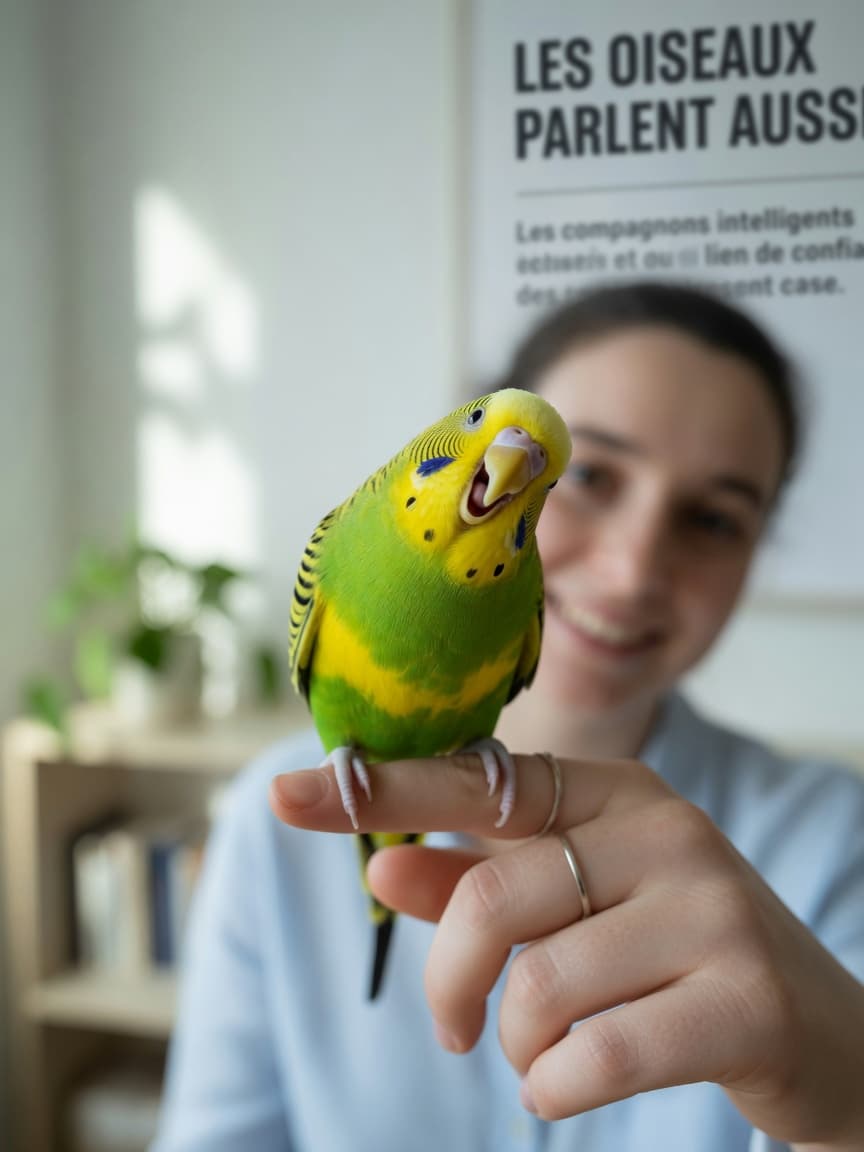
How to Teach Your Budgerigar to Talk: A Step-by-Step Training Guide
The budgerigar (Melopsittacus undulatus) holds a remarkable record in the avian world: the Guinness World Record for the largest verified vocabulary of any bird belonged to a budgie named Puck, who knew more than 1,700 words. While most pet budgies will not reach those heights, the majority of budgerigars are capable of learning meaningful vocabulary with consistent, patient training — often within a matter of weeks. This guide explains exactly how to do it.
Legal Status and EU Considerations
Budgerigars are not listed under CITES. They are native to Australia but have been bred in captivity for over 150 years and captive populations are enormous and self-sustaining worldwide. Budgies are legal to keep throughout the EU without any special permits. EU directive frameworks for the welfare of kept animals apply — minimum cage size recommendations, access to natural light cycles, and appropriate environmental enrichment are all part of responsible budgie keeping in Europe.
Which Budgies Talk Best?
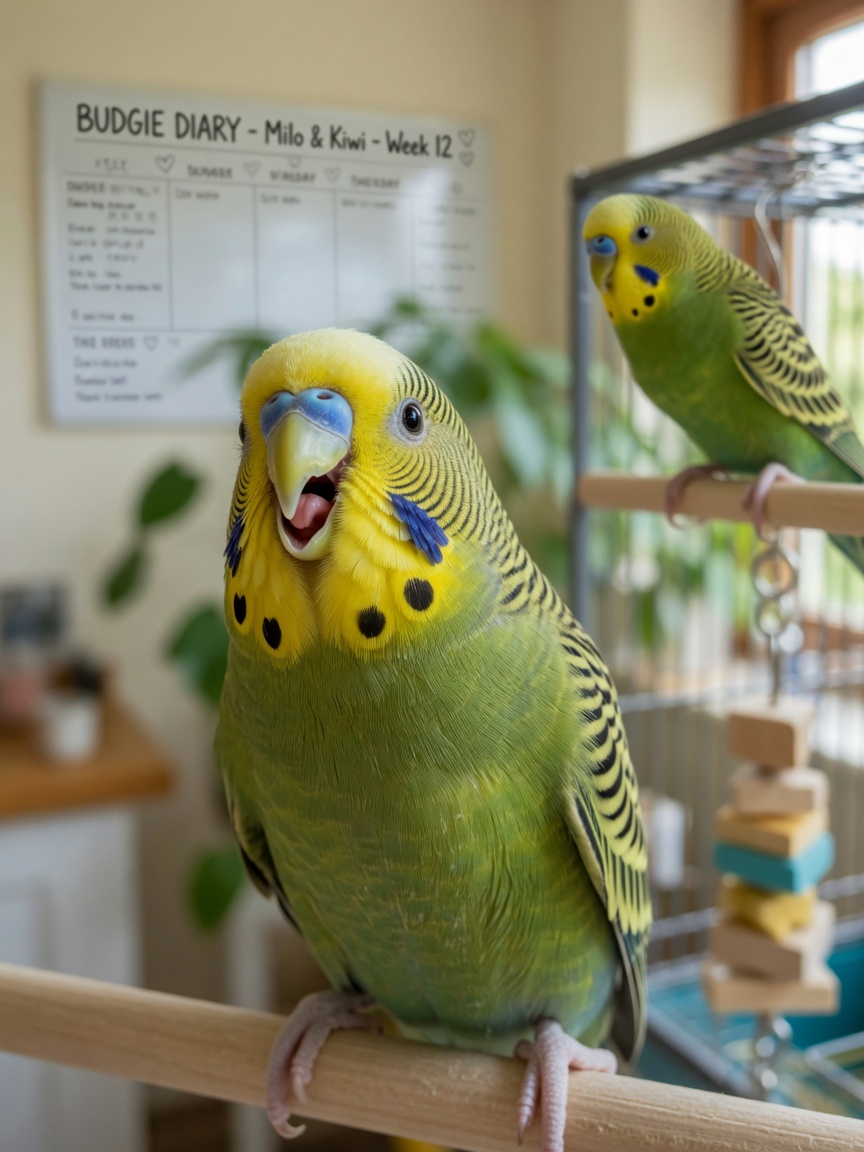
Male budgies have a strong statistical advantage when it comes to talking. In the wild, male budgerigars are responsible for the complex vocalisations used in courtship, and this predisposes them to more elaborate vocal learning in captivity. Females can and do talk, but male birds — identified by a blue cere (the fleshy area above the beak) in adult birds — tend to develop larger vocabularies more readily.
Young birds learn more easily than adults. A budgie acquired at 6–12 weeks of age and raised with regular human interaction from the outset will typically have a much stronger talking ability than a bird acquired as an adult with limited prior human contact. That said, adult birds can absolutely learn to talk — it simply requires more patience and consistency.
The Mirror Question
Many new budgie keepers instinctively place a mirror in the cage, believing it will keep the bird company. For talking training, however, mirrors are counterproductive. A budgie that becomes absorbed in its reflection treats the mirror image as a flock companion — and will direct its vocalisations at the mirror rather than at you. For a bird you want to talk, it is generally better to remove or avoid mirrors until a solid vocabulary is established, or to keep the bird without a mirror entirely if talking is a priority.
Why Some Budgies Talk More Readily When Alone
Budgerigars kept as single birds — with regular, meaningful human interaction as their primary social contact — often learn to talk more readily than those kept in pairs or groups. When a bird is housed with other budgies, its social and communicative needs are met by its companions, and the motivation to engage in human-directed vocal mimicry is reduced. This does not mean that solitary housing is the right choice for welfare reasons — a budgie kept alone requires substantial daily human interaction to compensate for the absence of conspecific company. If you want your budgie to talk and are prepared to provide that level of interaction, a single bird is more likely to talk than one kept with companions.
Training Technique: The Core Principles
Start With a Single Word
The most common mistake new trainers make is trying to teach too many words at once. Begin with a single, clear, short word — ideally your budgie's name, or a simple greeting like "hello." Repeat this word clearly and at a moderate pace during every training session. Do not rush to introduce new vocabulary until the first word is reliably repeated.
Session Length and Frequency
Short, frequent sessions dramatically outperform long, infrequent ones. Aim for two to three sessions of five to ten minutes each per day, ideally at the same time each day so the bird comes to anticipate them. Early morning is often the best time — budgies tend to be most alert and vocal shortly after waking.
Speak Clearly and Directly
Position yourself at the bird's eye level and make clear eye contact. Speak slowly and with clear enunciation — budgies mimic the pattern and rhythm of speech as much as the individual sounds. Avoid talking in the background without direct interaction; the bird needs to associate the word with you, not with ambient noise.
Positive Reinforcement
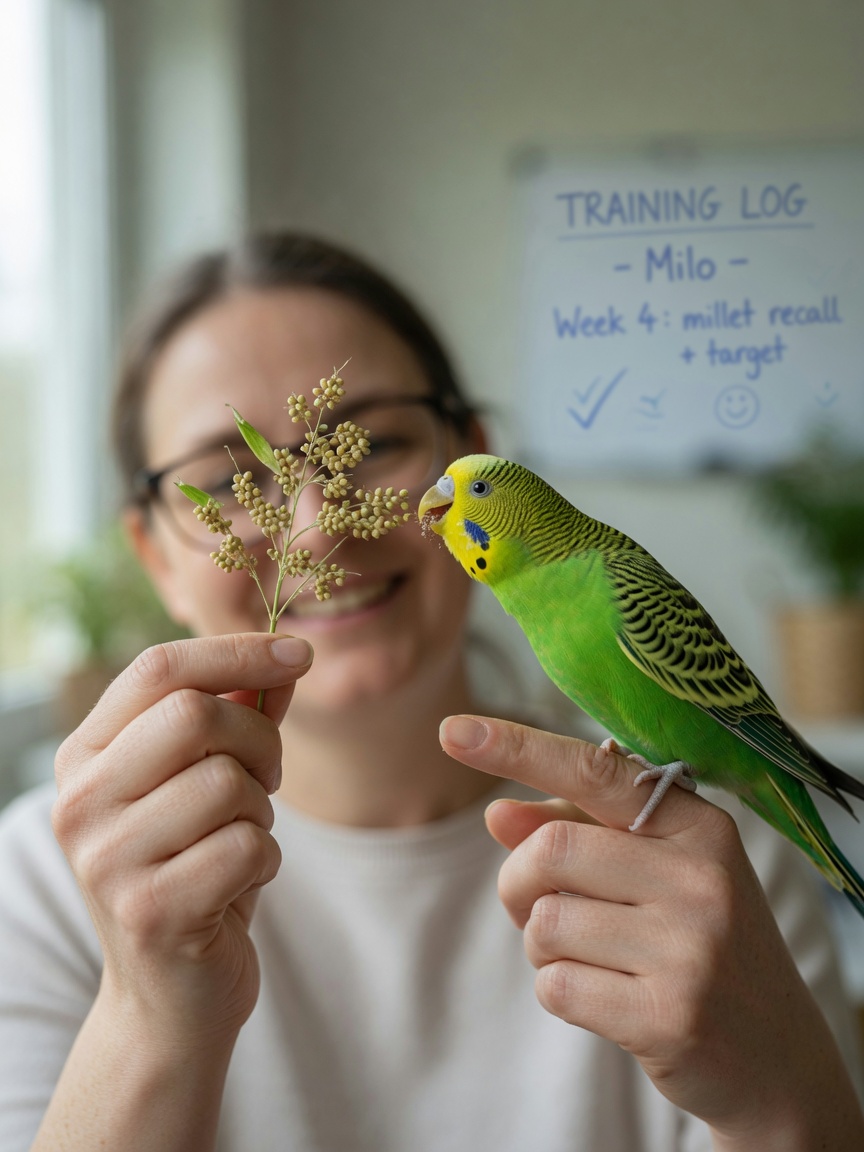
Use positive reinforcement to reward any vocalisation or attempt to mimic. Millet spray is the most universally effective training treat for budgies — it is nutritious, highly palatable, and can be offered in tiny amounts. Zooplus stocks a good range of millet sprays and training treats for small birds that are free from artificial additives and appropriate for regular use.
Whistles and Talking: A Note of Caution
Budgies find whistling easier to learn than words, because melodic sounds are closer to their natural vocalisation range. However, if you teach a budgie to whistle before they have learned to talk, they will almost always prioritise whistling thereafter. Establish spoken words first, and save whistle training for later if you want a talking bird.
Environment and Health for Optimal Vocalisation
A budgie's ability and motivation to vocalise is directly affected by their health and environment. Several factors should be considered:
- Respiratory health is fundamental — a bird with a respiratory infection will not vocalise well, and some infections produce abnormal sounds. Any change in the quality or frequency of a budgie's voice warrants veterinary assessment
- Airborne toxins are a serious hazard for birds. PTFE (polytetrafluoroethylene), found in many non-stick cooking coatings including some Teflon-branded products, releases fumes when overheated that are rapidly fatal to birds. Non-stick cookware must never be used in a kitchen where a bird is present, or anywhere the fumes can reach them
- Cigarette smoke, aerosol sprays, scented candles, and air fresheners are all harmful to budgie respiratory health and should be avoided entirely
- Cage placement matters — position the cage in a room where the bird has regular human company and can observe household activity, but not in a draughty position or in direct sunlight for extended periods
Common Health Issues Affecting Budgies in Europe
European budgie keepers should be aware of several conditions that can affect their birds:
- French moult — caused by Budgerigar Fledgling Disease Virus (BFDV), this condition affects feather development in young birds and is unfortunately common in some breeding populations
- Psittacosis — a bacterial infection (Chlamydia psittaci) that is transmissible to humans; birds showing signs of illness including lethargy, discharge, or breathing difficulties should be assessed promptly
- Scaly face and scaly leg mites — caused by Knemidocoptes pilae, these mites produce characteristic crusty growths around the beak and legs and are treatable by a vet
For all health concerns, seek out a vet with avian experience. The European College of Zoological Medicine (ECZM) accredits avian veterinary specialists, and an ECZM-accredited vet will have the training to diagnose and treat these conditions accurately.
Realistic Expectations and Timelines
With daily sessions and good technique, many budgies begin to attempt their first word within two to four weeks. A recognisable repetition of a short word may follow within six to eight weeks. Full, clear words with consistent use typically emerge over three to six months of regular training. Some birds progress faster; some take longer. Individual variation is significant, and a small number of budgies — regardless of technique — simply do not talk. This is not a training failure. A budgie that does not talk is not a lesser pet — the species is extraordinary company for reasons well beyond vocabulary.