
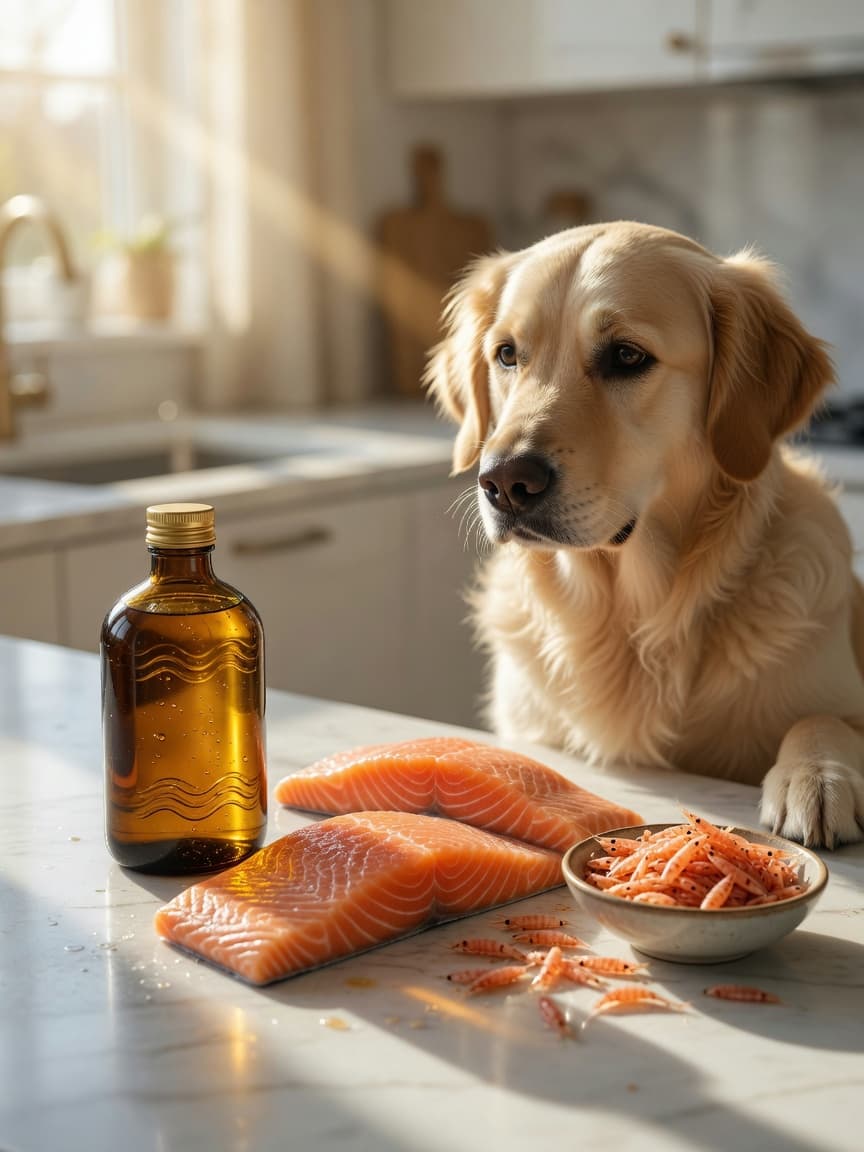
Best Omega-3 Supplements for Dogs: Fish Oil vs Krill Oil vs Algae
Omega-3 fatty acids — specifically EPA (eicosapentaenoic acid) and DHA (docosahexaenoic acid) — are among the most researched nutrients in veterinary medicine. The evidence is solid: therapeutic doses reduce systemic inflammation, support cognitive function in aging dogs, improve skin barrier integrity, and have documented benefit in dogs with osteoarthritis, atopic dermatitis, and chronic kidney disease. The keyword there is therapeutic doses. At the low amounts found in most commercial dog foods, you're getting maintenance levels at best. If you want a measurable clinical effect, you need to supplement — and supplement correctly.
The therapeutic dosing range established in veterinary literature sits at 20–55 mg of combined EPA+DHA per kilogram of body weight per day. For a 25 kg Labrador, that's 500–1,375 mg of EPA+DHA daily. Most fish oil capsules marketed to dogs deliver 150–300 mg per dose. You can see the gap immediately. Before you even think about which product to buy, get clear on the math for your dog's weight.
The Hidden Rancidity Problem
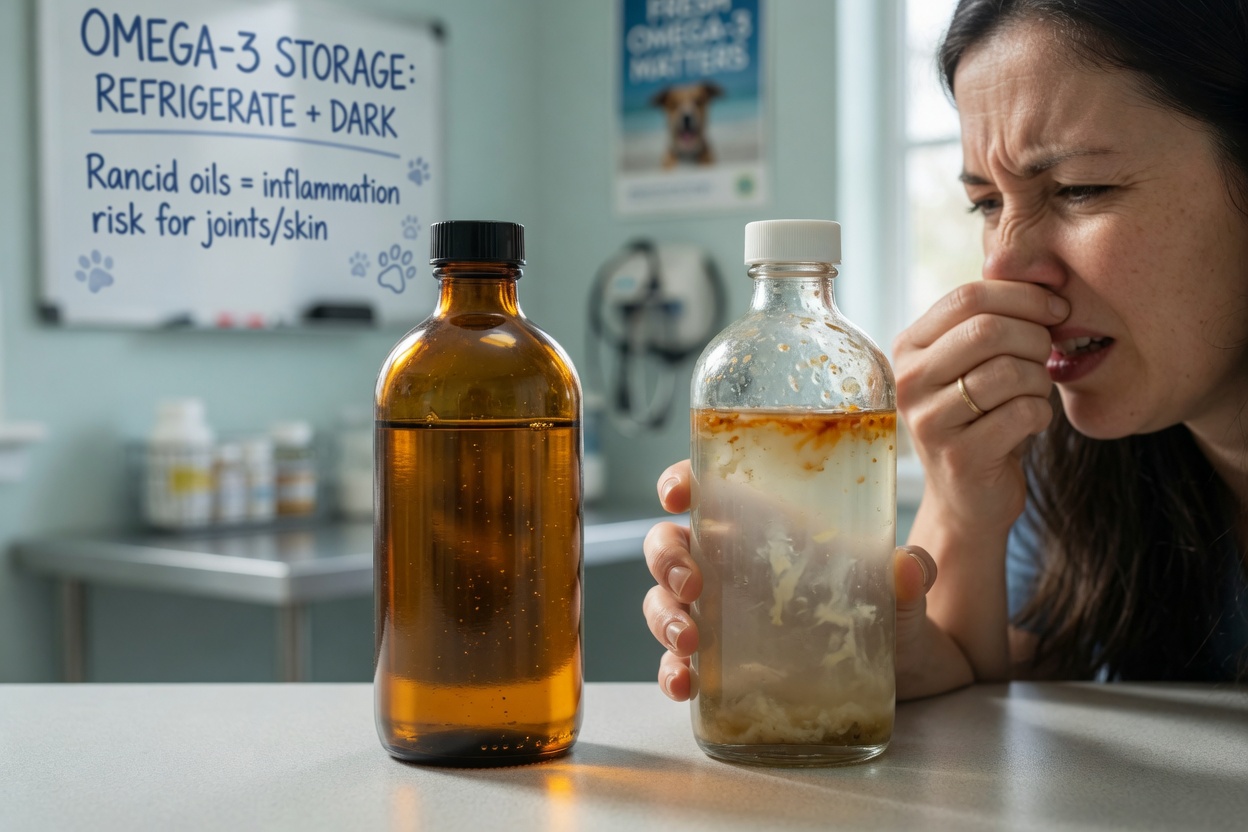
Here's the conversation the omega-3 supplement industry would rather not have: fish oil oxidizes rapidly, and a meaningful percentage of the products sitting on pet store shelves — or in your kitchen cabinet — are rancid. Oxidized oils don't just lose their therapeutic value; they generate free radicals (aldehydes, malondialdehyde) that actively promote the oxidative stress you were trying to reduce. You can be doing more harm than good.
Rancidity develops through a chain reaction triggered by heat, light, and exposure to oxygen. The time from fish catch to bottling to retail shelf to your dog's bowl can easily stretch to 18 months. High-quality manufacturers use nitrogen flushing, dark bottles, and antioxidant stabilizers (typically mixed tocopherols or rosemary extract) to slow this process. Budget brands often skip these steps.
The sniff test is real and useful. Fresh fish oil should smell like the ocean — mild, briny, slightly fishy but not offensive. If it smells strongly of rotten fish, paint, or crayons (that crayon smell is hexanal, a hallmark oxidation byproduct), discard it. This isn't foolproof — oil can be oxidized before it becomes organoleptically obvious — but it catches the worst offenders.
The more technical measure is peroxide value (PV), which quantifies primary oxidation products. The Global Organization for EPA and DHA Omega-3s (GOED) sets a maximum acceptable PV of 5 meq/kg for retail fish oils. Some third-party tested products exceed this straight off the shelf. If a brand publishes its Certificate of Analysis (CoA) with peroxide values, that's a transparency signal worth rewarding.
Critically, the molecular form of the oil matters enormously for oxidation stability. Fish oil comes in two main forms:
- Triglyceride (TG) form: The natural form found in fish tissue. More stable, more bioavailable (studies suggest 20–50% better absorption versus ethyl esters). Harder and more expensive to manufacture at high concentration.
- Ethyl ester (EE) form: Produced by transesterification — a processing step that strips the fatty acids from glycerol and attaches them to ethanol. Allows higher EPA/DHA concentration per capsule, but oxidizes significantly faster and has lower bioavailability. Most concentrated fish oils use this form.
This is not a minor distinction. If you're buying a highly concentrated EE-form fish oil, storing it at room temperature for three months, and giving your dog a dose once daily, you may be delivering progressively degraded oil with diminishing returns. Triglyceride form, properly stabilized and refrigerated after opening, is the better long-term choice.
Fish Oil vs Krill Oil vs Algae: Which Wins?
Fish oil (anchovy, sardine, salmon, pollock) remains the cost-effective gold standard. High EPA and DHA content per dollar, widely available, good clinical evidence base. The downsides are oxidation risk and the sustainability concerns of wild-catch fisheries, though anchovy-based oils from well-managed fisheries score reasonably well.
Krill oil is phospholipid-bound, which provides genuinely excellent bioavailability — the fatty acids enter cells more readily. Krill also contains astaxanthin, a potent carotenoid antioxidant that provides built-in protection against oxidation. This is a real advantage. The problem: krill oil delivers far less EPA+DHA per gram than concentrated fish oil. You'd need to give a large dog 5–10x the volume (and cost) to match a good fish oil dose. For small dogs or as an oxidation-stable maintenance supplement, krill has merit. For therapeutic dosing in medium or large dogs, the economics rarely work.
Algae oil is the only genuinely vegan omega-3 source with meaningful DHA content (and some EPA, depending on the strain). It's also where fish get their omega-3s originally — fish accumulate DHA by eating algae or algae-eating organisms. Algae oil is the right choice for dogs with confirmed fish or shellfish allergies, and for owners with strong sustainability concerns. It is, however, expensive — typically 3–5x the cost of equivalent fish oil — and DHA-heavy rather than EPA-heavy, which may matter depending on your dog's specific health goal.
Comparison at a Glance
| Product | EPA per dose | DHA per dose | Form | Source | Oxidation Risk | Price/day (25 kg dog) | Verdict |
|---|---|---|---|---|---|---|---|
| Nordic Naturals Omega-3 Pet | 425 mg | 275 mg | Triglyceride | Anchovy/Sardine | Low | ~€0.90 | Best overall |
| Zesty Paws Pure Wild Alaskan Salmon Oil | ~380 mg | ~210 mg | Ethyl ester | Wild Alaskan Salmon | Moderate–High | ~€0.55 | Budget pick with caveats |
| Grizzly Salmon Oil Plus | ~310 mg | ~200 mg | Natural triglyceride | Wild Alaskan Salmon | Low–Moderate | ~€0.70 | Solid mid-tier |
Note: Doses above are per recommended serving for a ~25 kg dog. Price estimates based on mid-2026 European retail. Always verify current CoA data with the manufacturer.
Product Analysis
Nordic Naturals Omega-3 Pet
This is the benchmark. Nordic Naturals uses a re-esterified triglyceride (rTG) form — meaning they concentrate the oil to boost EPA/DHA levels, then convert it back from ethyl ester form into triglyceride form. The result is both high-potency and stable. Per soft gel, you get approximately 425 mg EPA and 275 mg DHA — 700 mg combined. For a 25 kg dog aiming at the lower therapeutic threshold (500 mg EPA+DHA/day), a single soft gel nearly gets you there. They publish third-party test results, use nitrogen flushing, and include rosemary extract as antioxidant. The price is higher than budget options, but you're paying for molecular form and quality assurance. This is the one I'd use for a dog with diagnosed osteoarthritis or atopic dermatitis where you actually need results.
Zesty Paws Pure Wild Alaskan Salmon Oil
Zesty Paws has done well on the EPA/DHA numbers — approximately 380 mg EPA and 210 mg DHA per pump dose — and the "Wild Alaskan" sourcing is a legitimate marketing hook. My concern is the ethyl ester form. The pump bottle design means the oil is repeatedly exposed to air every time you dose, which accelerates oxidation from day one of opening. If you're disciplined about refrigerating immediately after use and finishing the bottle within 30–45 days, the risk is manageable. If the bottle sits on your counter for three months, you're rolling the dice. At the price point, it's the most cost-accessible way to hit therapeutic EPA+DHA levels, but the form is a genuine compromise you need to consciously accept.
Grizzly Salmon Oil Plus
Grizzly occupies an honest middle ground. It's naturally-derived triglyceride form (not re-esterified — these are the fatty acids as they come from the salmon, without chemical processing), which is a genuine plus for stability. EPA comes in at around 310 mg per serving and DHA at approximately 200 mg — combined 510 mg, which just clears the lower therapeutic threshold for a 25 kg dog at the recommended dose. The "Plus" formulation adds vitamin E, which helps with oxidation protection. It's a good, clean product, but it doesn't quite match Nordic Naturals on EPA+DHA concentration, so for larger dogs you may need to double-dose to hit target, pushing the per-day cost higher than it first appears.
Julia's Verdict
Best overall: Nordic Naturals Omega-3 Pet. The triglyceride form is genuinely more bioavailable and more oxidation-stable than ethyl ester alternatives. The third-party testing transparency matters. If you have a dog with a real inflammatory condition and you're dosing seriously, don't cut corners here.
Best budget pick: Zesty Paws, but only if you refrigerate it consistently and finish each bottle promptly. Do the sniff test every time you open it. If it smells off, replace it — don't use rancid oil to save €10.
Best for simplicity: Grizzly Salmon Oil Plus. Natural TG form, no chemical processing, honest label. Slightly lower potency than Nordic Naturals means you may need slightly more volume, but it's a trustworthy product.
Krill: Worth it for small dogs (under 10 kg) or as a rotation product for the astaxanthin antioxidant protection. Not cost-effective as the sole omega-3 source for large breeds at therapeutic dose.
Algae: Reserve for fish-allergic dogs. Expensive, but it works and avoids the ocean sustainability question entirely.
Key Takeaways
- Therapeutic dose is 20–55 mg EPA+DHA per kg body weight per day — most dogs receiving "one pump" of a standard salmon oil are getting far less than this.
- Oxidation is the biggest unacknowledged risk in fish oil supplementation. Rancid oil is worse than no oil. Sniff every bottle; refrigerate after opening; finish within 45–60 days.
- Triglyceride form (natural or re-esterified) is more bioavailable and more stable than ethyl ester form. Check the label or manufacturer's CoA.
- Nordic Naturals wins on form and transparency. Zesty Paws wins on price if you manage oxidation carefully. Grizzly wins on processing simplicity.
- Krill oil's astaxanthin content is a genuine antioxidant advantage; its low volume-per-dollar is a genuine disadvantage at therapeutic doses.
- For fish-allergic dogs, algae oil (DHA-dominant) is the only viable option with strong evidence.