
Pourquoi mon chat est-il constipé ? Causes et solutions sûres
Mise à jour juin 2026
- Aucune matière fécale dans le bac à litière pendant plus de 48-72 heures
- Le chat fait des efforts répétés sans rien produire — distinguez de l'obstruction urinaire (surtout les mâles)
- Vomissements ou léthargies accompagnant la constipation
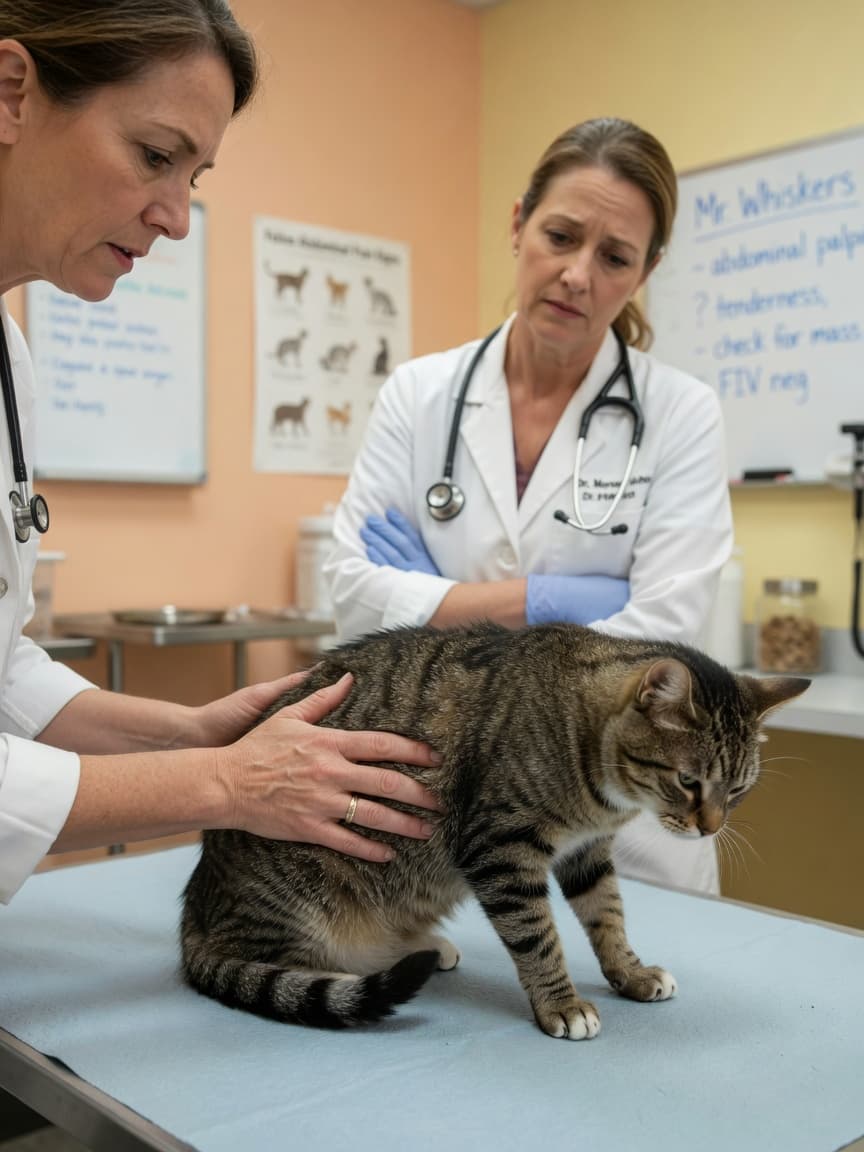
- Abdomen distendu, dur ou douloureux
- Petites quantités de matière liquide ou sanglante — peuvent indiquer une impaction avec débordement
La constipation est bien plus qu'un désagrément pour les chats — les efforts chroniques peuvent entraîner des complications graves, et un côlon gravement impacté (obstipation) peut devenir mortel sans intervention vétérinaire. Les chats devraient produire une selle au moins une fois tous les 24-36 heures. Si votre chat visite régulièrement la litière sans résultats, il est temps de comprendre pourquoi et d'agir.
Important : Constipation versus obstruction urinaire
Cette distinction peut sauver la vie de votre chat. Les deux conditions causent des efforts dans la litière sans production de résultats. Cependant, une obstruction urinaire — la plus courante chez les chats mâles — est une urgence qui met la vie en danger, tandis que la constipation est grave mais généralement pas immédiatement mortelle. Si votre chat est mâle et fait des efforts dans la litière sans rien produire, miaule de détresse ou semble mal à l'aise, traitez-le comme une urgence urinaire jusqu'à preuve du contraire. Appelez votre vétérinaire immédiatement plutôt que d'essayer des remèdes maison.
1. Déshydratation
Le rôle du côlon inclut l'absorption de l'eau des matières fécales. Quand un chat est déshydraté — en raison d'une consommation d'eau insuffisante, d'une maladie ou de vomissements — le côlon extrait plus d'eau que d'habitude, produisant des fèces sèches et dures difficiles à expulser. La constipation liée à la déshydratation est particulièrement courante chez les chats se nourrissant exclusivement de croquettes sèches. Le passage à une nourriture humide, l'ajout d'une fontaine à eau ou le mélange d'eau aux croquettes augmentent significativement l'apport hydrique quotidien et constituent l'une des prévention à long terme les plus efficaces contre la constipation.
2. Boules de poils et problèmes de fibres alimentaires
Les poils ingérés peuvent s'accumuler dans le côlon (plutôt que dans l'estomac) et contribuer à la constipation, particulièrement chez les races aux poils longs ou les chats qui se lèchent excessivement en raison de problèmes cutanés. Une teneur en fibres alimentaires insuffisante réduit également la motilité colique. Un régime avec une teneur appropriée en fibres — fibres solubles (psyllium, courge en boîte) — soutient la formation des selles et peut améliorer significativement la motilité. Le brossage quotidien réduit la quantité de poils ingérés.
3. Obésité et manque d'exercice
Les chats obèses et sédentaires ont une motilité colique réduite — les contractions musculaires qui déplacent les matières fécales. L'exercice stimule le mouvement intestinal, c'est pourquoi les chats d'intérieur ayant une activité limitée présentent un risque plus élevé de constipation. Encourager le jeu (jouets interactifs, structures d'escalade) et travailler vers un poids corporel sain grâce à une gestion appropriée des portions alimentaires aborde cette cause sous les deux angles.
4. Obstruction pelvienne ou rectale
Les anciennes fractures pelviennes mal cicatrisées peuvent rétrécir le canal pelvien, réduisant l'espace disponible pour le passage des fèces. Ceci est observé chez les chats de refuge ayant un historique de traumatisme. Les sténoses rectales, polypes ou tumeurs peuvent également obstruer physiquement la défécation. Si la constipation est récurrente et grave, des radiographies ou une endoscopie peuvent être nécessaires pour identifier les causes structurelles.
5. Douleur à la défécation
Un chat qui associe la défécation à la douleur — en raison d'abcès périanaux, de sacculite anale, de blessures rectales ou d'arthrite qui rend l'accroupissement inconfortable — peut supprimer l'envie de déféquer, entraînant une accumulation fécale. Identifier et traiter la source de douleur rompt ce cycle. La gestion de l'arthrite (médicaments anti-douleur, bacs à litière bas) peut faire une différence dramatique chez les chats ayant des difficultés de défécation liées à la mobilité.
6. Mégacôlon
Le mégacôlon est une condition où le côlon perd son tonus musculaire normal et devient chroniquement dilaté, incapable de propulser efficacement les matières fécales. C'est la conséquence finale d'une constipation sévère répétée et représente une condition significativement plus grave que la simple constipation. Les chats atteints de mégacôlon nécessitent une prise en charge agressive : désimpaction manuelle sous anesthésie, traitement laxatif à long terme (lactulose, polyéthylène glycol, cisapride pour stimuler la motilité) et gestion diététique. Dans les cas réfractaires, l'ablation chirurgicale du côlon affecté (colectomie subtotale) peut être curative.
7. Causes neurologiques et systémiques
L'hypothyroïdie (rare chez les chats), la dysautonomie (condition nerveuse rare), la maladie de la moelle épinière et certains médicaments (opioïdes, antihistaminiques) peuvent tous réduire la motilité colique et causer de la constipation. Traiter la condition sous-jacente ou ajuster le médicament résout la constipation secondaire dans ces cas.
Pour une constipation légère et peu fréquente chez un chat autrement sain, ajouter 1-2 cuillères à café de
```
Cet article s'appuie sur des recherches vétérinaires évaluées par des pairs et des sources fiables. Explorez la science dans notre Bibliothèque de recherche. Allergie chat au chien : symptômes, causes et solutions pour votre animal de compagnie. Conseil vétérinaire. Vaccin chaton : guide complet pour protéger votre animal de compagnie dès l'arrivée à la maison Aliments pour chat : quels aliments humains sont sûrs ? Conseils vétérinaire, croquettes et nutrition féline. Accueil d'un chaton : sécurité, croquettes et conseils vétérinaire pour votre animal de compagnie Soigner un chaton malade : guide complet pour animal de compagnie. Reconnaître les signes, consulter un vétérinaire, prévenir maladies virales et parasites. Découvrez si votre chat peut manger des myrtilles sans danger. Conseils vétérinaire sur l'alimentation féline et les friandises saines pour votre animal de compagnie.À lire aussi
Sources et pour aller plus loin
Related articles
Les chats peuvent-ils être allergiques aux chiens ?
Quels vaccins mon chaton doit-il recevoir ?
Que peut manger un chat ? Aliments humains sans danger et ingrédients toxiques
Comment sécuriser votre maison pour un chaton : guide complet de protection
Comment soigner un chaton malade : Guide complet du vétérinaire
Les chats peuvent-ils manger des myrtilles ? Est-ce sans danger ?
Free newsletter
Pet health tips, straight to your inbox
Weekly science-backed advice for dog & cat owners. No spam, unsubscribe anytime.