
Pourquoi les chats ont besoin de taurine : l'acide aminé essentiel qui prévient l'insuffisance cardiaque
Peu de découvertes en nutrition vétérinaire ont eu un impact aussi spectaculaire que l'identification de la carence en taurine comme cause d'une affection cardiaque féline dévastatrice dans les années 1980. Comprendre pourquoi les chats ont, de manière unique, besoin de taurine alimentaire — et comment s'assurer qu'ils en reçoivent suffisamment — est un savoir fondamental pour tout propriétaire de chat et quiconque nourrit des animaux pour gagner sa vie.
Qu'est-ce que la taurine ?
La taurine est un acide aminé sulfonique — techniquement, un acide bêta-aminé — dérivé du métabolisme de la cystéine. Contrairement aux 20 acides aminés standard qui sont incorporés dans les protéines, la taurine fonctionne principalement comme une molécule libre dans les tissus, où elle joue des rôles dans :
- La conjugaison des acides biliaires (essentielle à la digestion et à l'absorption des graisses)
- La modulation de la gestion du calcium dans les cellules musculaires cardiaques
- La défense antioxydante dans les photorécepteurs rétiniens
- L'osmorégulation (maintien du volume cellulaire sous stress osmotique)
- Le développement neurologique et la régulation des neurotransmetteurs
- La fonction immunitaire et l'activité anti-inflammatoire
La taurine se trouve aux concentrations les plus élevées dans le muscle cardiaque, la rétine, le cerveau et le muscle squelettique — ce qui explique précisément pourquoi la carence endommage ces tissus en premier.
Pourquoi les chats ne peuvent pas synthétiser la taurine — et les chiens le peuvent
La plupart des mammifères, y compris les chiens et les humains, peuvent synthétiser suffisamment de taurine à partir des acides aminés soufrés cystéine et méthionine via la voie de la décarboxylase de l'acide cystéine-sulfinique (CSAD). Les chats ont une activité CSAD très faible — environ 1/10 de celle des chiens — ce qui les rend presque entièrement dépendants de l'apport alimentaire en taurine pour maintenir les taux tissulaires.
Pour aggraver ce problème, les chats utilisent également la taurine pour conjuguer les acides biliaires (la plupart des mammifères peuvent passer à la conjugaison à la glycine lorsque la taurine est rare, mais les chats ne peuvent pas effectuer cette substitution efficacement). Cela signifie que même la taurine que les chats absorbent est continuellement perdue par l'intestin et doit être remplacement par l'alimentation chaque jour.
Ce n'est pas un défaut — cela reflète des millions d'années d'évolution en tant que carnivore strict consommant des animaux-proies intrinsèquement riches en taurine. Le problème survient lorsque nous nourrissons les chats avec des régimes qui ne reproduisent pas cet apport riche en taurine.
La crise historique des aliments pour animaux de compagnie : années 1980–1990
Au milieu des années 1980, les cardiologues vétérinaires ont commencé à constater une épidémie de cardiomyopathie dilatée (CMD) chez les chats domestiques. La CMD est une affection dans laquelle le muscle cardiaque s'affaiblit et les ventricules se dilatent, altérant la capacité du cœur à pomper le sang efficacement. Elle était souvent fatale dans les mois suivant le diagnostic.
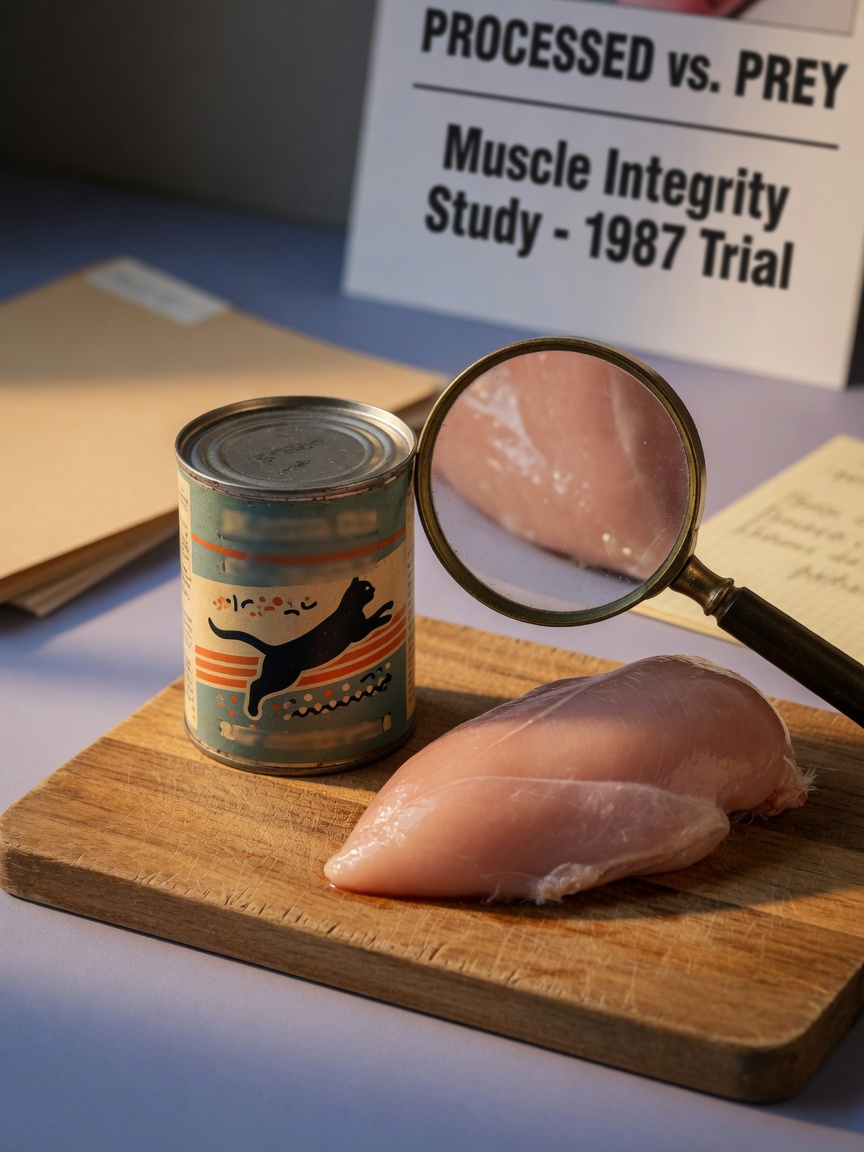
En 1987, le Dr Paul Pion et ses collègues de l'UC Davis ont publié une étude historique dans Science établissant un lien entre la CMD féline et de faibles concentrations plasmatiques de taurine. Ils ont découvert que les chats nourris avec des aliments pour chats préparés commercialement et traités thermiquement avaient des taux de taurine bien inférieurs à ceux des chats nourris avec des régimes à base de viande fraîche.
La cause était double : premièrement, les ingrédients protéiques d'origine végétale (courants dans les aliments commerciaux de l'époque) contenaient peu ou pas de taurine. Deuxièmement, le traitement thermique impliqué dans la production d'aliments pour chats en conserve et secs dégrade la taurine de manière significative. Certaines techniques de traitement thermique précoces détruisaient jusqu'à 50 % de la taurine présente dans les ingrédients crus.
En l'espace de quelques années après la découverte, l'industrie des aliments pour animaux de compagnie a reformulé ses produits pour y inclure une supplémentation en taurine, et l'AAFCO (the Association of American Feed Control Officials) a établi des exigences minimales en taurine pour les aliments pour chats. L'incidence de la CMD d'origine alimentaire chez les chats a chuté de manière spectaculaire — l'un des plus grands succès de santé publique de la nutrition vétérinaire.
Conséquences de la carence en taurine
Cardiomyopathie dilatée (CMD)
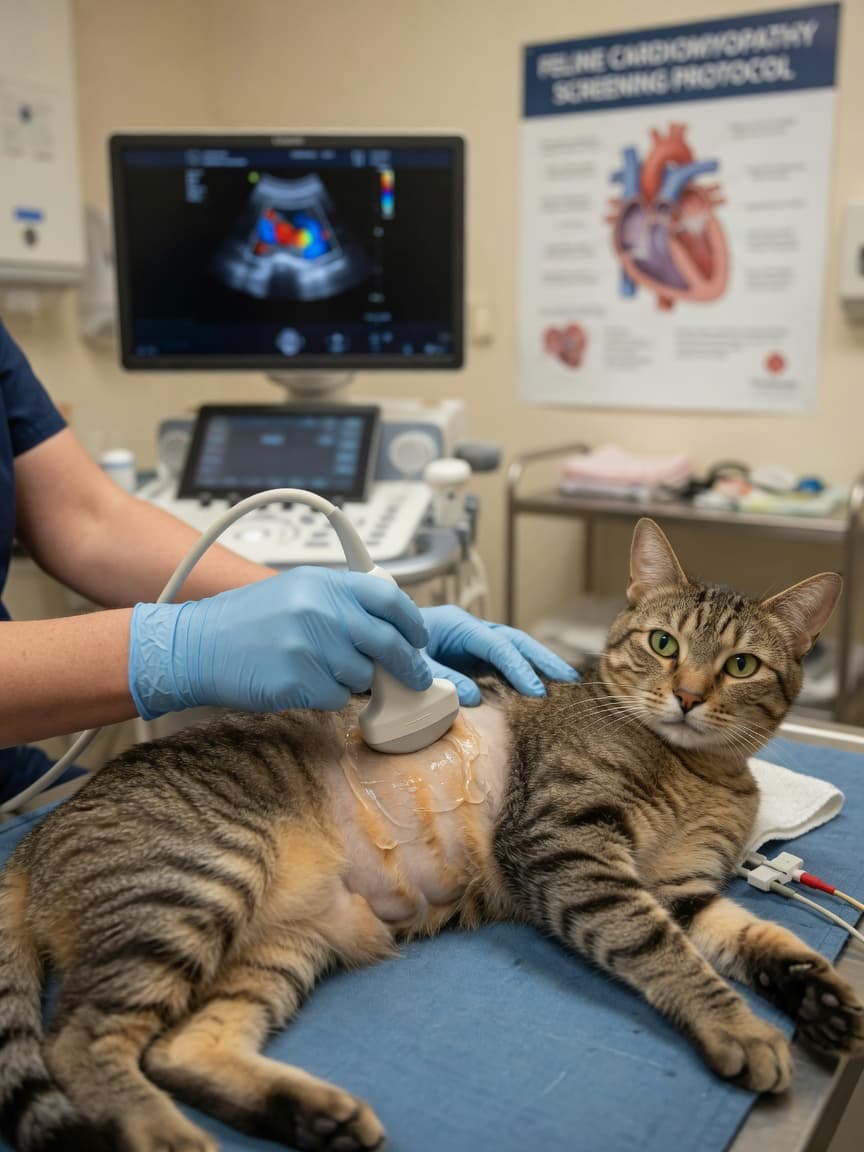
La CMD est la conséquence la plus dangereuse de la carence en taurine. Sans suffisamment de taurine pour réguler le mouvement du calcium dans les cardiomyocytes, le muscle cardiaque s'affaiblit progressivement. Les chats atteints développent une intolérance à l'effort, des difficultés respiratoires, une accumulation de liquide dans la poitrine (épanchement pleural), et peuvent mourir soudainement d'une arythmie ou d'une insuffisance cardiaque congestive. La bonne nouvelle : si elle est diagnostiquée avant des lésions irréversibles, la supplémentation en taurine peut inverser partiellement ou totalement la CMD chez les chats — un résultat remarquable pour une maladie cardiaque.
Dégénérescence rétinienne (dégénérescence rétinienne centrale féline, FCRD)
Les cellules photoréceptrices de la rétine figurent parmi les réserves de taurine les plus riches de l'organisme. La déplétion en taurine provoque la destruction progressive de ces cellules, commençant dans la rétine centrale (la zone de plus grande acuité visuelle). Les premiers signes comprennent la cécité nocturne et des pupilles dilatées ne réagissant pas à la lumière. Une carence avancée provoque une cécité complète et irréversible. Contrairement à la CMD, la dégénérescence rétinienne due à la carence en taurine n'est pas réversible une fois les photorécepteurs détruits.
Échec de la reproduction et anomalies du développement
Les chattes carencées en taurine connaissent des taux élevés d'échec de la reproduction : résorption fœtale, mortinaissances et mort néonatale. Les chatons nés de mères carencées en taurine présentent de graves anomalies du développement, notamment une hypoplasie cérébelleuse (sous-développement du cervelet, provoquant une ataxie et une mauvaise coordination), des déformations squelettiques et des déficits immunitaires. Les conséquences de la carence s'étendent sur plusieurs générations.
La taurine dans les aliments : sources animales vs sources végétales
Les tissus animaux contiennent de la taurine ; la matière végétale n'en contient essentiellement pas. C'est un point critique pour comprendre pourquoi les aliments pour chats riches en céréales ou en légumineuses sont plus susceptibles d'être insuffisants en taurine sans une supplémentation robuste.
| Ingrédient | Teneur en taurine (mg/100 g crus) | Notes |
|---|---|---|
| Palourdes (crues) | 240–520 | Parmi les sources naturelles les plus riches |
| Poulet cœur (cru) | 130–200 | Tissu cardiaque exceptionnellement riche en taurine |
| Bœuf (viande foncée, cru) | 40–80 | Source modérée ; diminue avec la cuisson |
| Poulet blanc (cru) | 18–30 | Inférieur à la viande brune ou aux abats |
| Saumon (cru) | 30–70 | Bonne source ; les taux varient selon l'espèce |
| Farine de poulet (extrudée) | 5–15 | Le traitement thermique détruit une quantité significative de taurine |
| Pois / lentilles (crus) | <1 | Négligeable — les protéines végétales n'en contiennent pratiquement pas |
| Gluten de maïs / de blé | 0 | Pas de taurine ; a historiquement contribué à l'épidémie de CMD |
Comment le traitement détruit la taurine
Les tissus animaux crus contiennent une quantité substantielle de taurine, mais le traitement commercial — en particulier les températures élevées impliquées dans l'extrusion des croquettes sèches et l'appertisation des aliments humides — la dégrade de manière significative. La réaction de Maillard (la même réaction de brunissement qui donne sa croûte au pain) consomme les acides aminés libres, y compris la taurine, les rendant biologiquement indisponibles. La cuisson entraîne également la taurine hydrosoluble dans les liquides de cuisson, qui sont souvent jetés.
C'est pourquoi la crise de CMD de 1987 s'est produite même chez des chats nourris avec des régimes commerciaux nominalement « à base de viande » : la taurine présente dans les ingrédients crus était substantiellement détruite avant que l'aliment n'atteigne jamais une gamelle.
Les fabricants modernes répondent en ajoutant de la taurine synthétique (issue de la synthèse chimique industrielle) directement aux produits finis. C'est sûr et efficace — la taurine de supplémentation est biodisponible — mais cela signifie que l'adéquation de la teneur en taurine d'un aliment commercial pour chats dépend entièrement de la quantité ajoutée lors de la formulation, et non de la liste des ingrédients crus à elle seule.
Exigences minimales de l'AAFCO
Les minimums actuels de l'AAFCO pour la taurine dans les aliments complets pour chats (sur une base de matière sèche) sont :
- Aliment sec pour chats : 0,10 % de taurine (1 000 mg/kg)
- Aliment en conserve/humide pour chats : 0,20 % de taurine (2 000 mg/kg) — plus élevé car la matrice humide et riche en protéines utilisée dans la mise en conserve réduit davantage la biodisponibilité de la taurine
De nombreux nutritionnistes considèrent ces minimums comme prudents et recommandent de rechercher des aliments qui les dépassent, en particulier pour les chats consommant des formules sans céréales riches en pois, lentilles ou pommes de terre — des ingrédients qui ont été associés à une absorption réduite de la taurine chez les chats comme chez les chiens.
Reconnaître les signes de carence en taurine
- Des difficultés respiratoires ou une respiration bouche ouverte au repos
- Une léthargie, une faiblesse ou un collapsus
- Une vision réduite, des heurts contre des objets, ou des pupilles dilatées en lumière vive
- Une respiration rapide, laborieuse ou anormale
- Une perte soudaine de coordination ou une faiblesse des membres postérieurs
Comment garantir un apport adéquat en taurine
- Donnez un aliment commercial pour chats complet selon l'AAFCO : Tout aliment portant la mention « complet et équilibré » de l'AAFCO pour les chats doit satisfaire aux exigences minimales en taurine. Ne donnez pas d'aliment pour chiens aux chats — il ne contient pas les taux de taurine requis.
- Si vous donnez des régimes faits maison : Travaillez avec un nutritionniste vétérinaire certifié. Les régimes faits maison sont l'une des méthodes d'alimentation les plus à risque de carence en taurine. Une supplémentation en taurine est presque toujours nécessaire.
- Si vous donnez des régimes crus : Incluez des ingrédients riches en taurine (cœur, fruits de mer) et envisagez une supplémentation si vous donnez des formules crues riches en végétaux.
- Évitez les aliments à dominante de protéines végétales : Les aliments sans céréales riches en pois et en lentilles ont été associés à des problèmes cardiaques chez les chats comme chez les chiens ; bien que le mécanisme ne soit pas entièrement élucidé, une biodisponibilité réduite de la taurine est une hypothèse dominante.
- La taurine est un acide aminé essentiel pour les chats ; contrairement aux chiens et à la plupart des mammifères, les chats ne peuvent pas la synthétiser en quantités suffisantes et doivent l'obtenir entièrement de leur alimentation.
- La carence en taurine provoque une cardiomyopathie dilatée (CMD), une dégénérescence rétinienne menant à la cécité, et un échec de la reproduction — toutes des affections graves et potentiellement irréversibles.
- La découverte de 1987 établissant un lien entre les aliments commerciaux pour chats et la CMD a conduit à une reformulation à l'échelle de l'industrie et aux normes minimales de l'AAFCO, réduisant de manière spectaculaire les maladies liées à la carence.
- Les protéines animales sont riches en taurine ; les protéines végétales n'en contiennent pratiquement pas. Le traitement à haute température détruit une grande partie de la taurine des ingrédients crus.
- Les minimums de l'AAFCO sont de 0,10 % pour les aliments secs et de 0,20 % pour les aliments humides (base matière sèche). Tout aliment commercial pour chats complet selon l'AAFCO doit satisfaire à ces normes.
- Ne donnez jamais d'aliment pour chiens aux chats, et consultez toujours un nutritionniste vétérinaire avant de donner des régimes faits maison ou crus afin de garantir un apport adéquat en taurine.
- Pion PD, Kittleson MD, Rogers QR, Morris JG. Myocardial failure in cats associated with low plasma taurine: a reversible cardiomyopathy. Science. 1987;237(4816):764–768. PMID: 2886923
- Sturman JA. Taurine in development. Physiol Rev. 1993;73(1):119–147. PMID: 8419962
- Backus RC, Cohen G, Pion PD, Rogers QR, Morris JG, Fascetti AJ. Taurine deficiency in Newfoundlands fed commercially available complete-and-balanced diets. J Am Vet Med Assoc. 2003;223(8):1130–1136. PMID: 14584729