
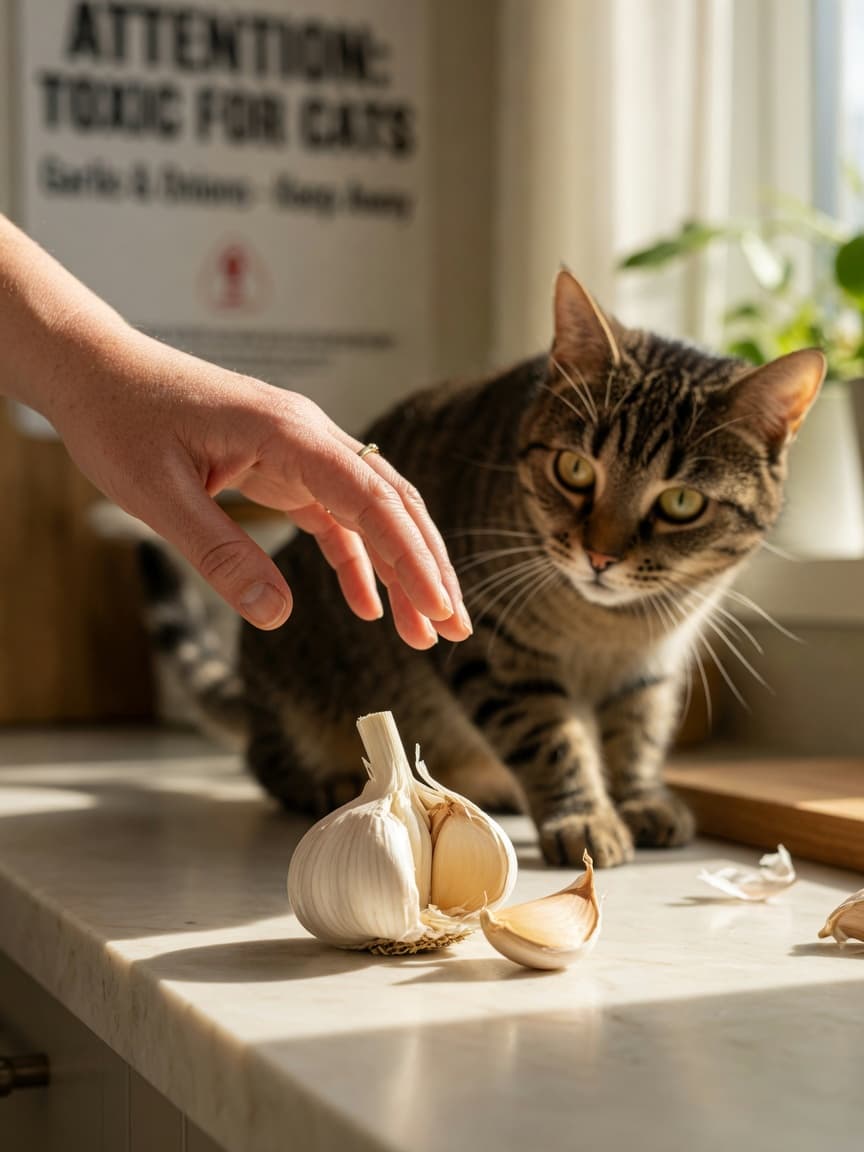
¿Pueden los gatos comer ajo? No — es extremadamente tóxico y puede ser mortal
El ajo es uno de los alimentos más peligrosos que puedes dar a un gato. Es 5 veces más tóxico para los gatos que para los perros por unidad de peso corporal. Incluso una cantidad minúscula — un solo diente, una pizca de ajo en polvo o comida con sabor a ajo — puede desencadenar una anemia hemolítica potencialmente mortal. Si tu gato ha comido cualquier forma de ajo, llama a tu veterinario o al ASPCA Animal Poison Control Center de inmediato: (888) 426-4435. No esperes a que aparezcan los síntomas. El tiempo es crítico.
El ajo pertenece a la familia de plantas Allium, junto con las cebollas, los puerros, el cebollino y las chalotas. Aunque los humanos han utilizado el ajo con fines medicinales y culinarios durante miles de años, este bulbo constituye una auténtica emergencia para los gatos. A pesar de los viejos mitos que circulan en internet de que el ajo puede «desparasitar» a los gatos o reforzar su inmunidad, ninguna evidencia científica respalda estas afirmaciones, y actuar según ellas puede matar a tu gato.
Este artículo explica exactamente por qué el ajo es tan peligroso, qué ocurre en el interior del organismo de tu gato tras la ingestión, qué síntomas vigilar y qué debes hacer si tu gato ha estado expuesto.
¿Por qué es el ajo tan tóxico para los gatos? El mecanismo de intoxicación
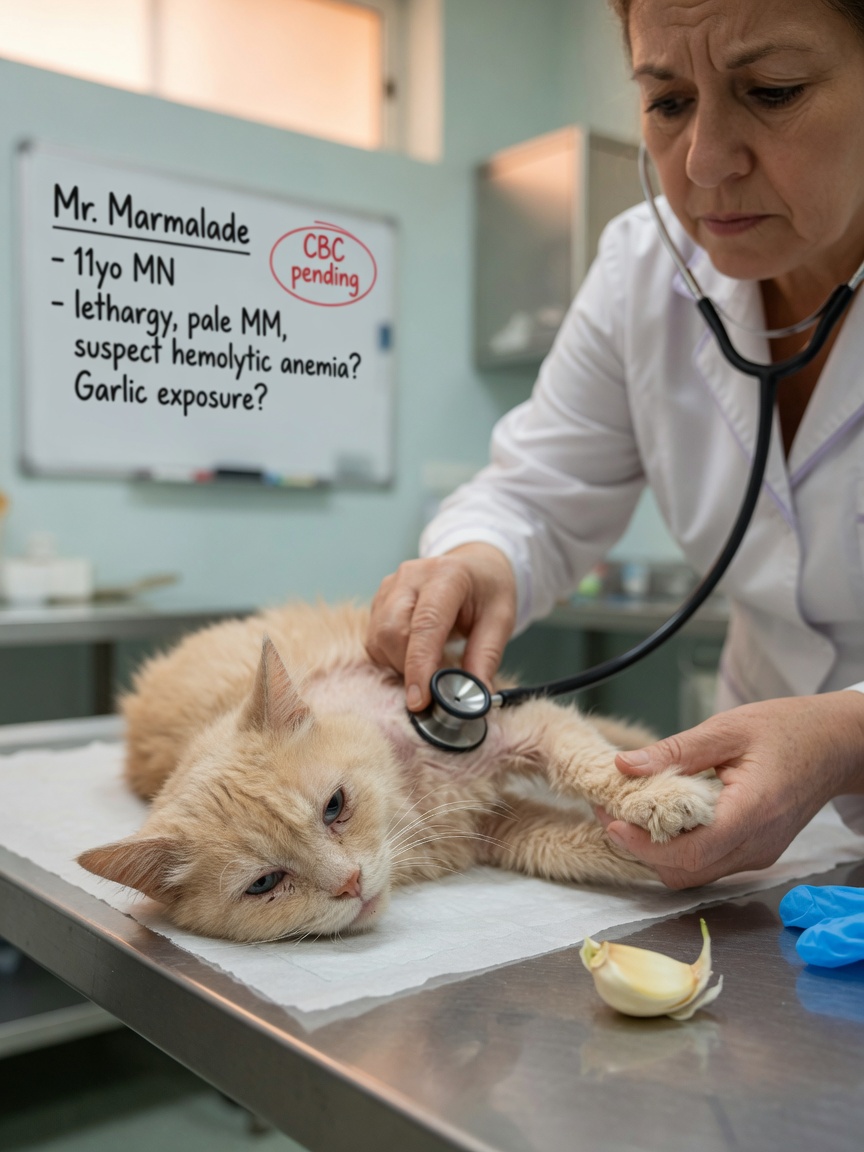
La toxicidad del ajo en los gatos se debe a un compuesto químico específico: el N-propyl disulfide (también llamado tiosulfato). Este compuesto organosulfurado se encuentra en toda la planta del ajo: en la pulpa, la piel, el jugo y el polvo. Cuando los gatos ingieren ajo, el N-propyl disulfide entra en el torrente sanguíneo y empieza a interferir con los glóbulos rojos de un modo catastróficamente peligroso.
Esto es lo que ocurre a nivel celular: el N-propyl disulfide se une a las moléculas de hemoglobina del interior de los glóbulos rojos. La hemoglobina es la proteína responsable de transportar el oxígeno por todo el organismo. Una vez unida por el N-propyl disulfide, la hemoglobina se oxida: queda dañada y estructuralmente deformada. El sistema inmunitario del gato reconoce entonces estos glóbulos rojos dañados como invasores extraños y los destruye.
Esta destrucción de los glóbulos rojos se denomina hemólisis, y la afección resultante se conoce como anemia hemolítica por cuerpos de Heinz. El nombre proviene de los «cuerpos de Heinz»: acúmulos de hemoglobina desnaturalizada que se forman en el interior de los glóbulos rojos dañados y son visibles al microscopio. Los gatos son especialmente vulnerables a la formación de cuerpos de Heinz porque la hemoglobina felina tiene una estructura molecular única con más grupos sulfhidrilo que la hemoglobina del perro o del ser humano, lo que la hace mucho más susceptible al daño oxidativo.
A medida que los glóbulos rojos se destruyen más rápido de lo que la médula ósea puede reponerlos, el gato desarrolla una anemia grave. Sin suficientes glóbulos rojos funcionales, el organismo no puede suministrar oxígeno a los órganos y los tejidos. Los órganos empiezan a fallar. Sin tratamiento veterinario de urgencia, este proceso puede ser mortal.
Todas las formas de ajo son peligrosas — no existe ninguna cantidad segura
Una de las cosas más importantes que deben comprender los dueños de gatos es que todas las formas de ajo son tóxicas. No hay ningún método de preparación que elimine el peligro:
- Ajo crudo — la forma más inmediatamente tóxica
- Ajo cocinado — cocinar NO destruye el N-propyl disulfide
- Ajo en polvo — altamente concentrado y extremadamente peligroso; una fracción de una cucharadita puede ser una dosis letal
- Ajo deshidratado o seco — igualmente concentrado
- Suplementos de ajo o aceites infusionados con ajo — comercializados para mascotas por vendedores irresponsables, son realmente potencialmente mortales
- Ajo en comida humana cocinada — las salsas, sopas, caldos o platos de carne que contengan ajo no son seguros para compartir con tu gato
El ajo en polvo merece un énfasis especial. Al estar deshidratado, el ajo en polvo está muchísimo más concentrado que el ajo crudo. Un pequeño espolvoreado de ajo en polvo representa el equivalente en toxina de varios dientes crudos. Si tu gato lame un plato o una encimera donde se haya usado ajo en polvo, o come cualquier alimento condimentado con él, se trata de una emergencia veterinaria.
Síntomas de la intoxicación por ajo en gatos
La intoxicación por ajo no siempre provoca síntomas inmediatos, lo que la hace especialmente insidiosa. La anemia puede tardar de 2 a 4 días en desarrollarse tras la ingestión. Cuando aparecen los síntomas visibles, el daño a los glóbulos rojos suele ser ya grave. Vigila cualquiera de las siguientes señales de alarma:
- Letargo y debilidad extrema — tu gato, normalmente activo, de repente no puede mantenerse en pie o parece agotado
- Encías pálidas, blancas o amarillentas — las encías de un gato sano deben ser rosadas; la decoloración indica anemia grave
- Respiración rápida o dificultosa — el organismo intenta compensar la falta de oxígeno respirando más rápido
- Frecuencia cardíaca elevada
- Pérdida de apetito y vómitos
- Orina oscura, anaranjada o con tinte rojizo — causada por la hemoglobina liberada de los glóbulos rojos destruidos
- Colapso o falta de respuesta — una emergencia extrema que requiere intervención inmediata
No esperes a ver si los síntomas se resuelven por sí solos. Si tu gato ha comido ajo en cualquier cantidad y forma, llama al centro de control de intoxicaciones o a tu veterinario ahora mismo, incluso antes de que aparezcan los síntomas. La descontaminación precoz — inducir el vómito en las primeras horas — puede salvar la vida de tu gato. Esperar a que aparezcan los síntomas significa que la anemia ya está en marcha.
El ajo es 5 veces más tóxico para los gatos que para los perros
Muchos dueños de mascotas saben que el ajo es peligroso para los perros, pero lo que quizá no sepan es que los gatos son aproximadamente 5 veces más sensibles a la toxicidad del ajo por unidad de peso corporal en comparación con los perros. Esto se debe a la bioquímica única de los glóbulos rojos felinos. Los grupos sulfhidrilo de la hemoglobina felina reaccionan más fácilmente con los compuestos de tiosulfato del ajo, lo que significa que una dosis que podría causar una enfermedad leve en un perro puede ser mortal en un gato.
El pequeño tamaño corporal de un gato agrava este riesgo. Un gato de 4 kg podría sufrir una anemia hemolítica grave al ingerir menos de un solo diente de ajo. Este no es un alimento del que un pequeño bocado pueda considerarse «probablemente está bien». No puede.
Qué hacer si tu gato ha comido ajo — actúa de inmediato
Se trata de una emergencia en la que el tiempo es crucial. Sigue estos pasos sin demora:
- No induzcas el vómito por tu cuenta sin orientación veterinaria — algunos métodos usados en humanos pueden dañar a los gatos.
- Llama al ASPCA Animal Poison Control Center: (888) 426-4435. Esta línea está atendida las 24 horas del día, los 365 días del año, por toxicólogos veterinarios. Puede haber una tarifa de consulta.
- Llama a tu clínica veterinaria de urgencias más cercana y describe exactamente qué ha comido tu gato, cuánto y hace cuánto tiempo.
- Lleva el envase del ajo o una muestra del alimento que haya ingerido tu gato: las listas de ingredientes ayudan al veterinario a evaluar la dosis.
- No des a tu gato ningún remedio casero, leche u otros alimentos mientras esperas la atención veterinaria.
El tratamiento en la clínica veterinaria puede incluir vómito inducido (si la ingestión ha sido muy reciente), carbón activado para reducir la absorción, fluidos intravenosos, transfusiones de sangre en casos graves y cuidados de apoyo para ayudar a la médula ósea a recuperarse.
- El ajo es uno de los alimentos más tóxicos para los gatos: más peligroso que para los perros.
- La toxina N-propyl disulfide destruye los glóbulos rojos y provoca anemia hemolítica.
- Todas las formas son tóxicas: crudo, cocinado, en polvo, suplementos, ajo en salsas.
- Los síntomas pueden no aparecer durante 2–4 días, pero el daño comienza de inmediato.
- Cualquier exposición al ajo = emergencia veterinaria. Llama al (888) 426-4435 o a tu veterinario ahora.
- Nunca des suplementos de ajo a los gatos: estos productos son peligrosos independientemente de las afirmaciones de marketing.
Alternativas seguras: qué puedes dar de comer a tu gato
La dieta de tu gato debe consistir principalmente en alimento comercial para gatos de alta calidad formulado para satisfacer las necesidades nutricionales felinas. Los gatos son carnívoros estrictos: necesitan proteínas de origen animal y no pueden sintetizar ciertos nutrientes esenciales (como la taurina y el ácido araquidónico) a partir de fuentes vegetales. Una dieta comercial equilibrada proporciona todo lo que tu gato necesita sin el riesgo de exposición tóxica.
Si quieres complementar la dieta de tu gato con golosinas seguras, busca productos formulados específicamente para gatos, que no contengan ingredientes de Allium y que estén libres de conservantes artificiales que podrían ser perjudiciales con el tiempo.
Ver alimentos para gatos en Zooplus →Elegir un alimento recomendado por veterinarios y adecuado a la especie es lo mejor que puedes hacer para proteger la salud de tu gato, y para asegurarte de que nunca esté expuesto accidentalmente a ingredientes tóxicos ocultos como el ajo.
Referencias y lecturas adicionales
- Cope RB. "Allium species poisoning in dogs and cats." Vet Med. 2005;100(8):562–566.
- Kovalkovicova N, Sutiakova I, Pistl J, Sutiak V. "Some food toxic for pets." Interdiscip Toxicol. 2009;2(3):169–76. PMID: 21217842
- Lee KW, Yamato O, Tajima M, et al. "Hematologic changes associated with the appearance of eccentrocytes after intragastric administration of garlic extract to dogs." Am J Vet Res. 2000;61(6):582–8. PMID: 10850838