
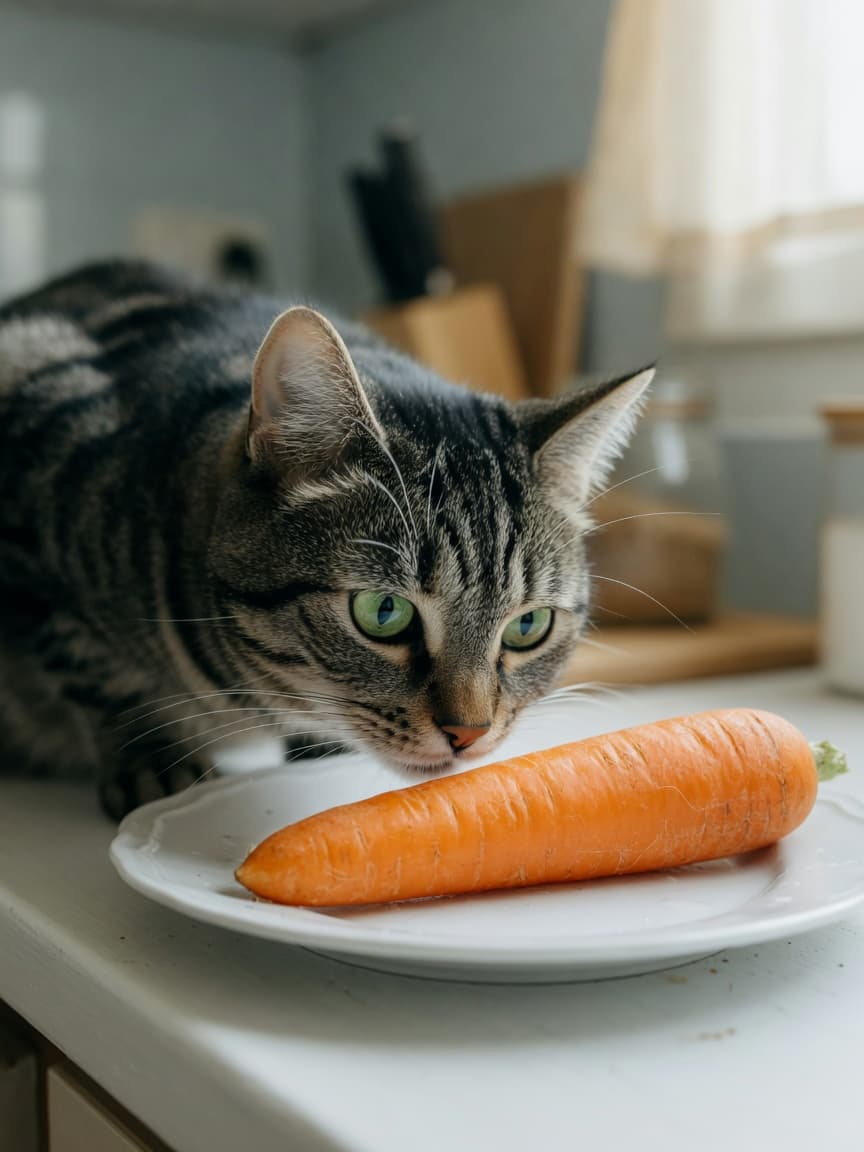
¿Pueden comer zanahorias los gatos? La verdad sobre los gatos y las verduras
Las zanahorias tienen una excelente reputación en la nutrición humana — y con razón. Están llenas de betacaroteno, fibra y una variedad de vitaminas y minerales. Si estás comiendo zanahorias regularmente, podría parecer lógico compartir un trozo con tu gato. La buena noticia es que las zanahorias no son tóxicas para los gatos. La noticia más importante es que los gatos y las zanahorias ocupan mundos metabólicos completamente diferentes, y lo que te beneficia sustancialmente hará muy poco por tu compañero felino.
Los gatos son carnívoros obligados — Y eso lo cambia todo
El hecho fundamental de la nutrición felina es que los gatos son carnívoros obligados. Esto significa que todo su sistema metabólico evolucionó alrededor del consumo de presas animales. A diferencia de los omnívoros como los humanos, los perros y los osos, los gatos han perdido la capacidad enzimática de convertir eficientemente muchos nutrientes basados en plantas en las formas que sus cuerpos pueden utilizar. No es una cuestión de preferencia — es genética y fisiología.
Uno de los ejemplos más claros de esto es el metabolismo de la vitamina A. En los humanos y muchos omnívoros, el betacaroteno de las fuentes vegetales se divide por la enzima beta-caroteno dioxigenasa para producir retinol (la forma activa de la vitamina A). Los gatos tienen niveles extremadamente bajos de esta enzima y no pueden realizar esta conversión eficientemente. Dependen completamente de la vitamina A preformada — retinol — que se encuentra exclusivamente en los tejidos animales, particularmente en el hígado.
Esto significa que las zanahorias, una de las fuentes vegetales más ricas en betacaroteno, ofrecen a los gatos esencialmente nada en términos de vitamina A. El nutriente por el que las zanahorias son famosas es en gran medida inaccesible para el metabolismo felino.
¿Qué hay de los otros nutrientes en las zanahorias?
Las zanahorias también contienen fibra, potasio, vitamina C y vitamina K. Aquí nuevamente, el contexto importa para los gatos:
- Vitamina C: A diferencia de los humanos, los gatos sintetizan su propia vitamina C en el hígado. No necesitan obtenerla de los alimentos. El contenido de vitamina C de las zanahorias es nutricionalmente irrelevante para un gato.
- Fibra: Un poco de fibra puede ser beneficiosa para gatos con ciertos problemas digestivos, particularmente estreñimiento. Sin embargo, los gatos obtienen fibra más apropiadamente calibrada del pienso para gatos comercial diseñado para la salud digestiva — no de verduras crudas.
- Potasio: Los gatos necesitan potasio, pero lo obtienen fácilmente de las dietas basadas en carne. La pequeña cantidad en un trozo de zanahoria es insignificante en el contexto de la dieta total de un gato.
- Carbohidratos: Las zanahorias se componen principalmente de carbohidratos y agua. Los gatos tienen una capacidad limitada para digerir carbohidratos en comparación con los omnívoros; sus enzimas digestivas están adaptadas para proteínas y grasas, no para almidón y azúcar.
El riesgo de asfixia con zanahorias crudas
Las zanahorias crudas son firmes y crujientes — perfectas para un snack humano, pero potencialmente problemáticas para un gato pequeño. La mandíbula de un gato está diseñada para desgarrar carne, no para moler material vegetal duro. Los molares de los gatos carecen de la superficie plana de molienda que se encuentra en los herbívoros y omnívoros. Un trozo grande de zanahoria cruda podría presentar un riesgo de asfixia, particularmente en gatos pequeños o gatos mayores con problemas dentales.
Si optas por ofrecer a tu gato zanahoria, cocínala primero hasta que sea lo suficientemente blanda para aplastarla entre los dedos. Cocinar al vapor o hervir sin sal ni condimentos añadidos es el método más seguro. Déjala enfriar a temperatura ambiente antes de ofrecerla. Córtala en trozos muy pequeños y manejables.
Ver alimentos para gatos en Zooplus →Por qué algunos gatos muestran interés en las zanahorias
Algunos gatos muestran curiosidad por las zanahorias. Esto no es porque su cuerpo les esté diciendo que necesitan algo en la zanahoria — los gatos carecen del receptor de sabor dulce que haría que una verdura harinosa sea atractiva. Es más probable que un gato investigando una zanahoria esté respondiendo al olor, a la novedad de la textura, o simplemente imitando el comportamiento humano que ha observado. Los gatos son animales curiosos, y la novedad a menudo impulsa el comportamiento investigador independientemente de la necesidad nutricional.
Si tu gato olfatea una zanahoria y luego se va, eso es completamente típico. Si tu gato parece genuinamente interesado y muerde un pequeño trozo de zanahoria cocida, eso también está bien — simplemente no está haciendo mucho por su salud de ninguna manera.
¿Hay algún beneficio en absoluto?
En escenarios estrechos y específicos, hay un beneficio menor que vale la pena mencionar. La zanahoria cocida proporciona una pequeña cantidad de fibra soluble que puede apoyar suavemente la motilidad intestinal en un gato propenso al estreñimiento leve. Sin embargo, si tu gato tiene un problema digestivo crónico, este es un asunto para la orientación veterinaria — no para suplementación con zanahoria. Hay piensos para gatos comerciales y alimentos veterinarios
```