
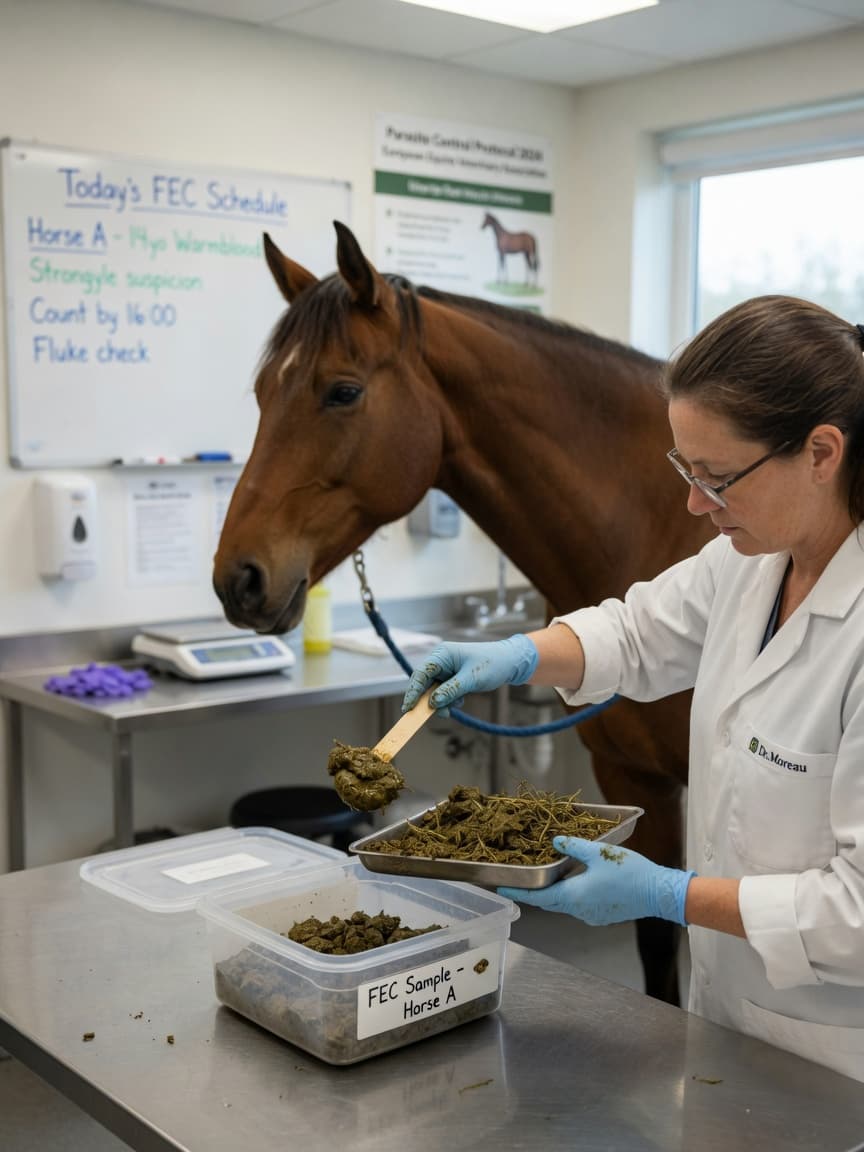
Why Blanket Worming No Longer Works
For decades, horse owners were advised to worm every horse every six to eight weeks, rotating between drug classes each time. That approach made sense when anthelmintic resistance was not widely understood. Today, resistance in equine parasites — particularly small redworms — is so widespread that blanket treatment is not only wasteful but actively accelerates the problem. Treating horses that carry a low worm burden contributes nothing to their health and removes the susceptible parasite population that otherwise dilutes resistant worms in the environment.
The modern standard, now promoted by equine vets and organisations including the British Equine Veterinary Association, is targeted selective treatment. Under this model, only horses with a clinical need are treated. That need is determined by diagnostic testing, not the calendar.
Understanding Worm Egg Counts
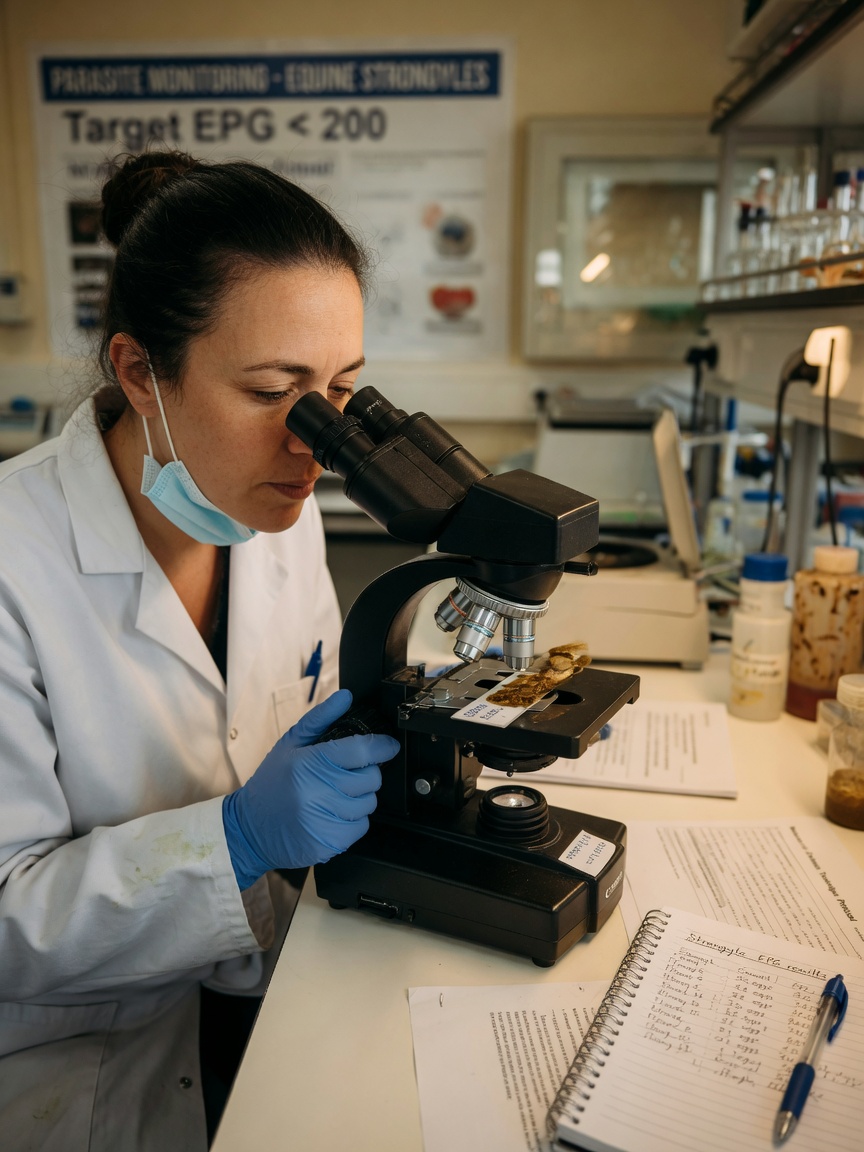
A worm egg count (WEC) is performed on a fresh dung sample collected from your horse. A laboratory technician examines the sample under a microscope and counts the number of strongyle eggs per gram (EPG). The result tells you whether your horse is shedding eggs into the pasture at a level that warrants treatment.
- Below 200 EPG: low shedder — treatment generally not required during the grazing season
- 200–500 EPG: moderate shedder — treat and retest
- Above 500 EPG: high shedder — treatment indicated and pasture management review recommended
Roughly 20 per cent of horses on a yard account for 80 per cent of egg output. Identifying these individuals and targeting treatment at them — while leaving low shedders untreated — is the core principle of targeted worming. Low shedders should still be tested at least twice a year, and all horses require strategic treatment for parasites that WEC does not detect.
The CANTER Programme
The CANTER (Controlling ANThelmintic resistance in Equines through Responsible use) programme provides a practical framework for equine parasite management in the UK. It encourages owners and vets to work together to test before treating, record all treatments and test results, and assess pasture contamination risk. The underlying goals are to preserve the effectiveness of the anthelmintic drugs that remain active, reduce unnecessary chemical use on horses and in the environment, and improve health outcomes by focusing intervention where it is genuinely needed.
Your vet can help you build an annual plan based on your horse's test history, yard management, and the time of year.
Strategic Treatments: When Testing Is Not Enough
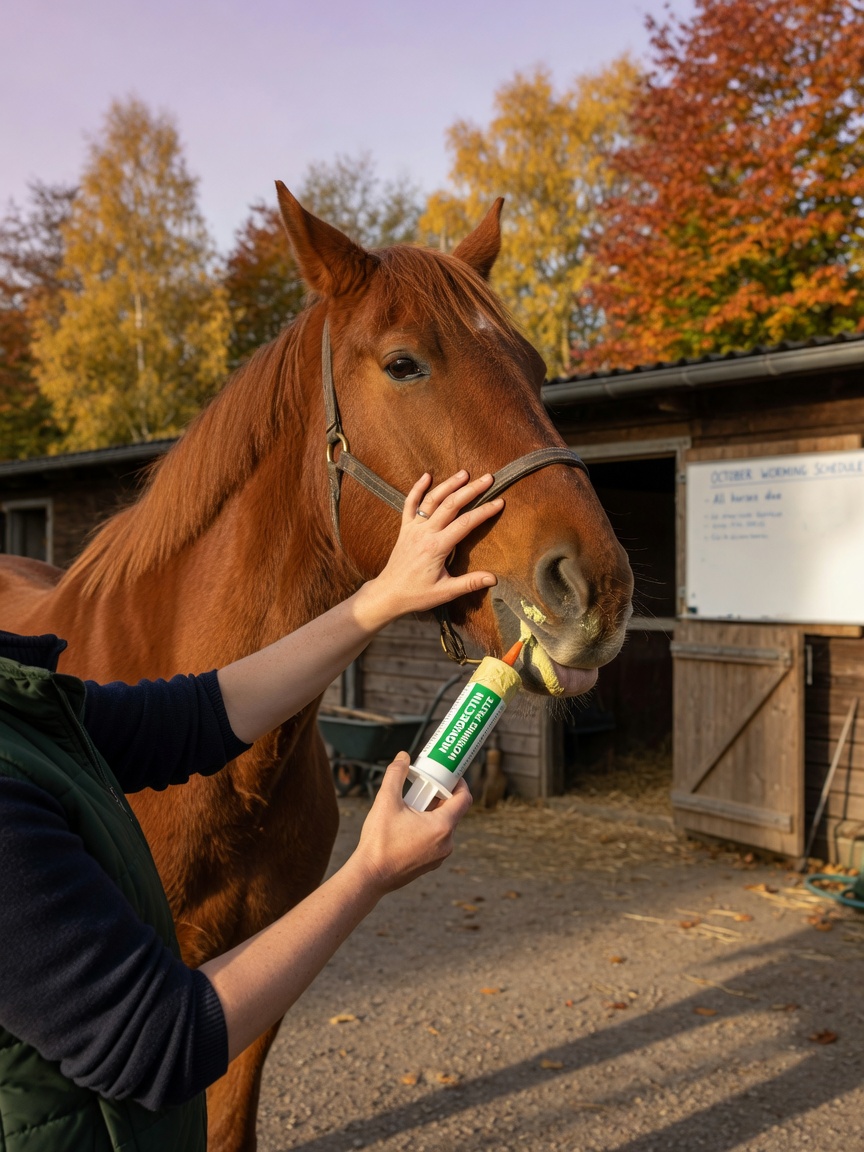
Targeted selective treatment covers strongyle egg shedding during the grazing season, but certain parasites require strategic treatment at specific times regardless of egg count results.
Small Redworms (Cyathostomins)
Cyathostomins are the most significant equine parasite in the UK. Their larvae can encyst in the gut wall over winter, emerging in large numbers in late winter or spring and causing larval cyathostominosis — a potentially fatal condition involving severe diarrhoea, weight loss, and colic. All horses should receive a moxidectin-based treatment in late autumn or early winter to target these encysted larvae, as no other licensed drug class is effective against them at this stage.
Large Redworm (Strongylus vulgaris)
Once the most dangerous equine parasite, Strongylus vulgaris is now much less common due to decades of worming, but it has not been eliminated. Its larvae migrate through blood vessels and can cause severe colic and arterial damage. Testing for S. vulgaris larvae requires a specific blood test rather than a standard WEC, and affected horses require prompt treatment with ivermectin or moxidectin.
Tapeworm (Anoplocephala perfoliata)
Tapeworm eggs are not reliably detected by standard WEC because they are shed intermittently. The EquiSal saliva test is a non-invasive, validated method for detecting tapeworm antibodies, offering a more accurate picture of burden than a blood test or egg count. Horses with moderate or high results should be treated with a praziquantel-based product or a double dose of pyrantel. Treatment is typically recommended in spring and autumn.
Bots (Gasterophilus spp.)
Bot flies lay yellow eggs on the horse's coat, particularly on the legs and shoulders, from late summer onwards. The larvae are swallowed and spend winter in the stomach. A single ivermectin or moxidectin treatment after the first frost — when adult bot flies have died — is sufficient to clear larvae before they cause gastric irritation.
Resistance Testing: DrenchRite and Faecal Egg Count Reduction
Knowing which drug classes are still effective on your yard is increasingly important. A faecal egg count reduction test (FECRT) involves counting eggs before treatment and again 14 days afterwards. A reduction of less than 95 per cent with ivermectin, or less than 90 per cent with benzimidazoles, suggests resistance. The DrenchRite larval development assay offers a more detailed in vitro picture of resistance across multiple drug classes from a single faecal sample, and is particularly useful when planning a yard-wide strategy.
Resistance to benzimidazoles (fenbendazole, oxibendazole) is now widespread. Resistance to pyrantel is increasing. Ivermectin and moxidectin retain good efficacy in most UK yards, but this must not be taken for granted.
Pasture Management
Treatment alone cannot control equine parasites. Larvae on pasture can survive for months in mild, moist conditions. Practical steps to reduce pasture contamination include removing dung at least twice weekly, avoiding overstocking, resting pasture where possible, and not spreading fresh manure on horse grazing land. Harrowing in hot, dry weather can help desiccate larvae but should not be used as a substitute for dung removal.
Building Your Annual Plan
A sensible annual worming programme for most adult horses in the UK involves WEC testing every three months during the grazing season, EquiSal testing for tapeworm in spring and autumn, a moxidectin treatment in late autumn targeting encysted cyathostomin larvae, and a post-frost treatment for bots. New arrivals to a yard should be treated on arrival with moxidectin plus praziquantel, then stabled for 48 hours before turnout to avoid introducing resistant worms. Work with an equine vet or suitably qualified person (SQP) to tailor this plan to your individual horse and management situation.