

Why Working Dogs Are More Vulnerable to Heat Than You Might Think
Dogs do not thermoregulate the way humans do. They have sweat glands only in their paw pads, which contribute negligibly to overall heat dissipation. Their primary cooling mechanism is panting — evaporative cooling from the respiratory tract — and it is far less efficient than sweating across a large body surface. Add physical exertion, warm ambient temperatures, humidity that limits evaporation, and the constant drive of a working dog that will not voluntarily stop, and you have conditions in which heat illness can escalate from mild to fatal in under an hour.
Hyperthermia in working dogs is not rare. It kills dogs at field trials, on hunting days, during police K9 operations, and at agility competitions every year. Unlike heatstroke in sedentary dogs left in hot cars, exertional hyperthermia occurs in dogs that are doing exactly what they are bred and trained to do. Preventing it is the handler's responsibility.
Understanding the Physiology of Heat Illness
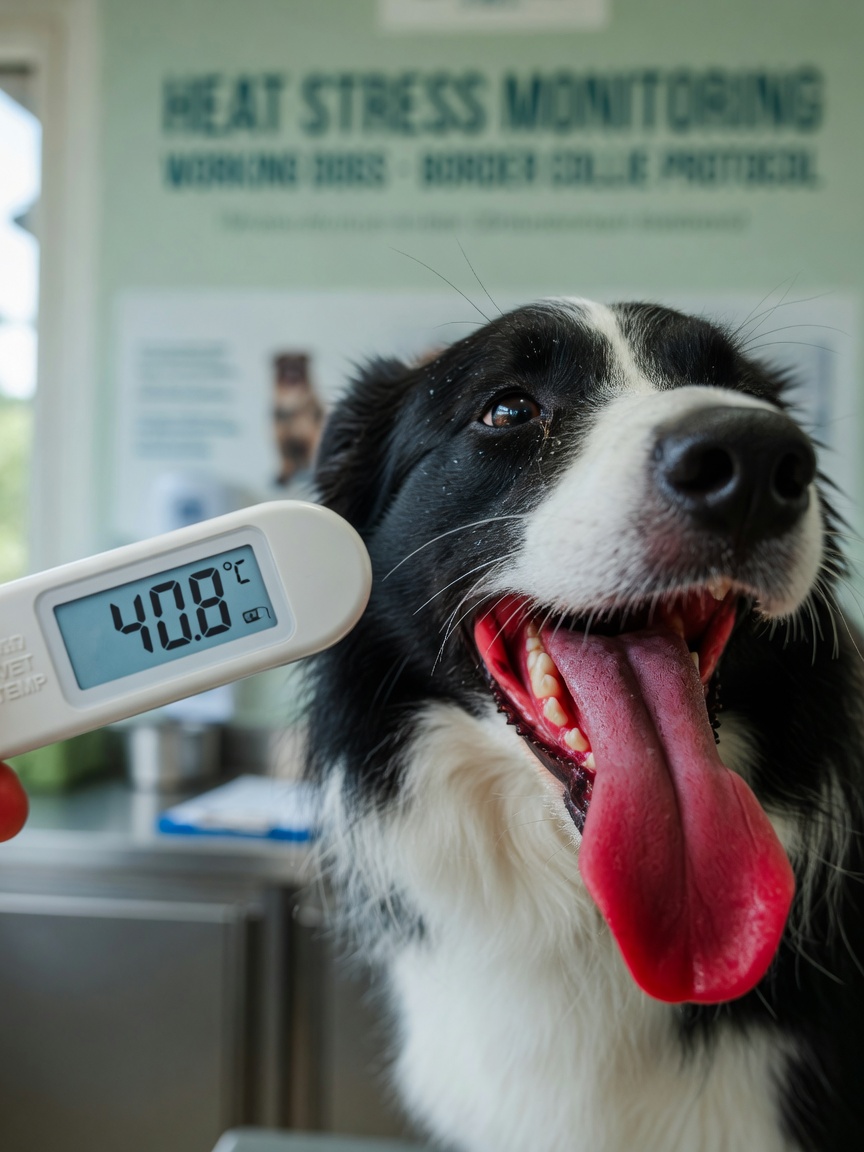
Normal canine body temperature ranges from approximately 38.0 to 39.2 degrees Celsius. During exercise, working muscles generate substantial heat, and core temperature rises. In a healthy, well-managed dog on a cool day, this rise is moderated and dissipated through panting, radiation from exposed skin around the ears and groin, and conduction when the dog rests on cool ground.
When the combination of environmental heat, humidity, and exertion exceeds the dog's capacity to dissipate heat, core temperature climbs above the normal range. At around 40.5 to 41.0 degrees Celsius, early signs of heat stress appear. Above 41.5 degrees Celsius, cellular damage begins. Above 43 degrees Celsius, multi-organ failure becomes a serious risk. Proteins denature, the blood-brain barrier is compromised, coagulation is disrupted, and the gastrointestinal tract becomes permeable to bacterial translocation.
The speed of this progression is the critical danger. A working dog can move from normal to dangerously hyperthermic in 20 to 30 minutes in the wrong conditions.
Risk Factors That Compound Vulnerability
Not all dogs face equal risk. Several factors significantly increase susceptibility to exertional hyperthermia:
- Brachycephalic anatomy: flat-faced breeds have a structurally compromised airway that limits panting efficiency, but even non-brachycephalic working breeds are at significant risk during high exertion
- Obesity: excess body fat insulates against heat dissipation and increases metabolic heat generation
- Poor conditioning: unfit dogs generate more metabolic heat for a given work output than well-conditioned dogs
- Dark or dense coat: absorbs more radiant heat from the sun
- Dehydration: even mild dehydration reduces evaporative cooling efficiency
- High humidity: limits the evaporation that makes panting effective
- Previous heatstroke: dogs that have experienced hyperthermia are at increased risk of subsequent episodes, possibly due to lasting effects on thermoregulatory mechanisms
Recognising Heat Stress and Heat Stroke
Early recognition is everything. Handlers who can identify heat stress before it progresses to heat stroke have a much higher chance of preventing serious harm. Signs present in a rough progression:
- Excessive panting that seems disproportionate to workload or conditions
- Reduced willingness to continue working — a drive-bred dog slowing down voluntarily is a significant warning sign
- Excessive salivation and thick, ropey saliva
- Elevated heart rate that fails to reduce with brief rest
- Mucous membranes that are bright red or brick red rather than pink
- Stumbling, apparent disorientation, or weakness in the hindquarters
- Vomiting or diarrhoea, which may be bloody in severe cases
- Collapse or seizures — at this point the situation is immediately life-threatening
Emergency Field Response
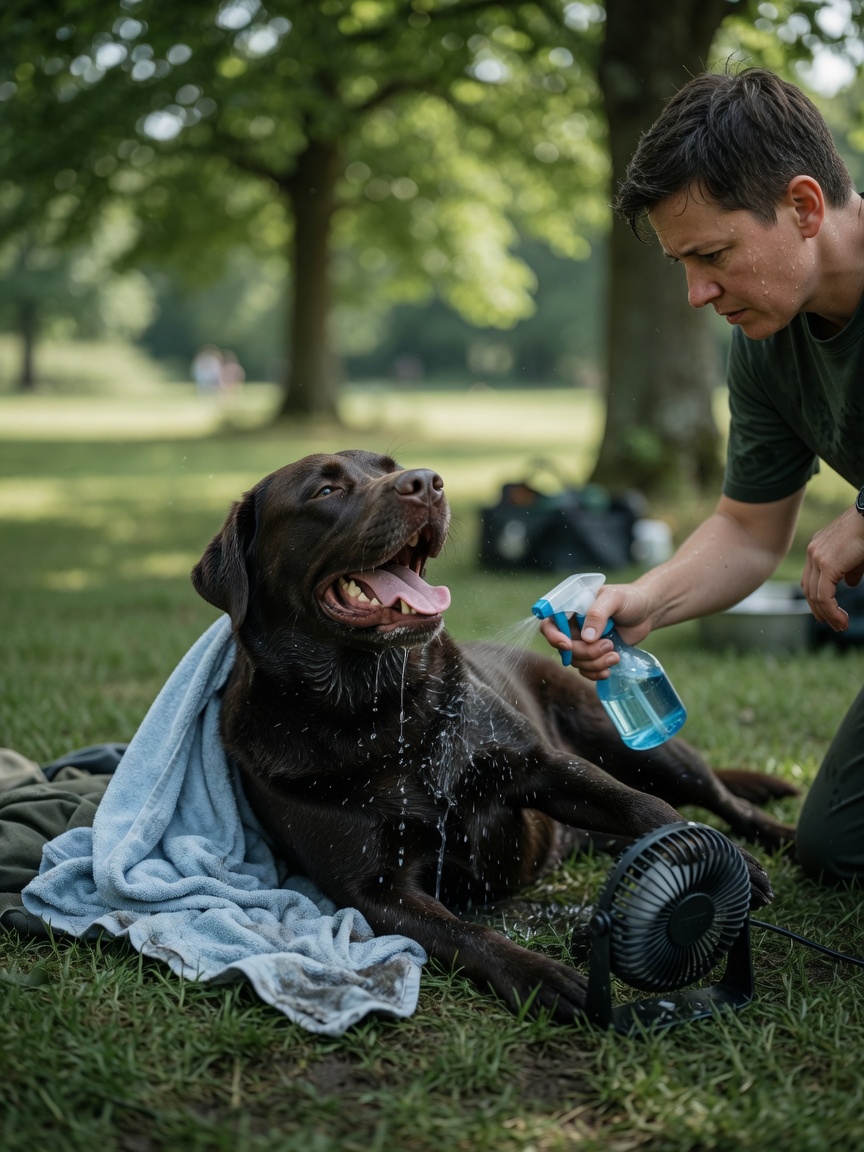
If you suspect a working dog is experiencing hyperthermia, act immediately. Do not wait to see if the dog improves on its own. The goal is rapid cooling to below 39.5 degrees Celsius, then stopping active cooling to prevent overcorrection into hypothermia.
Move the dog to shade immediately. Apply cool — not ice cold — water to the body, particularly to the neck, armpits, groin, and paw pads where blood vessels are close to the surface. Wet towels can be applied but must be replaced frequently as they absorb body heat and become counterproductive if left in place. If available, a fan directed at the wetted dog dramatically increases evaporative cooling.
Ice-cold water applied directly to the entire body is controversial. Some research suggests it can cause peripheral vasoconstriction that reduces heat dissipation. Cool water — between approximately 15 and 25 degrees Celsius — is more effective and safer. Allowing the dog to drink small amounts of cool water if conscious is appropriate. Do not force water on an unconscious or distressed dog.
Transport to a veterinary facility immediately, even if the dog appears to recover. Internal organ damage from hyperthermia can develop over the 24 to 72 hours following the event and is not always externally apparent.
Prevention Strategies for Working Conditions
Prevention requires planning before, during, and after every working day in warm conditions.
- Monitor the temperature-humidity index (THI): at a THI above 80, consider modifying work intensity and duration significantly. At a THI above 88, working dogs in sustained exertion is high risk
- Work during cooler parts of the day: early morning and evening are substantially safer in warm weather
- Pre-hydrate: ensure dogs are well hydrated before work begins, not just during it
- Build in rest and shade breaks: enforce rest every 20 to 30 minutes in warm conditions, regardless of the dog's apparent willingness to continue
- Use cooling vests or jackets: phase-change cooling vests and water-soaked cooling wraps have demonstrated benefit in maintaining lower core temperatures during work
- Acclimatise to heat gradually: dogs need 10 to 14 days of graduated exposure to heat before their physiological thermoregulation adapts to warmer working conditions
- Know your individual dog: some dogs run hotter than others. Learn your dog's individual baseline and warning signs
The working drive that makes sporting and field dogs exceptional at their jobs also makes them a risk to themselves in hot conditions. They will not stop voluntarily. The handler must do it for them.