
Dog Heatstroke: Signs, Emergency Treatment & Prevention
By Julia Wrenfield, Pet Wellness Researcher
Heatstroke — clinically termed hyperthermia — occurs when a dog's body temperature rises beyond what normal physiological mechanisms can correct. Unlike humans, dogs rely almost entirely on panting to dissipate heat. On a hot, humid day, panting becomes inadequate very quickly, and core temperature can spike to fatal levels in under 15 minutes. Understanding the warning signs and knowing the correct cooling protocol can save your dog's life.
Warning Signs of Heatstroke in Dogs
Symptoms progress rapidly. Early recognition is critical.
Early / Moderate Signs
- Excessive, rapid panting — more frantic than normal
- Thick, ropy saliva
- Bright red gums and tongue
- Restlessness or agitation
- Increased heart rate
- Mild weakness or stumbling
Severe / Critical Signs
- Gums turning pale, grey, or bluish-purple
- Vomiting or diarrhoea (sometimes bloody)
- Marked weakness, inability to stand
- Disorientation, glassy eyes, confusion
- Muscle tremors or seizures
- Collapse and loss of consciousness
Brachycephalic breeds (Bulldogs, Pugs, French Bulldogs, Boxers), obese dogs, elderly dogs, and puppies reach the critical stage faster than healthy adult dogs.
Emergency Treatment: Step-by-Step Cooling Protocol
Step 1 — Move the Dog Immediately
Get the dog out of the hot environment right now. Move to a shaded, air-conditioned space. Every second of continued heat exposure worsens the prognosis.
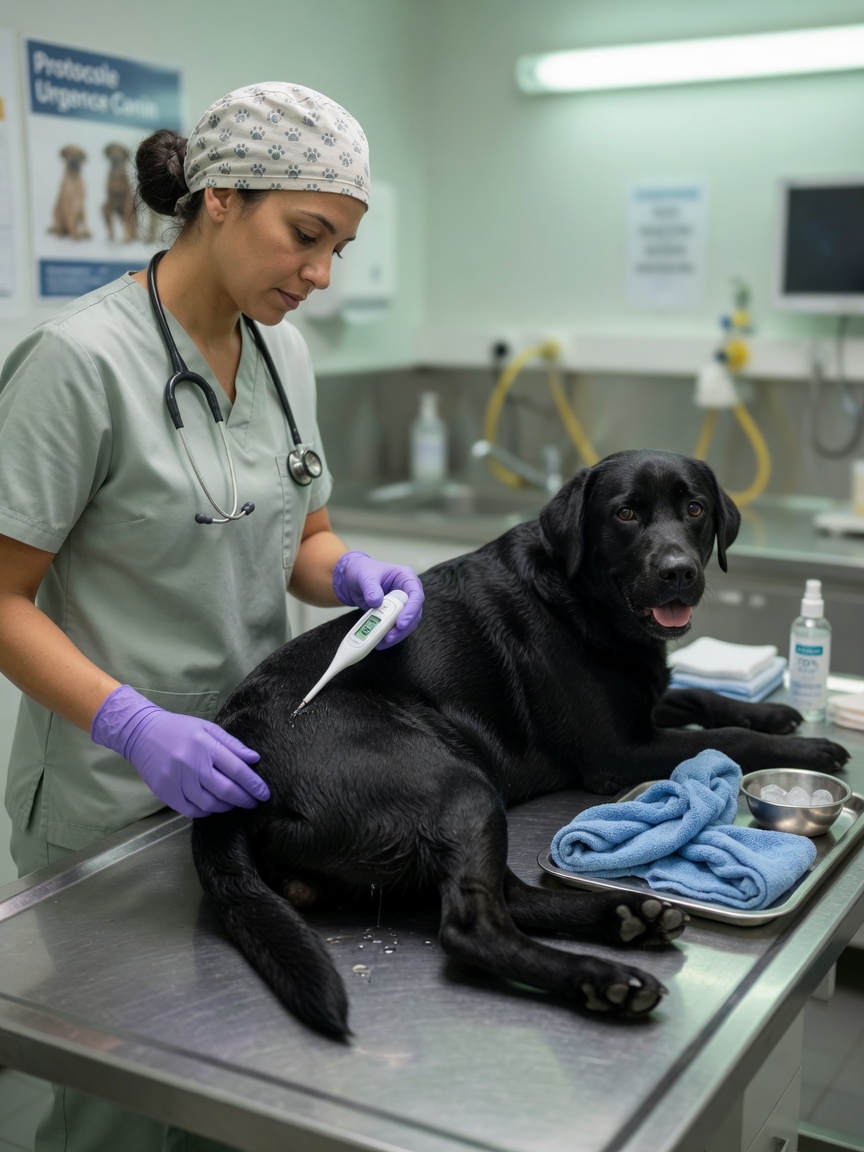
Step 2 — Take the Temperature If Possible
A rectal thermometer gives the most accurate reading. Use lubricant and insert gently. Normal canine temperature is 101–102.5°F (38.3–39.2°C). If you cannot take the temperature, begin cooling anyway based on clinical signs.
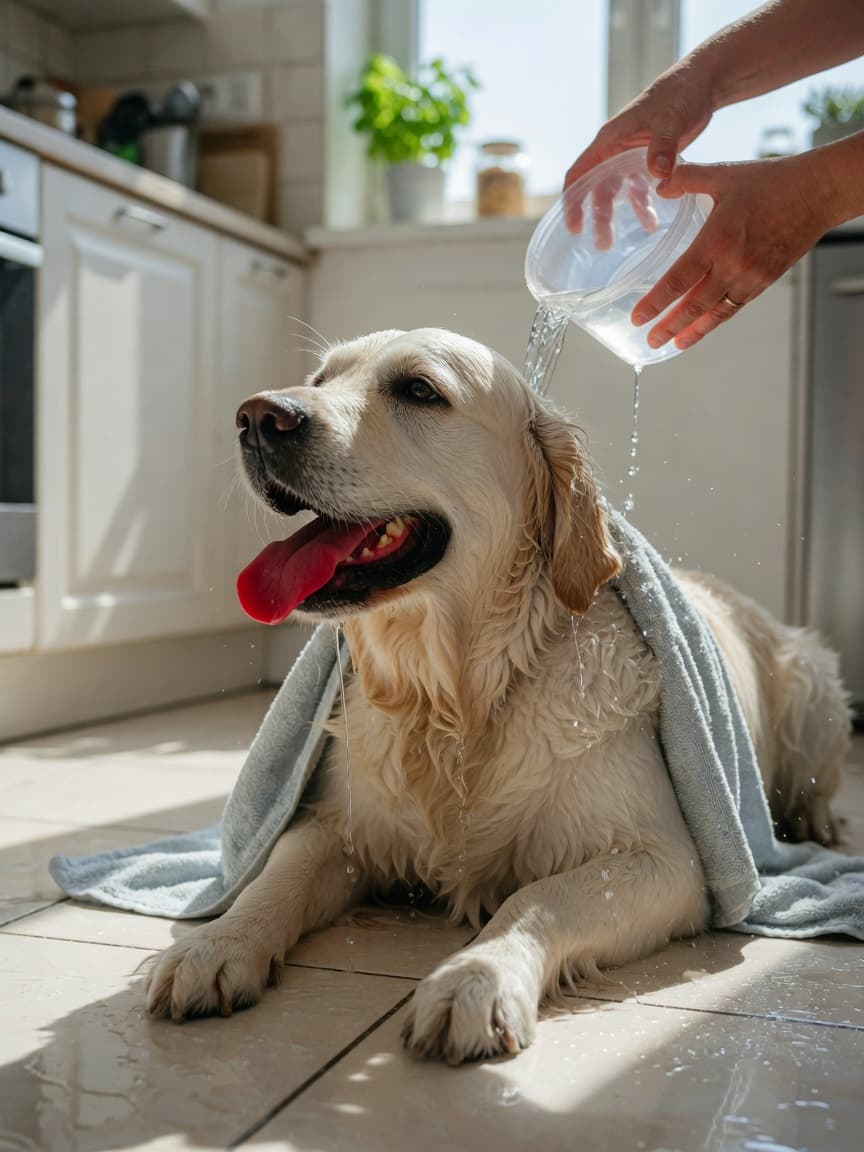
Step 3 — Begin Active Cooling With Cool (Not Cold) Water
This distinction is critical: ice-cold water causes peripheral blood vessels to constrict, trapping heat in the body core and worsening the situation. Use cool tap water (approximately 60–70°F / 15–21°C).
- Soak towels in cool water and drape over the neck, armpits, and groin (areas of major blood vessels).
- Pour cool water over the dog's body continuously — do not use ice packs or ice water.
- If available, place the dog in a shallow bath of cool water.
- Fan the wet dog to accelerate evaporative cooling.
Step 4 — Offer Small Sips of Water
If the dog is conscious and can swallow, allow it to drink small amounts of cool water. Do not force water into an unconscious or semi-conscious dog — aspiration risk is high.
Step 5 — Keep Monitoring Temperature
Stop active cooling once the temperature reaches 103°F (39.4°C). Continued aggressive cooling can cause hypothermia, which introduces a new set of life-threatening complications.
Step 6 — Transport to the Vet Immediately
Heatstroke triggers a cascade of organ damage — kidney failure, blood clotting disorders (DIC), brain swelling — that may not be apparent for 24–72 hours. Your dog requires IV fluids, monitoring, and possibly additional treatment even after external temperature has normalised. Do not skip the vet visit because the dog "seems better."
What NOT to Do
- Do not use ice or ice water — causes vasoconstriction and worsens core temperature.
- Do not cover the dog with wet towels and leave them in place — rewet and move them to maintain evaporation.
- Do not give aspirin or paracetamol (acetaminophen) — these are toxic to dogs and ineffective for heatstroke.
- Do not leave the dog unattended during cooling.
Dogs Left in Hot Cars: The Numbers Are Stark
On a 70°F (21°C) day, the interior of a parked car reaches 89°F (32°C) within 10 minutes and 104°F (40°C) within 30 minutes. Cracking windows provides negligible cooling. Never leave a dog in a parked car, even briefly, in warm weather.
A cooling mat or vest designed for dogs uses evaporative technology to keep body temperature regulated during walks and outdoor activities. Look for products with independent temperature-testing data and machine-washable covers.
Prevention: Keeping Your Dog Safe in the Heat
- Walk dogs in the early morning or after sunset when temperatures are lowest.
- Provide constant access to fresh, cool water.
- Never leave dogs outdoors in direct sun without shade and ventilation.
- Avoid exercise on days with high humidity — humidity reduces the efficiency of panting.
- Know your breed's risk level; brachycephalic dogs need extra caution even in mild heat.
- Clip thick double coats in summer (consult your vet — some coats actually insulate against heat).
- Heatstroke is fatal within minutes — begin cooling before driving to the vet.
- Use cool (not ice-cold) water on the neck, armpits, and groin.
- Stop cooling at 103°F to prevent hypothermia.
- Never use ice, ice packs, or ice water — vasoconstriction traps heat in the core.
- Always follow up with emergency vet care; organ damage can appear 24–72 hours later.
- Brachycephalic breeds, puppies, obese, and elderly dogs are highest risk.
- Bruchim Y, Loeb E, Saragusty J, Aroch I. Pathological findings in dogs with fatal heatstroke. J Comp Pathol. 2009;140(2-3):97-104. PMID: 19070860
- Drobatz KJ, Macintire DK. Heat-induced illness in dogs: 42 cases (1976-1993). J Am Vet Med Assoc. 1996;209(11):1894-1899. PMID: 8944789
- Hemmelgarn C, Gannon K. Heatstroke: clinical signs, diagnosis, treatment, and prognosis. Compend Contin Educ Vet. 2013;35(7):E4. PMID: 24009150